
To diversify content site revenue, test two things separately: whether a second earning mechanism contributes after its costs, and whether it depends on different demand. Adding display ads beside affiliate links can change who pays you while leaving both incomes exposed to the same search-traffic loss.
Start with a revenue map, then choose one small experiment. You need revenue statements, acquisition-channel records, operating costs, owner-work estimates and the permissions governing the proposed offer. Allow a focused planning session to prepare the test; its observation period must match the buying cycle rather than an arbitrary seven-day deadline.
This is an operating method, not a tested earnings case. The worked figures below are hypothetical.
1. Map revenue to the demand source it depends on
Use one row for each earning mechanism. Record the payer, customer action, acquisition source, asset you control and what would interrupt payment. Keep these fields separate even when the same dashboard reports them.
A fictional gardening publisher might record the following dependencies:
| Mechanism | Paid action | Demand source | Shared interruption |
|---|---|---|---|
| Affiliate commission | Eligible referred purchase | Search visitor reading a guide | Search arrivals decline |
| Display advertising | Monetizable ad exposure | The same guide visits | Search arrivals decline |
| Planning resource | Purchase of the publisher's product | The same guide visits | Search arrivals decline |
| Direct sponsorship | Agreed delivery to a defined audience | Publisher's permission-based readership | Audience engagement declines |
The first three rows have different payers or products, but one major common dependency. The sponsorship row is not automatically independent either: if the readership is replenished entirely by search, the relationship still has an upstream exposure.
Trace one step further than the revenue label. Ask how readers first arrived, why they return and whether you can reach them through a channel they have chosen. Do not treat an exported list as proof of usable marketing permission or continued engagement.
Verify the map against actual links, campaign tags and statements. If channel attribution is incomplete, mark the source uncertain rather than assigning every untagged purchase to your preferred channel. The useful output is an honest dependency map, including unknowns.
2. Compare mechanisms by the work they require
Choose a mechanism that serves a demonstrated reader need. Affiliate links help a reader choose another company's product. Ads sell access to attention. Sponsorship sells a specified commercial placement. An owned resource creates a direct delivery, support and refund obligation.
| Route | Main operating question | Evidence before expansion |
|---|---|---|
| Affiliate | Can the reader make a better purchase decision? | Relevant clicks and eligible attributed transactions |
| Ads | Does monetization preserve a usable page? | Net statement revenue and reader-experience checks |
| Sponsorship | Can you deliver what the advertiser bought? | Agreed audience definition, delivery and billing record |
| Own product | Can you deliver the promised outcome economically? | Accepted delivery, refunds, support and contribution |
Avoid comparing gross product receipts with net affiliate commission. A $20 resource purchase may carry more fulfilment work than a smaller commission. Conversely, a useful owned resource could improve control over the offer even before it diversifies acquisition.
If the site has not yet established its first useful reader-to-revenue loop, work through content-site first revenue before adding another mechanism. Otherwise the second experiment can obscure why the original one has not worked.
3. Check permissions and continuing costs
Read the actual programme and offer terms before changing placements or commercial behaviour. Amazon's Associates Operating Agreement incorporates programme policies and restricts assignment without prior written approval. That does not make another provider's rules identical or establish that every proposed placement is permitted.
For each mechanism, record the applicable account, agreement, qualifying event, exclusions, payout timing and ownership-change questions. Ask the provider about a specific uncertainty. A working link establishes that a page can open; it does not establish valid attribution, an eligible sale or a future payout.
For an owned resource, include payment charges, production, delivery, accessibility, support, updates and refund handling. For sponsorship, include sales conversations, reporting and any make-good obligations. Price owner work visibly even if it is unpaid.
Check that monetization does not weaken the article's main purpose. Google's people-first content guidance asks whether content provides useful, original value for its intended audience. It does not supply a safe ad density or a ranking guarantee. Inspect the actual page rather than using revenue per visit as the sole acceptance measure.
4. Define one bounded second-revenue experiment
Write a short test card before building anything. Specify the reader problem, offer, audience, acquisition source, maximum cash spend, maximum work and review date. Include a stopping condition that you would still respect after receiving encouraging early orders.
For example, the gardening publisher might offer one seasonal planning resource to readers of a relevant guide. The test asks whether people can buy, receive and use that resource with manageable support. It does not claim to test every gardening product or establish a new independent channel.
Keep the original article's useful answer intact. Place the offer where it follows naturally from the reader's task. Explain the deliverable accurately, make payment and refund information clear, and avoid taking money for a capability that does not exist.
Observe the complete transaction: an authorized purchase, payment confirmation, delivery, support and any refund. Use an appropriate safe test environment for workflow checks before real transactions. Never invent a completed customer test for a planning worksheet.
If the resource cannot be delivered reliably within the work budget, repair the delivery process or stop. Increasing traffic will magnify a broken obligation rather than validate it.
5. Calculate contribution and inspect audience effects
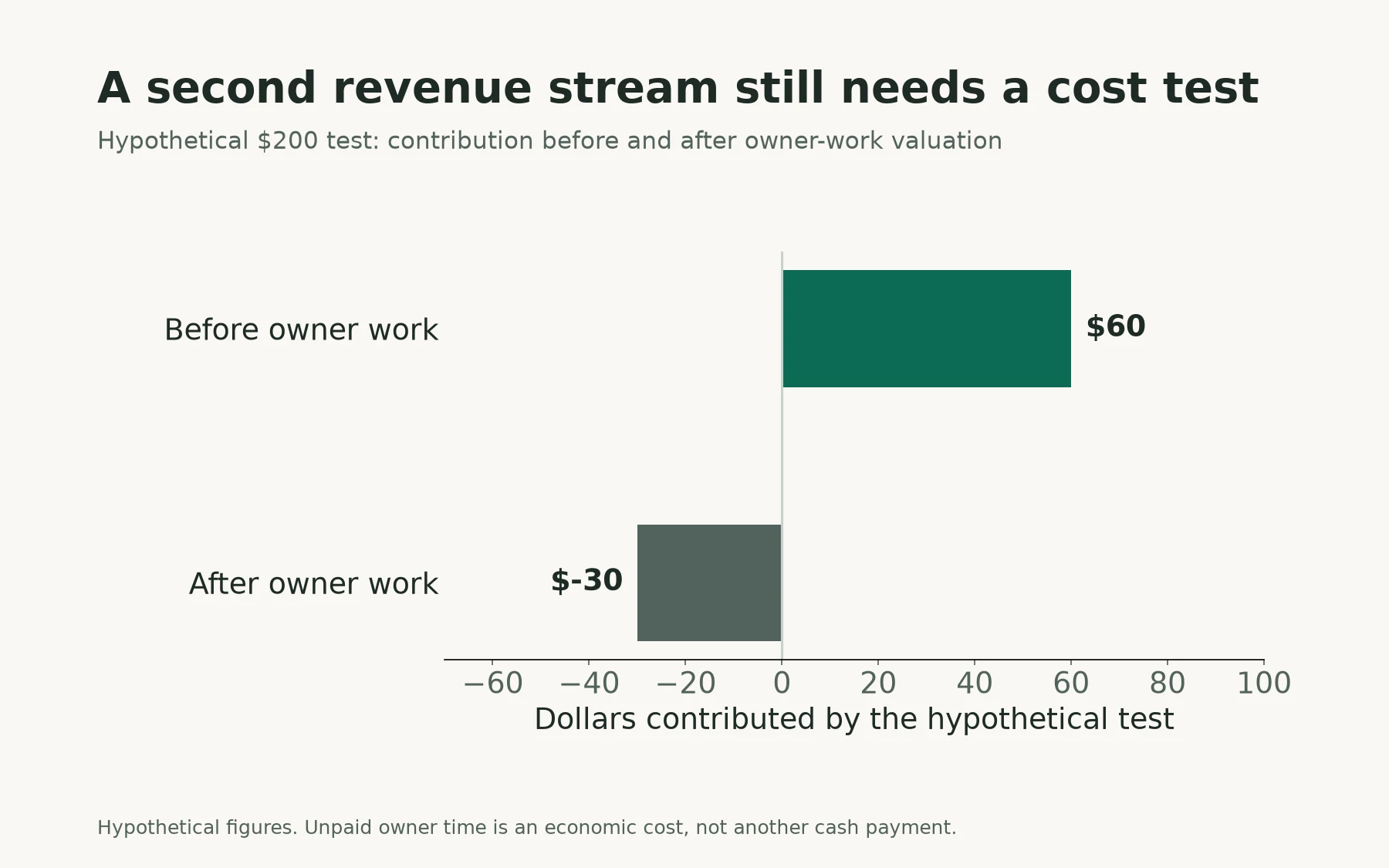
The fictional test collects $200. Delivery costs are $140, and the operator spends three hours valued at an assumed $30 per hour.
| Item | Hypothetical amount |
|---|---|
| Collected receipts | $200 |
| Delivery costs | −$140 |
| Owner-work valuation | −$90 |
| Contribution after owner work | −$30 |
The test generates $60 before valuing owner time and negative $30 after that valuation. If the $90 is imputed unpaid time, it is an economic cost rather than an additional cash payment. State whether the $140 was actually paid and keep outstanding obligations separate.
Do not call this profitable merely because the product has positive receipts. Inspect refunds, disputes, delivery failures and support backlog. If there is an unresolved refund request, record the obligation rather than reporting every receipt as safely retained.
Review the audience alongside the accounts. Did the added offer obstruct the original answer? Did readers complain about an unexpected promotion? Did affiliate clicks fall because the owned offer replaced a recommendation? Compare the whole page or audience relationship, not just the new revenue line.
A short before-and-after period cannot isolate causality when seasonality, traffic mix or other changes moved simultaneously. Record those changes and use the results to decide the next bounded test, not to advertise an established uplift.
6. Decide what actually diversified
End with two decisions. First, should you keep, change or stop the mechanism based on contribution and delivery? Second, did the demand dependency change?
If both affiliate commissions and resource sales still come from the same search visitors, report broader monetization with continued search concentration. That can be useful, but it does not justify removing the traffic-risk reserve.
If a permission-based readership begins returning directly, examine repeated behaviour and the effort needed to maintain it. A one-off campaign does not establish durable independent demand. Likewise, replacing one large sponsor with another has not necessarily improved payer concentration.
Keep a record of the test's dates, assumptions, costs, accepted deliveries and unresolved questions. That operating history becomes useful when you eventually prepare a website for sale, but a sale is optional. The immediate result should be a better-controlled business.
Common questions
Should I add ads or an owned product first?
Choose the route whose obligations you can support and whose reader need you can describe. Request a current ad-network offer if ads fit; scope one deliverable if a product fits. Compare net economics and reader effects rather than assuming direct sales are always superior.
Does a second affiliate programme remove concentration?
It may reduce dependence on one payer. It does not remove shared reliance on the same search rankings, buying intent or audience. Show both changes in the dependency map.
What should I do with a negative first test?
Identify whether delivery cost, price, support or demand caused the failure. Change one supported assumption and repeat within a new limit, or stop. Keeping the test small preserves the option to learn without committing the site to an uneconomic obligation.