
Customer data due diligence in a business sale should begin with a purpose map, not a full database export. A buyer may need evidence about customer economics without needing identifiable records at the first stage. Buying a business also does not automatically authorize every new marketing use.
Identify the information, parties, purposes and jurisdictions, then give qualified advisers a controlled disclosure plan. This guide teaches preparation and operating controls; it does not establish the legal basis for your transaction.
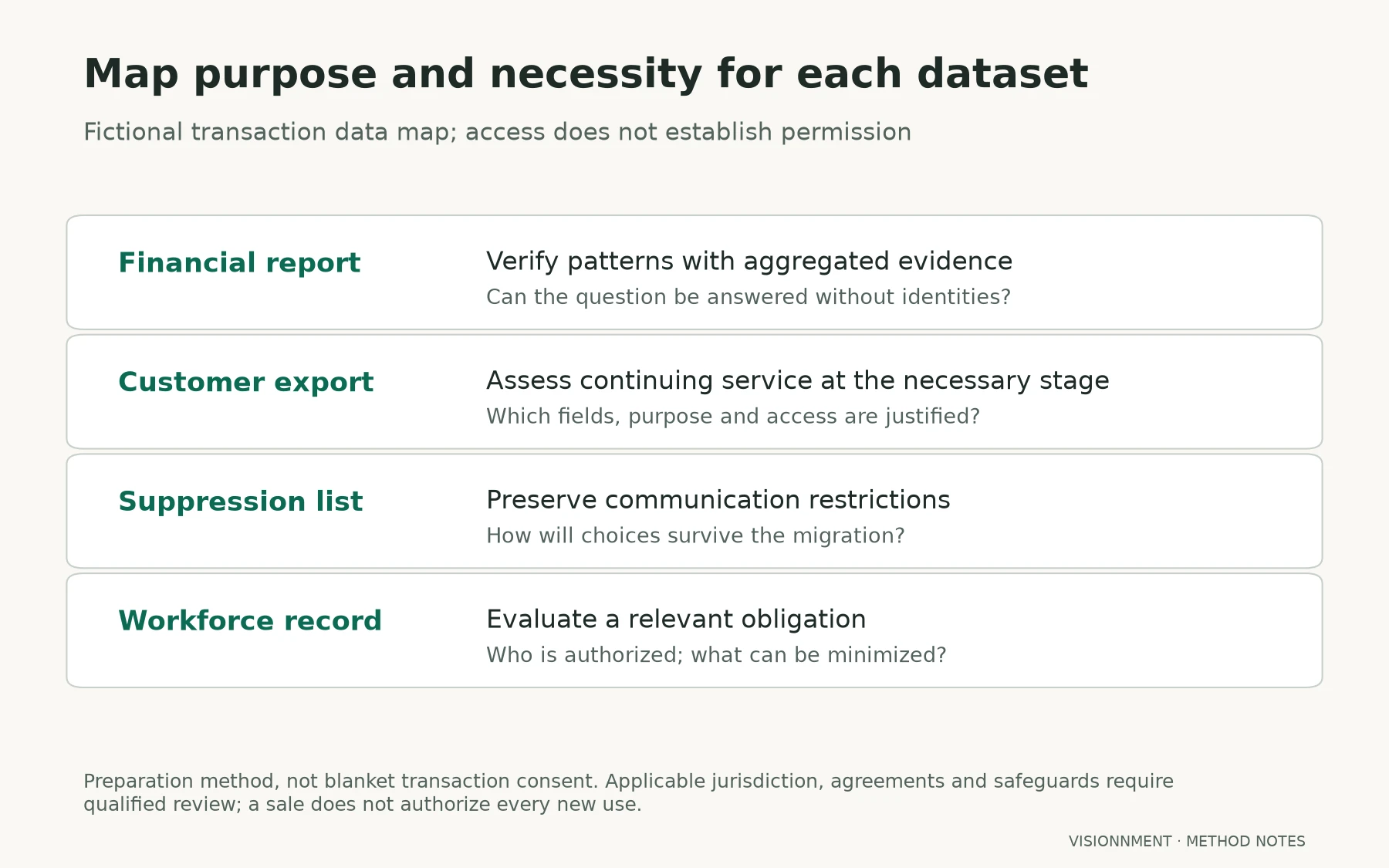
The four-record map below is hypothetical. No customer information was accessed, disclosed or transferred. You need current contracts and privacy notices, provider arrangements, data inventories, proposed transaction terms and authorized professional review.
1. Identify data, parties and jurisdictions
Inventory customer accounts, order records, support conversations, subscriptions, marketing preferences, suppression lists and workforce information. Include copies in analytics, billing, email, backups and personal working files where relevant.
Record the entity responsible for each dataset and the providers processing it. Identify who currently has access, where the information is held and the locations relevant to the owner, individuals and transaction. Do not assume server location alone settles applicable law.
Create an initial map:
| Hypothetical dataset | Intended diligence use | First question |
|---|---|---|
| Aggregated financial report | Verify revenue patterns | Can the question be answered without identities? |
| Customer export | Assess continuing service | Which fields and stage are necessary? |
| Marketing suppression list | Preserve communication choices | How will restrictions survive migration? |
| Workforce record | Evaluate a relevant obligation | Who is authorized and what can be minimized? |
Keep financial evidence and personal information distinct where possible. A summary can still require care if small groups or combined fields reveal individuals. Ask the reviewer about that risk rather than assuming aggregation always removes it.
BDC's business-acquisition overview provides broader transaction context. It does not supply permission to disclose the particular records in your map.
2. Limit pre-close access to the actual question
Write the diligence question before choosing the data. “Verify recurring revenue and refund rates” may first require a redacted ledger and reconciliation, rather than names, message histories and complete payment profiles.
Use staged access: summary, controlled sample and more detailed records only when the purpose and authorization justify them. Record who receives each set, what they may do with it and when access ends.
Separate viewing from exporting. A read-only account can still reveal sensitive information; a download can create copies outside the data room. Choose controls appropriate to the actual platform and review need.
Use least-privilege roles and avoid sharing a founder's master login. Do not provide raw card data, secrets or unrelated personal messages as evidence of a customer relationship.
If a buyer requests broader access, ask which unresolved question it answers. A reasonable diligence process can investigate legitimate needs while refusing unnecessary disclosure. Record the alternative evidence offered and any remaining limitation.
3. Use Canadian transaction provisions only at their proper scope
Canada's PIPEDA section 7.2 provides a conditional business-transaction example. For prospective transactions, it addresses necessity, transaction-related purposes, appropriate safeguards and return or destruction if the transaction does not proceed, within the specified agreement framework.
Its completed-transaction provisions include further conditions around permitted purposes, safeguards, withdrawal of consent, necessity and notification. Section 7.2(4) excludes transactions whose primary purpose or result is buying, selling, acquiring, disposing of or leasing personal information itself from the conditional transaction provisions in subsections (1) and (2). Those provisions do not authorize such a data transaction. Ask qualified counsel to determine applicability and the requirements of other relevant law.
These provisions are not a global rule, automatic marketing permission or clearance for every workforce record. Counsel must determine applicability and the actual conditions for the business, information and jurisdictions involved.
For the hypothetical customer export, ask which fields are necessary at the current stage and which agreement and safeguards support disclosure. For workforce records, ask separately; do not assume the customer analysis covers employment information.
Keep the adviser's answer attached to the actual fact pattern. If the deal changes from a continuing business acquisition to a database-only purchase, revisit the analysis rather than reusing the earlier conclusion.
4. Plan customer, subscriber and workforce handling separately
For customer service records, identify the obligations the buyer must continue and the minimum information needed to do so. Check contract scope, historical disputes, refunds and access needs. A right to service a customer is not necessarily permission for unrelated promotion.
For subscribers, preserve consent or other applicable permission evidence, acquisition source, preference state and suppression. A list size is not evidence that every address can be mailed under the buyer's intended programme.
Mailchimp's audience requirements and practices describe platform expectations. They are distinct from the legal requirements governing your relationship and from another email provider's terms.
For workforce information, restrict access to the appropriate diligence and professional roles. Identify necessity, retention and the actual contemplated transfer or engagement. Avoid spreading payroll or sensitive personnel records across a general buyer folder.
If a dataset combines these categories, separate the review views or fields where possible. Convenience in exporting is not a sufficient reason to disclose everything together.
5. Preserve suppression, security and retention controls
Treat “do not contact” and unsubscribe records as operating constraints to preserve, not inactive rows to discard for a cleaner list. Review how those choices are represented in the current and receiving systems.
Test mappings with synthetic records: a subscribed address, an unsubscribed address, a restricted-contact record and a deletion or retention exception where applicable. Confirm that the destination interprets them correctly before any authorized live migration.
Google's email-sender guidance addresses technical and sending practices. Passing authentication or delivery checks does not establish recipient permission. Keep technical acceptance and legal or platform permission as separate gates.
Document access logging, secure storage, permitted copying, incident escalation and retention. A confidentiality agreement alone does not configure these controls. Assign a person to verify they are actually in place.
For the newsletter migration workflow, preserve audience choices alongside content and delivery configuration. Do not start a campaign merely to see whether the transferred list works.
6. Define failure, withdrawal and completion procedures
Before disclosure, specify what happens if the transaction stops. Identify access revocation, return or destruction, permitted retained professional records and evidence of completion under the applicable requirements.
A buyer deleting a local folder does not necessarily remove copies in cloud storage, backups or advisers' systems. Ask the relevant people and providers about their actual capabilities and obligations. Do not promise deletion your process cannot verify.
If information was shared too broadly, use the appropriate incident and adviser process. Avoid silently deleting the audit trail or treating the event as routine cleanup. Preserve the facts needed to assess the issue.
At completion, confirm the authorized transaction perimeter, continuing purposes and required notifications or other actions. Reconcile customer access and support responsibilities so the transfer does not interrupt legitimate service.
If the buyer wants a new use, investigate that use separately. The fact that the transaction closed does not transform every historical record into an unrestricted marketing asset.
7. Build the controlled disclosure record
Keep a ledger of dataset, purpose, fields, recipient, access method, authorization, disclosure date, retention rule and final disposition. Use references to secure records rather than duplicating sensitive information in the ledger itself.
Walk one hypothetical row end to end. The aggregated financial report answers the initial question; a limited authorized customer sample resolves a later discrepancy; the full export remains held until its purpose and conditions are established. That is a controlled investigation, not incomplete diligence.
Ask advisers to resolve remaining jurisdictional or permission questions and record who owns each action. Leave unresolved items visible in the transaction schedule instead of marking all data transferable.
Use the sale data-room checklist to organize staged access, and the Empire Flippers seller guide only for the distinct platform route. Neither supplies blanket legal permission.
Common questions
Does an NDA permit the full customer export?
An NDA can be relevant but does not by itself answer necessity, applicable law, platform terms or every permitted use. Review the actual purpose and conditions.
Can the buyer market immediately to every customer?
Do not assume so. Continuing service, subscriber permission and a new marketing purpose need separate review.
What should the completed inventory show?
It should identify what information exists, why each disclosure is needed, who may receive it and what remains unresolved. Technical possession should never be mistaken for unrestricted authority.