
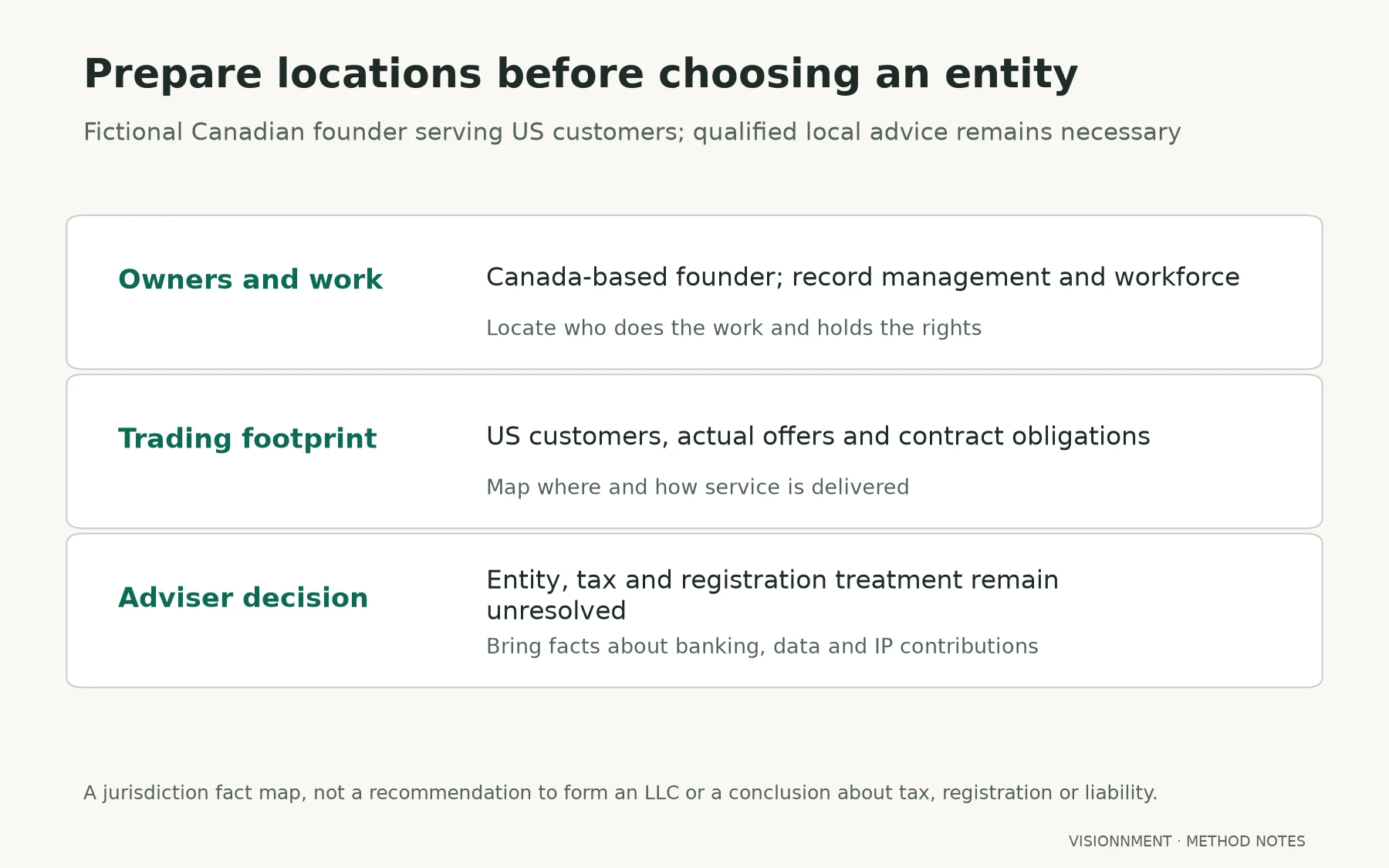
Digital-business legal setup questions begin with the owner's location, the actual operation and the people and assets involved. A US LLC is a legal-form label, not a universal tax answer for a Canadian founder serving US customers.
Prepare a fact packet before choosing an entity, opening accounts or relying on a future exit assumption. This guide explains the questions to organize; it does not select a legal structure, establish tax treatment or provide an opinion on your transaction.
The Canadian-founder example is hypothetical. The public Canadian and US sources were reviewed on November 16–17, 2026. A lawyer and tax adviser qualified for the relevant jurisdictions should evaluate the actual facts and current requirements.
1. Identify owner, customer and operating locations
Write where each founder lives and works, where management decisions occur, where any existing entity is registered and where the business actually operates. Distinguish citizenship, residence, entity location and customer geography; they are not interchangeable facts.
For the fictional founder, the facts might be: an individual living and working in Canada, selling a digital service to US and Canadian customers, using hosted infrastructure and considering a US payment or company arrangement. The customer list does not establish the founder's residence or determine the right structure.
Add workforce and contractor locations, data storage and the activities performed in each place. Record what is planned versus already happening. An adviser needs the real operation, not only the address you hope to put on a registration.
| Fact | Record to prepare | Why it matters to the discussion |
|---|---|---|
| Owners and management | Names, locations, ownership plan | Relevant personal and entity questions |
| Customers and offers | Countries, contract type, delivery | Trading and customer obligations |
| Workforce | Locations, tasks, proposed relationships | Local engagement and rights questions |
| Infrastructure and data | Providers, regions, access | Contracts and privacy questions |
If a location or relationship is uncertain, mark it. Do not choose an entity first and then edit the fact pattern to make it appear suitable.
2. Separate legal form, tax treatment and liability
Ask three separate questions: what form can be registered, how it will be treated for the relevant taxes, and which liabilities remain with whom. A familiar name does not settle all three.
The IRS LLC guidance explains that an LLC is allowed under state statute and that federal tax classification depends on circumstances such as the number of members and elections. It does not establish how Canada will treat a particular cross-border arrangement.
The Canadian government's incorporation guidance distinguishes federal and provincial or territorial incorporation questions. Its sole-proprietorship and partnership guidance describes another registration path. Use them to identify questions for the actual province and operation, not as equivalent alternatives with guaranteed outcomes.
For the fictional founder, ask the advisers to compare the relevant Canadian route and any proposed US arrangement together. Request an explanation of filings, administration, ownership, tax treatment and exit implications under the same facts.
Do not assume that incorporating removes every personal exposure or that a US entity produces tax savings. Contracts, guarantees, conduct and jurisdiction-specific rules require actual review.
3. Map registrations, records, banking and contracts
List the registrations and records the proposed operation may need, then identify which authority or adviser will confirm each. Keep company formation, business-name registration, tax accounts and sector-specific requirements distinct.
Map the customer contract, payment account, bank account, domain, hosting and key software subscriptions to the intended contracting party. A bank or payment provider can have its own identity and eligibility process; company registration alone does not establish account approval.
Prepare questions about who signs, who receives payments, how expenses are recorded and how founder contributions are documented. Keep business and personal records sufficiently clear for the adviser and bookkeeper to work from actual transactions.
The SBA business-planning resources provide US planning context. They are not a substitute for Canadian registration or tax advice, and US customers do not automatically make every US business guide applicable to the owner.
If the operating arrangement changes, update the packet. Adding a founder, hiring in another country or moving management can change the relevant questions. A memo based on a former plan should not be treated as perpetual clearance.
4. Compare the US and Canadian questions at their proper scope
Use a comparison request rather than a preferred answer. Ask each adviser to identify the applicable law, assumptions, required filings, administrative cost and unresolved issues. Where the analysis crosses jurisdictions, ask who coordinates it.
For a proposed US LLC, questions can include state formation and ongoing obligations, US federal classification, foreign-owner reporting and the interaction with the Canadian owner's position. Listing these questions does not assert that every obligation applies or specify its outcome.
For the Canadian route, ask about the relevant registration or incorporation choice, provincial or territorial operation, tax accounts and the treatment of owner remuneration and business income. The adviser should evaluate actual facts and current rules.
Compare total administration as well as formation cost. A cheap filing can produce continuing accounting, compliance and banking work. Obtain current professional quotes rather than treating an online registration price as the whole cost.
Keep unresolved answers visibly open. If one adviser covers only US matters, do not extend that opinion to Canada. Ask for the missing expertise before relying on the structure for a material contract or sale.
5. Document intellectual property and founder contributions
List the assets the business uses: code, designs, content, domain names, datasets, brand material and commissioned work. Record the creator, existing owner, applicable licence or assignment, payment evidence and any restrictions.
Payment for work does not by itself establish every right needed to operate or transfer it. Give counsel the actual contractor agreement and proposed use. Ask about background materials, third-party components and rights that may remain with a creator.
For multiple founders, record cash, existing assets, labour and promised future contributions separately. Ask how ownership, decision rights, departures, disputes and sale decisions should be documented. An informal percentage in a message is not a complete governance arrangement.
Check account identity and rights separately. The founder may control a domain login while a company owns the brand, or a contractor may host the repository under a personal account. Identify the inconsistency and obtain a supported correction.
If the asset uses customer or workforce information, describe the data, purposes, access and transfer plan for qualified privacy review. A technical export does not establish permission to reuse or disclose everything it contains.
6. Prepare an adviser packet that supports a decision
Send a concise summary with attachments organized by question. Include the current fact pattern, proposed routes, ownership diagram, customer and workforce geography, major contracts, asset-rights register, financial outline and expected operating or sale plans.
Mark decisions already taken and deadlines that create real commitments. Ask which steps should wait for advice and which information is missing. Do not manufacture urgency from a hoped-for launch date.
Request a written scope and answer where appropriate: jurisdictions covered, assumptions, recommended next actions, ongoing obligations and triggers for review. Preserve the adviser relationship and current documents securely.
For the fictional founder, the packet ends with entity and tax treatment still unresolved until the cross-border review is complete. That is the intended result of preparation: the decision is based on relevant facts rather than a generic instruction to form an LLC.
Connect the setup to building the digital asset, then maintain the rights and account records as the business operates. If a sale later becomes relevant, sale preparation can organize the evidence, but counsel must review the actual transaction and applicable law.
Keep a decision and change record
After receiving advice, record the chosen route, documents signed, relevant registrations and who must maintain each obligation. Keep the scope and assumptions attached to the advice. If the fictional founder later adds a US-based partner or a new data-intensive service, flag the changed facts for review instead of assuming the earlier analysis covers them. The record should help the adviser see the change quickly, while leaving the new legal and tax conclusions to the qualified professional.
Common questions
Do US customers mean I need a US LLC?
That fact alone does not answer the question. Provide the complete owner and operating circumstances to qualified advisers and compare the applicable routes.
Can an online checklist select my tax treatment?
No. It can help organize facts and questions. The actual classification, reporting and cross-border consequences require advice at the relevant scope.
What if I am too early to know the final business model?
Explain what is fixed and what remains hypothetical. Seek advice proportionate to the next real commitment, and identify which changes will require another review.