
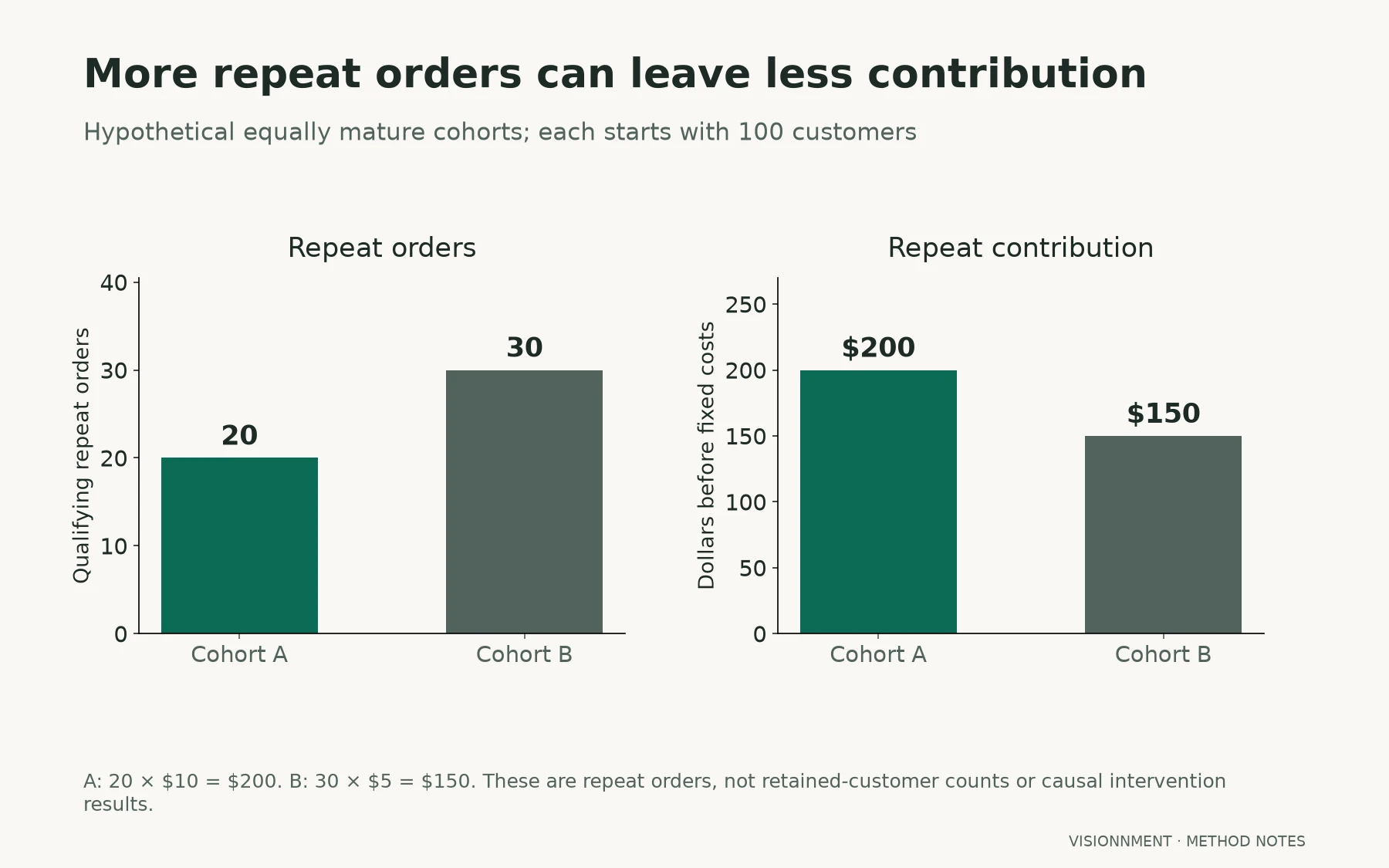
A DTC repeat-purchase retention audit should compare customers at the same stage and measure what their repeat orders contribute. More repeat orders can produce less contribution when discounts, fulfilment or support costs rise.
Start with the product's natural buying cycle. Then build equally mature cohorts, investigate the actual friction and test one change with margin and customer-experience limits. You need order-level records, customer identities handled appropriately, refunds, delivery exceptions, acquisition sources and direct costs.
The two 100-customer groups below are hypothetical. They illustrate arithmetic and diagnosis, not a performed experiment or a claim that one intervention caused a result.
1. Define the natural repeat-purchase interval
Write what repeat buying means for this product. A replenishable supply, a durable tool and a seasonal gift have different reasons to return. A customer who has no current need is not automatically dissatisfied.
Choose an observation window that gives the intended repeat action a reasonable opportunity. Record the start event, eligible products and what counts as a repeat. Decide whether exchanges, replacement shipments and cancelled orders belong outside the paid repeat-order count.
For a fictional replenishable product, the owner might examine paid second purchases within a defined period after first delivery. The specific duration should come from the product and observed customer use, not a borrowed universal benchmark.
Shopify's customer-attrition discussion can frame retention questions, but general examples do not set a valid repeat interval for your catalogue. Use your actual product promise and buying history.
If the business has only recently begun selling, mark the cohort immature. There is no analytical fix for time that has not elapsed. You can inspect delivery and interview customers while waiting for a comparable repeat opportunity.
2. Compare equally mature first-order cohorts
Group customers by a defined first-order event, such as first paid order month, and compare them after equal elapsed periods. Preserve the cohort sizes and exclusions. A January group observed for six months cannot fairly be compared with a June group observed for one month.
Record acquisition channel, first product, promotion and geography where relevant and permitted. Differences in those fields can explain differences in repeat buying without the retention intervention being the cause.
Use a cohort sheet like this:
| Field | Required definition |
|---|---|
| Starting cohort | Unique eligible first-time customers |
| Maturity | Same elapsed observation period |
| Repeat customer | Customer with a qualifying subsequent purchase |
| Repeat orders | Number of qualifying later orders |
| Repeat contribution | Defined net sales less matched direct costs |
Keep customers and orders separate. One customer placing three later orders should not be counted as three retained customers. Also distinguish the customer's order time from the later collection or refund date.
If using a web funnel, Google's funnel exploration guidance explains a tool for inspecting steps. An analytics funnel can help locate behaviour, but it does not replace the order ledger or prove why a customer did not return.
3. Locate product, delivery and payment friction
Inspect the path from the first promise through delivery and use. A customer can receive the product but fail to achieve the intended result; another can love it but be unable to complete a later checkout. Those require different repairs.
Join relevant evidence at a permitted scope: late or damaged delivery, returns, support categories, product complaints and checkout failures. Use a small authorized sample to understand the sequence, then quantify the issue with consistent definitions if the data supports it.
Separate one-off purchases from subscriptions. Shopify's subscription considerations identify additional continuing billing and service dependencies. An unpaid renewal is not the same as a customer declining a new optional purchase.
For the fictional replenishable product, repeated “too much left” feedback might suggest the assumed reorder interval is wrong. Repeated delivery failures suggest an operational problem. Do not respond to both by sending a larger discount.
If evidence is missing, state the competing explanations. Choose the next observation that can distinguish them instead of assigning a convenient cause to the whole cohort.
4. Ask bounded customer questions
Invite a small, appropriate set of customers to describe their actual experience. Avoid asking only enthusiastic repeat buyers or presenting the desired answer in the question. Use the contact permissions and privacy practices applicable to the relationship.
Ask what they bought for, when they first used it, what happened, whether the need remains and what prevented the next step. “Did you enjoy your order?” is less diagnostic than a description of what they tried to accomplish.
For someone who reordered, ask why that timing made sense. For someone who did not, allow “I do not need another” to be a complete answer. The goal is to distinguish product fit, timing, fulfilment and buying friction.
Record the small sample and its limitations. Five interviews can reveal a plausible obstacle; they do not establish how common it is in the full population. Avoid converting memorable quotes into invented percentages.
Translate the findings into a testable hypothesis. For example: customers who cannot understand the sizing instructions need clearer guidance. Keep that distinct from an unproven claim that guidance will increase repeat revenue.
5. Test one change with margin guardrails
Define the eligible audience, change, observation period, accepted outcome and stopping conditions before launch. A clearer instruction insert, a corrected checkout step or an appropriately timed reminder addresses a specific obstacle. Testing all three together makes diagnosis harder.
Record contribution components: net sales after relevant refunds or discounts, product cost, fulfilment, shipping subsidy, payment charges and incremental support. Keep acquisition spending and fixed overhead in separate stated views rather than silently ignoring them.
A promotion should have an explicit cost limit and truthful terms. Do not make cancellation, refunds or customer support harder to improve a retention metric. A retained order with an unresolved customer obligation is not an unqualified success.
If feasible, use a suitable comparison group and consistent assignment. With small samples or uncontrolled rollout, describe the result as observed alongside the change rather than caused by it. Note concurrent changes in price, product, delivery and acquisition mix.
The acceptance decision should include both the intended customer outcome and the contribution guardrail. If support demand overwhelms the operation, stop or repair even if repeat counts rise.
6. Work the repeat-contribution comparison
Suppose two fictional, equally mature cohorts each begin with 100 customers. Cohort A produces 20 qualifying repeat orders at $10 contribution each. Cohort B produces 30 at $5 each.
| Hypothetical cohort | Repeat orders | Contribution per order | Repeat contribution |
|---|---|---|---|
| A | 20 | $10 | $200 |
| B | 30 | $5 | $150 |
B has more repeat orders but $50 less contribution under the stated definition, before fixed costs. That calculation does not explain why. The difference could involve discounts, order mix, costs or other factors that require inspection.
Check refund timing and exceptional support costs before accepting either result. A window that ends before returns are processed can make a promotion look better than it is. Retain a review for later adjustments.
Keep the acquisition context visible too. Higher repeat contribution does not automatically make a cohort profitable if acquiring its first orders was much more expensive. The repeat analysis is one part of the operating economics.
7. Decide and preserve the evidence
Choose keep, revise or stop based on the stated customer outcome and contribution. Explain remaining uncertainty and the next review. If the groups are not comparable, repair the analysis rather than selecting the more attractive chart.
Retain cohort definitions, cost rules, exclusions, intervention dates and exception records. Those make the result repeatable by another operator and useful during website sale preparation. They do not establish a guaranteed valuation uplift.
For a broader ecommerce decision, connect the result to the build-or-buy preflight and operating cash requirements. A growing repeat-order line cannot compensate for stock or support obligations the business cannot fund.
Common questions
Is repeat-purchase rate enough?
It helps describe behaviour under a definition. It does not show contribution, customer outcomes or causation. Pair it with the cost and exception record.
What if customers buy only occasionally?
Use an observation period that reflects their need, and examine whether the first job was completed well. Do not manufacture a subscription problem where the product serves an occasional task.
What is the next useful action with little data?
Reconcile a small cohort, inspect delivery and ask focused questions. Keep the claims narrow while you collect enough elapsed history for a fair comparison.