
Flippa auctions, bids and offers use different sale formats and commitment points. A low displayed bid does not mean a high proxy maximum is harmless, and a classified offer can become a commitment when accepted. Complete the evidence and funding screen before using those controls.
Identify the format, calculate a funded maximum and record the terms governing acceptance, disputes and payment. You need the exact listing, current provider terms, authorized evidence access, a total capital ceiling and an operating reserve.
Affiliate disclosure: Visionnment may earn a commission from qualifying Flippa referrals, including eligible buying or selling activity under its programme terms. The relationship does not determine our analysis. Eligibility and payment depend on current qualifying-user, listing and fee-event conditions.
The $10,000 capital example is hypothetical. No bid, offer, private access or purchase was performed. This method does not appraise a listing or establish that a commitment can be cancelled safely.
1. Identify the actual sale format
Record whether the listing is an auction, classified negotiation, a Buy It Now opportunity or a post-auction negotiation. Inspect the actual control and current terms rather than assuming every price on the page is an accepted sale value.
Flippa's bids-and-offers guidance distinguishes auction bidding from private classified offers. It also describes an unsuccessful auction moving into post-auction negotiation with an indicative price. That price is a negotiation starting point, not an independently established value.
For a Buy It Now control, read the applicable instructions before acting. Do not assume it is a request for information or that a later inspection makes all earlier commitments optional.
Capture the listing version, asset perimeter, currency, seller statements and format at the time of review. A later change can matter, but it does not erase the record of what you agreed to investigate.
If the format or control is unclear, ask the platform before clicking. Clarifying a workflow is cheaper than trying to unwind an unintended commitment.
2. Complete pre-commitment evidence checks
Verify what is sold: an operating business, starter capability, domain, software or another category. Separate revenue, profit, traffic and user claims from the actual records available to inspect.
Flippa's verification-assessment guidance describes a provider process. A verification label does not establish every expense, right, dependency or future outcome the buyer needs to assess.
Request appropriate source evidence and independent review for material financial, legal and technical risks. Do not bid first with the plan to discover whether you can operate the asset afterward.
For a starter project, Flippa's starter-site advice provides model context. A functioning site without earnings still needs demand, distribution and operating work; it is not a cheap version of a proven cash-flow business.
List unresolved dependencies and their decision impact. A missing minor receipt and a critical account without a supported transfer route are not equivalent. If essential evidence is unavailable, wait or decline rather than assuming the auction clock creates permission to skip it.
3. Calculate a funded maximum
Start with total capital you can commit, then reserve for review, closing, operation and downside. Include stock, migration, replacement work and applicable payment costs where relevant. Avoid allocating the same reserve to several needs.
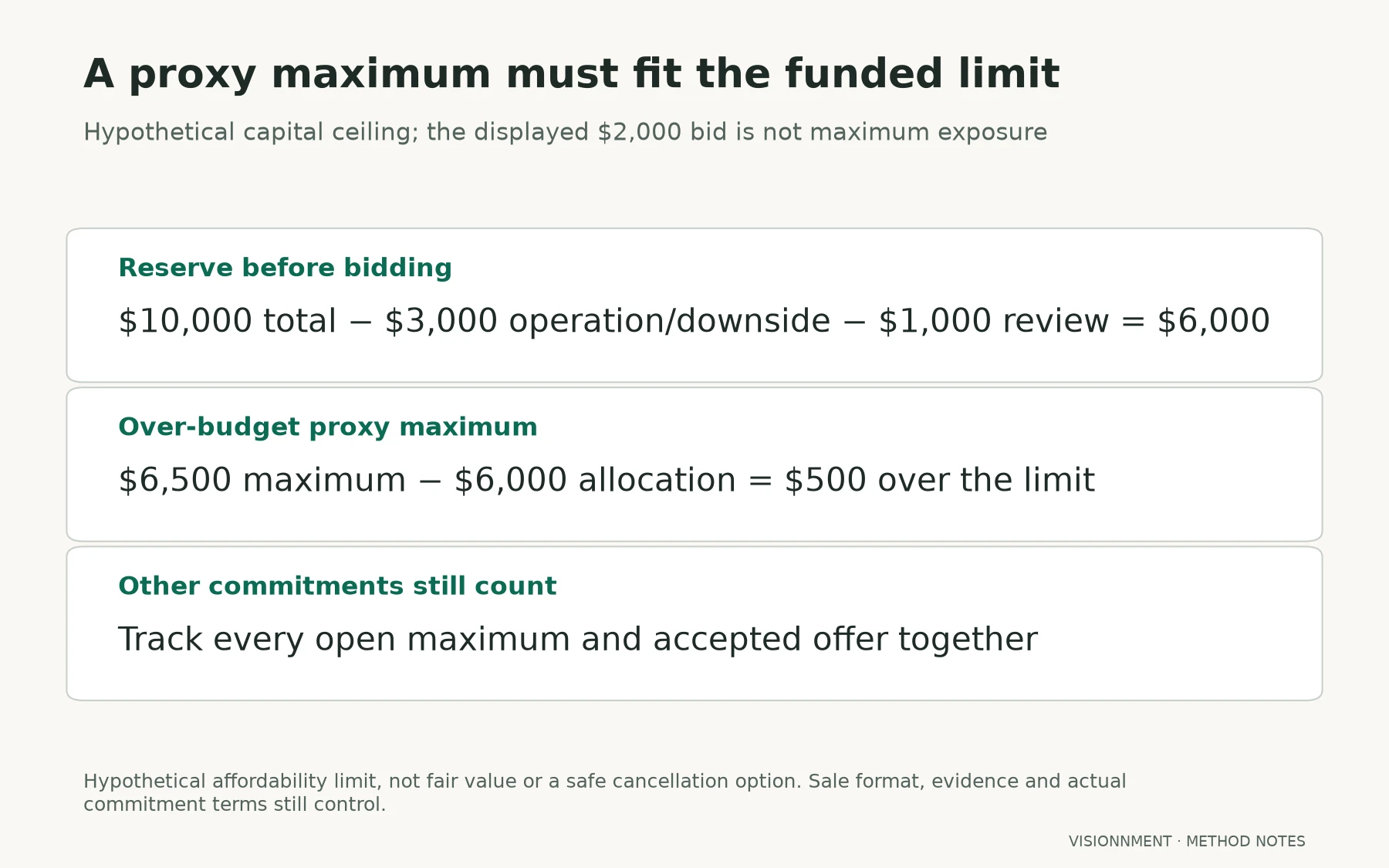
The hypothetical buyer has a $10,000 total ceiling, reserves $3,000 for operation and downside, and $1,000 for diligence and closing. At most $6,000 remains for purchase under those assumptions.
| Hypothetical capital allocation | Amount |
|---|---|
| Total ceiling | $10,000 |
| Operating and downside reserve | −$3,000 |
| Review and closing reserve | −$1,000 |
| Maximum remaining purchase allocation | $6,000 |
A $6,500 proxy maximum exceeds the allocation even if the public current bid is $2,000. The system can move toward the maximum under its rules. The maximum represents potential commitment, not an informal expression of interest.
This $6,000 is an affordability limit, not fair value. The evidence may justify less or no purchase. Unknown material costs can reduce the allocation further; they do not belong at zero merely because a bid field needs a number.
4. Understand proxy bidding and reserve outcomes
The auction guidance describes automatic bidding up to the buyer's maximum and a seller bidder-approval step. It distinguishes approving a bidder from accepting an individual bid; removing future bidding permission does not erase bids already made.
Record the reserve treatment and the conditions for a successful outcome. An auction ending below reserve and moving to negotiation is different from winning under the sale rules. Do not call the highest displayed unsuccessful bid a completed comparable sale.
Set the maximum from the completed screen before competitive pressure rises. Reassess only if new evidence changes value, cost or capital; another bidder's enthusiasm is not evidence of your operating fit.
If several listings are active, consider aggregate commitments. Two maxima that each fit the budget separately can exceed it together. Keep open bids and accepted offers in one commitment ledger.
Do not rely on imagined cancellation flexibility. Use the actual terms and obtain advice where legal consequences are unclear.
5. Record accepted-offer and winning-bid responsibilities
For a classified offer, identify amount, assets, currency, expiry or response rules and conditions. The bids-and-offers guidance, reviewed November 17, 2026, says a classified offer that is neither accepted nor rejected is automatically rejected after 72 hours. Record that platform response window separately from any signed agreement, financing or inspection deadline. The same guidance says an accepted offer obligates the parties to proceed. Treat the control as part of a transaction process, not a consequence-free negotiation game.
Read the terms of service and the relevant Site Rules at their proper scope. The buyer-seller agreement, platform obligations and payment instructions are related documents, not interchangeable ones.
Record the next steps for verification, funding, documents, transfer and inspection. Identify who can sign and who can authorize payment. A person with browsing access may not have authority to commit company funds.
If you need a financing or evidence condition, obtain an appropriate reviewed arrangement before accepting a commitment. Do not assume a private note added after clicking overrides the governing terms.
Use the Flippa buying guide for the broader acquisition sequence and retain independent diligence. An accepted price does not complete the actual operating handover.
6. Handle changed facts through the actual process
If material new information appears, preserve it with the listing and agreement version. Identify the affected claim and communicate through the authorized route promptly. Do not disappear or assume silence cancels the transaction.
Flippa's buyer-backout guidance describes scenarios and a dispute process, including consequences for repeated cancellations. It is not a blanket legal assurance of penalty-free withdrawal.
If assets have moved, return and condition questions can arise before a refund. Follow the governing process with the provider and qualified advisers. Do not delete the asset or release funds simply to make a difficult situation end.
Distinguish a legitimate new finding from buyer remorse or an unfunded maximum. The pre-commitment budget and evidence work exist to prevent those avoidable problems.
7. Choose bid, negotiate, wait or decline
Finish the screen with format, supported claims, missing evidence, full capital exposure, operating fit and the exact next action. If the evidence and capacity fit, set a maximum within the funded allocation. If terms need work, negotiate through the supported route.
If a critical gap remains, wait or decline. A missed auction does not prove a missed good investment. No return, quick resale or successful handover is promised by the format.
For a fitting route, explore Flippa and confirm the current sale format and terms. Public Flippa referral terms require a listing price of at least $5,000 and other eligibility and actual fee-event conditions; a bid or signup alone is not a paid referral result.
Before using a control, have the authorized decision-maker check the commitment ledger and remaining capital again. An earlier accepted offer may have consumed part of the reserve since the initial screen. If that makes the new maximum unaffordable, reduce or avoid the new commitment through the supported process rather than hoping only one transaction completes.
Common questions
Is the current bid my maximum exposure?
Not if you have entered a larger valid proxy maximum or have other commitments. Track the amount you can become obligated to pay.
Is a verification badge enough to bid?
No. Match the evidence to the asset, your operating plan and the rights and costs that matter.
Can I cancel if I later change my mind?
Do not assume a safe cancellation option. Review the actual terms and provider process before committing, and obtain advice on a real dispute.