
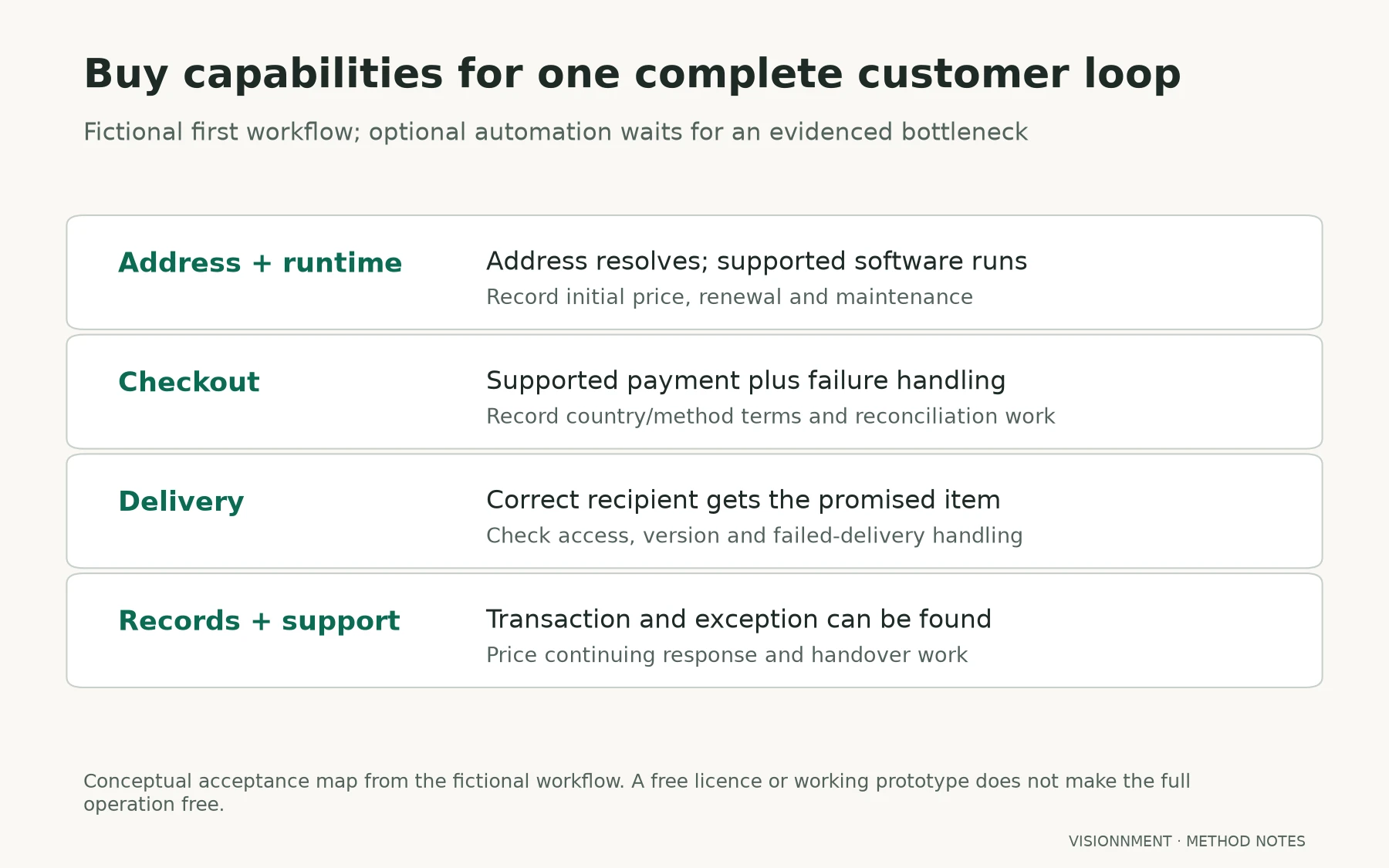
A minimum viable digital business tech stack is the smallest set of capabilities that can complete your first useful customer workflow safely and reliably. It is not the fewest subscriptions or a universal bundle that costs under $100.
Define the workflow, choose the required capabilities, price the continuing operation and verify one whole value loop. You need a customer promise, delivery method, payment and recordkeeping plan, current quotes and an estimate of owner work.
The worked resource-selling business below is hypothetical. No vendor quote, account setup, purchase or customer result was performed. Blank cost fields are questions to resolve, not zero-dollar assumptions.
1. Define the first useful workflow before tools
Write the sequence from discovery to accepted delivery. For the fictional business, a customer finds a useful resource, understands the paid offer, purchases through a supported checkout, receives the promised file and can obtain help or a refund under the actual terms.
That sequence requires more than a landing page. It also needs an accurate offer, authorized payment collection, delivery, records and support. It may not need a complex automation platform on day one.
State the accepted outcome. A payment success screen is insufficient if the customer cannot access the file. A delivered file is insufficient if it differs materially from the description. Use the promise to determine the capabilities.
The SBA planning resources frame market research, planning and startup-cost questions. Use that planning discipline to keep software purchases tied to a real operating job rather than an imagined future company.
If you cannot describe the first useful result, work through building a digital asset from scratch first. Buying tools will not supply the missing customer problem.
2. Separate essential infrastructure from convenience
Create a capability map without naming vendors initially. For the resource business, the map might contain an address readers can find, supported page hosting, secure checkout, delivery, records, support contact and an appropriate backup or recovery route.
| Capability | Required for the first loop? | Acceptance evidence |
|---|---|---|
| Domain and public address | Depends on the chosen route | Intended destination resolves correctly |
| Supported hosting or runtime | Yes for a self-hosted route | Required software runs and can be maintained |
| Checkout | Yes if charging | Supported payment and failure handling |
| Delivery | Yes | Correct recipient receives the promised item |
| Recordkeeping and support | Yes | Transaction and exception can be found |
| Advanced automation | Only for an evidenced need | Removes a measured bottleneck safely |
Some hosted services combine several capabilities. Some self-hosted routes split them across tools. Count the functions and responsibilities rather than assuming one subscription is always simpler than three.
WordPress publishes runtime requirements. A free software licence does not provide hosting, compatible services, maintenance or support. Check the current requirements for the actual version and route you intend to operate.
Mark optional convenience explicitly. A sophisticated attribution dashboard may be useful later, but the first customer still needs correct delivery and a usable support route.
3. Compare free, hosted and commissioned routes fairly
Compare the same accepted workflow. A free page builder without payment and delivery is not equivalent to a hosted selling service that supplies both. A commissioned build must specify who maintains it and what documentation and rights are included.
For each route, list capabilities included, limitations, account ownership, export or migration options and work retained by the operator. Ask whether integrations are supported or rely on a fragile manual step.
Evaluate the cost of a realistic failure. If a hosted service becomes unavailable, can you find transaction records and communicate with affected customers? If a self-hosted update breaks delivery, who can restore it? Keep recovery proportional to the promise and risk.
Obtain quotes for the exact plan, usage and term. Introductory pricing is not the renewal price. Free tiers can have limits that matter to your workflow, and a paid upgrade may be needed before the first intended transaction.
If a commissioned route lacks acceptance criteria, write them before accepting the price. “Build a website” is too vague to compare with a working checkout, delivery and recordkeeping loop.
4. Record renewals, usage, labour and exit costs
Build a cost register with one row per component. Include current price, currency, billing interval, renewal terms, usage assumptions, tax treatment questions, cancellation and ownership-transfer or migration costs.
For the hypothetical stack, leave actual quote fields blank until inspected:
| Component | Quote needed | Continuing work to price |
|---|---|---|
| Domain | Initial and renewal term | Renewal and ownership records |
| Hosting/runtime | Supported plan and usage | Updates, backup and recovery |
| Payment | Applicable country and method | Reconciliation, disputes and refunds |
| Delivery | Storage, access and usage | Failed delivery and version updates |
| Records/support | Actual plan or manual capacity | Response, retention and handover |
Stripe's pricing depends on the applicable offer and transaction details. Use the actual country, payment method and account terms rather than a single remembered fee. Separate reserves or delayed settlement from ordinary expenses where appropriate.
Shopify's app-billing guidance illustrates another cost boundary: recurring, usage and external charges can coexist. Removing a tool from an interface does not prove every obligation has ended.
Price owner work visibly. Imputed unpaid time is an economic cost, not cash spent. Show both the cash budget and the contribution after owner work so a buyer or collaborator can understand the operating burden.
5. Test a whole value loop
Use an appropriate supported test environment and synthetic information to inspect discovery, checkout, payment failure, delivery, support and refund handling. Keep a written sequence of expected results and the evidence that confirms each.
For the resource business, verify that the correct version reaches the intended test recipient and that the operator can locate the related transaction. Check mobile presentation and the path available when a message does not arrive.
Inspect failure behaviour. A rejected payment should not be recorded as collected revenue. A duplicated event should not create misleading duplicate sales. A delivery outage needs a clear recovery action rather than a silent failure.
Do not test with live customer charges or data merely because setup seems straightforward. Use the provider's supported mechanisms and permissions. A safe synthetic test also does not establish real customer demand.
After authorized real operation begins, reconcile actual transactions and support effort against the forecast. The first useful loop includes the customer's accepted result, not only a technically successful button press.
If one step fails, repair that capability and repeat the representative task. Adding unrelated automation will not resolve missing delivery or an unclear offer.
6. Add tools only for a verified gap
Define the gap in operating terms: a manual reconciliation takes too long, delivery errors recur or an essential permission cannot be managed safely. Then compare repairing the existing route, changing the process and adding a tool.
Estimate implementation, migration, recurring fees, training and exception handling. A tool that saves one task but creates another may not reduce overall work. State the assumed workload and check it after rollout.
Set an acceptance condition and a review date. For example, the new delivery tool must preserve transaction records and reduce a documented failure without making support inaccessible. If it does not pass, use the planned fallback.
Avoid buying capacity for a hoped-for audience that has not appeared. Keep a watch point for the actual limit and enough lead time to act. The minimum viable stack can grow when the evidence supports it.
Keep ownership and continuity visible
Record who owns each account, who can administer it, how access is recovered and which obligations survive cancellation or sale. Use supported roles rather than sharing a founder's personal master login.
Save current quotes, architecture notes, renewal dates and the whole-loop acceptance record. These help a successor operate the business and later prepare the website for sale. They do not make the asset profitable or transferable by themselves.
The finished stack decision should explain what each component does, what it costs to keep, who maintains it and how you know the first promise can be delivered. If a component cannot be connected to that explanation, investigate before adding it.
Common questions
Can I start for free?
Some capabilities may have a free route. The complete operation still has usage, work, renewal and support questions. Obtain actual terms before calling the whole workflow free.
Should I automate immediately?
Automate a known process and a measured bottleneck. A manual early loop can expose the missing steps that automation would otherwise repeat faster.
When should I replace a working tool?
When an evidenced capability, cost or continuity problem justifies the full change. Verify the replacement workflow and actual cancellation of the old obligations separately.