
Payment processing after a business sale needs a provider-supported transition for the actual merchant entity. Administrator access, a changed payout bank and a transferred storefront answer different questions. None alone establishes that the buyer may continue charging customers under the seller’s arrangement.
Build a transition register before choosing the cutover. Collect the merchant country, contracting entity, provider products, recurring subscriptions, pending payouts, refunds and disputes. Include the purchase structure and any cross-border change. The output is a set of confirmed routes and unresolved conditions, with separate acceptance for billing, customer service and settlement.
Separate administration from merchant identity and legal ownership
Write four identities in the register: account administrator, contractual merchant, payout recipient and legal business owner. They may coincide before the transaction and diverge during it. A buyer who can edit settings might still lack approval for the entity that will actually serve customers.
Describe whether the deal purchases assets, shares or another ownership interest. Ask advisers which rights and obligations move under the transaction documents. Ask each payment provider what its own agreement permits. The purchase contract and provider approval should be reconciled without treating one as a substitute for the other.
List the payment-related products separately. Checkout, recurring billing, fraud services and platform-connected payment accounts may have different requirements. A support answer for one product should not be silently applied to every service carrying the same brand.
Keep sensitive verification information in the provider’s secure process. A transition spreadsheet needs status, responsibility and evidence references; it does not need full bank details, identification documents or customer card information. Restrict access to people who need it for the approved work.
Check the actual country, entity and product route
Stripe’s business-sale guidance directs the existing owner to contact support first to confirm required information updates. For acquisition by an entity in another country, its separate cross-country instructions, reviewed November 17, 2026, specify three steps: transfer ownership to the new owner; the new owner creates a new Stripe account in the new business country; then the new owner asks Stripe Support to transfer data from the old account. An existing Stripe account’s registered country cannot be changed. This supported sequence does not guarantee every datum, subscription or customer mandate can move.
The PayPal United States user agreement restricts transfer or assignment of rights and obligations without prior written consent. Keep that statement within its U.S. account scope. A buyer using another country’s service must consult the governing local agreement and obtain the relevant provider response.
Shopify’s ownership documentation distinguishes an existing-user owner change from transferring a store outside the store or organization. For the outside transfer, it requires Shopify Payments to be deactivated beforehand; if payment-business information must change, contact Shopify Support. An existing-user change does not have that same deactivation requirement. Confirm the actual branch and connected-service conditions before scheduling the change.
Create one route row for each provider and product. Record who requested confirmation, the account country, transaction structure, support reference, required actions and open questions. If a provider answer is conditional, preserve the condition in the closing plan.
Obtain provider confirmation before changing payment details
Send a concise description through the supported channel: current entity, intended buyer entity, countries, transaction type, affected products and proposed date. Ask what must be approved, which information can be updated securely, what history remains accessible and whether recurring billing needs a separate migration.
For Stripe, its published instructions specifically warn against emailing the new owner’s personal details; support enables the relevant secure editing route. Use that distinction when coordinating the buyer and seller. A request for confirmation is not an invitation to circulate sensitive documents among every adviser.
Keep requests and approvals distinct. “Support ticket opened,” “documents submitted” and “entity accepted” are separate states. Preserve a written response or secure reference for the material approval rather than relying on one party’s recollection of a telephone conversation.
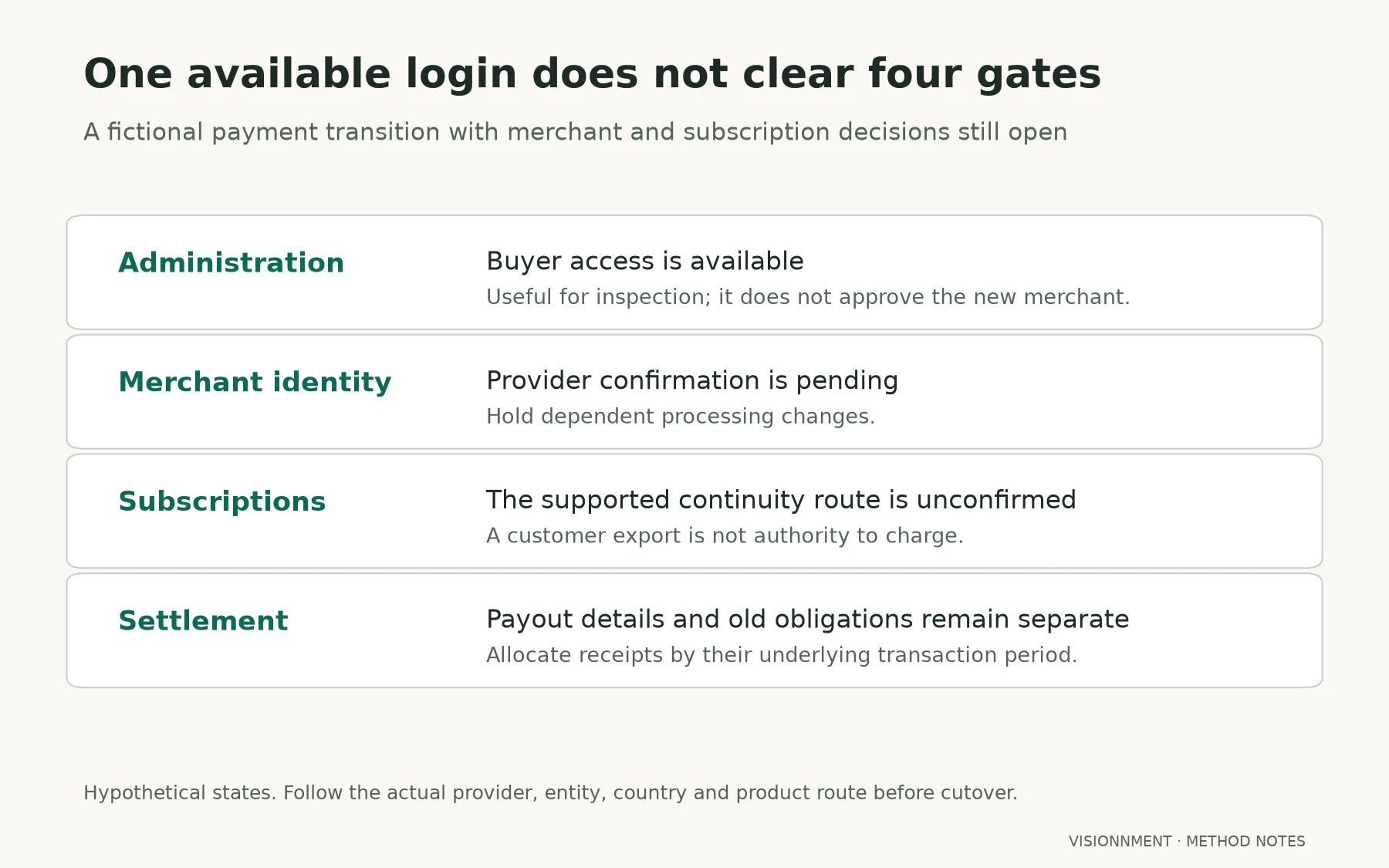
A hypothetical transition might show this position:
| Gate | Hypothetical status | Owner | Decision effect |
|---|---|---|---|
| Buyer administrative access | Available | Buyer account lead | Settings can be inspected |
| Merchant entity change | Pending provider confirmation | Seller and provider | Processing continuity unresolved |
| Recurring billing | Route unconfirmed | Billing specialist | Subscription cutover held |
| Bank settlement | Not yet changed | Approved finance owner | Existing payouts require allocation |
That account is not ready merely because the first row is complete. Changing the bank to make the handover look finished could create a second problem while leaving merchant approval unresolved. Hold the dependent action until the supported sequence is established.
Map subscriptions, refunds, disputes and pending payouts
Inventory each recurring arrangement by billing platform, customer commitment, payment method, renewal timing and entitlement system. Identify which provider holds the payment credentials and what supported migration or continuity route applies. Do not assume an exportable customer list includes transferable authority to charge.
Shopify’s subscription considerations, reviewed November 17, 2026, list Shopify Payments, PayPal Express, Authorize.net, Adyen and Stripe for third-party subscription apps, with Stripe limited to select merchants. Region, gateway terms and supported recurring payment methods still restrict availability; not every method offered by an otherwise supported gateway works for subscriptions. Check the actual app, merchant and method combination. Listing a supported gateway does not authorize transfer of existing customer mandates or settle continuity after an entity change.
Separate new charges from old obligations. List refunds requested before closing, disputes still open, payouts not yet settled and retained balances. Record the party responsible for customer communication, provider action and financial cost. These responsibilities can differ, so avoid using one broad owner column.
Build a cutoff table using transaction, earning or service period, settlement date and bank recipient. A payout received by the buyer after closing may relate to seller-period transactions. Reconcile its allocation under the agreement instead of counting it automatically as new buyer revenue.
Include exceptional payment cases, such as a renewal that fails during the transition or an old order needing a refund after the seller loses access. Determine the supported operator and escalation route in advance. A new provider account may not provide authority over the old provider’s transaction history.
Rehearse an authorized transition and customer-exception route
Create a non-destructive rehearsal plan with the provider and technical operator. Define the expected checkout, billing record, entitlement, notification and reporting result. Use synthetic records or supported test environments where appropriate. This article does not claim any account migration or charge was performed.
Test the dependencies as a chain. A payment confirmation without the promised service is an incomplete result. A service entitlement without a reconciled payment record also needs explanation. Verify the intended merchant descriptor and receipt identity through supported checks rather than assuming a logo establishes the customer’s contractual counterparty.
Write the failure route for an existing subscriber. Identify who handles a failed renewal, how the customer securely updates information if required, and how access is preserved or changed under the actual terms. Do not request card data by email or manually repeat a charge outside the permitted workflow.
Set cutover ownership and a stop condition. The change lead needs authority to pause the transition if entity approval, subscription continuity or reconciliation fails. Preserve a supported fallback and a communication plan. Rolling back an application setting does not undo a completed charge or restore an expired mandate.
Include privacy and customer communication review where the legal entity or service arrangement changes. Qualified advisers should assess applicable notices and consent requirements. Do not declare that a generic sale notice resolves every jurisdiction’s obligations or every customer contract.
In the hypothetical register, administrative access remains useful for preparation while the merchant and recurring-billing gates stay on hold. The correct next action is provider confirmation and a supported sequence, not another attempt to change settings. That preserves an honest distinction between ready work and unresolved permission.
Accept receipts, billing and settlement independently
Create separate acceptance evidence for three outputs. Billing acceptance covers the authorized charge and correct recurring arrangement. Service acceptance covers the promised entitlement or order. Settlement acceptance covers the correct payout recipient, amounts and accessible records. One successful step does not prove the rest.
Compare the first supported operating cycle with the expected register. Match transaction identifiers, refunds, fees and payouts. Investigate missing or duplicated records before describing the transition as complete. Keep any seller-period obligations visible until their required actions and financial allocation are resolved.
Retain lawful historical access only for the period and purpose required. Remove unnecessary identities through the supported process once open obligations permit it. Preserve accounting evidence without giving the seller continuing visibility into unrelated buyer activity.
The website handover checklist coordinates this payment gate with domains, infrastructure and other services. The Empire Flippers buying-process guide explains one optional assisted transaction route. Neither changes the governing provider agreement or grants merchant approval.
The final record should state what is approved, what was actually verified, which obligations remain and when they will be reviewed. Provider-supported control improves the quality of the transition evidence. It does not guarantee uninterrupted billing, customer retention or the future commercial result of the business.