
To reduce founder personal brand dependence, identify the moments where customers rely on the individual and test whether another authorized person can deliver the promised result. Changing the logo or removing a byline does not transfer expertise, reputation or future revenue.
Start with a relationship map, select one representative delivery cycle and record the founder's remaining interventions. You need customer promises, role and permission records, delivery instructions, work estimates and an appropriately authorized replacement.
The small client-group test below is hypothetical. No client was contacted, replacement introduced or transfer performed. A successful limited test would establish only the capability actually observed.
1. Map where the founder personally creates trust
Trace the customer journey: discovery, evaluation, purchase, onboarding, delivery, support and renewal. At each step, ask whether the customer needs the founder's identity, expertise, relationship, approval or access.
A founder's name on an article may be honest attribution rather than an operating bottleneck. A private relationship that wins every renewal can be a substantial dependency even when the public brand looks corporate.
Use a map like this:
| Trust moment | Founder contribution | Possible substitute | Evidence needed |
|---|---|---|---|
| Sales explanation | Specialist judgement | Trained lead with defined limits | Accurate representative discussion |
| Delivery approval | Technical expertise | Authorized reviewer | Accepted work at the required quality |
| Customer support | Personal reassurance | Named service owner | Resolved issue without hidden intervention |
| Renewal | Relationship and results | Shared account ownership | Customer's actual response over time |
Record the frequency, time and consequence of each dependency. Prioritize high-impact repeated work rather than cosmetic founder mentions. Do not assume that an infrequent but critical expert decision is easy to replace.
BDC's business-purchase overview frames the importance of understanding the business being acquired. Your map turns that general diligence task into concrete operating questions.
2. Separate identity, expertise and permissions
For each dependency, identify its cause. The founder may be the only person with expertise, the only authorized signatory, the holder of a personal account or simply the familiar face customers expect. Each requires a different response.
Training can address some expertise gaps. Supported account roles can address some access gaps. A legal authority or contract assignment may require a separate approval. A customer relationship needs honest continuity work and cannot be created by giving someone credentials.
List rights in the name, image, content and other personal-brand assets if a transaction is contemplated. Obtain qualified advice on the actual permitted use. Do not imply the founder endorses future work indefinitely unless the agreed rights and communications support that claim.
Inspect service promises. If customers purchased the founder's personal involvement, substituting another person can be a material change requiring review and communication. Rebranding the invoice does not resolve it.
Where the dependency cannot be removed, record it accurately. A sale can include defined continuing support or retain some founder involvement if the parties agree. Full independence is not the only honest operating model.
3. Define an authorized replacement role
Choose a role with explicit tasks, competence, access and escalation limits. Do not ask a general assistant to replace specialist judgement without the needed training or qualifications.
Prepare a representative task and acceptance condition. For a fictional service business, the replacement might coordinate one agreed delivery cycle, prepare the output and resolve routine questions within a stated scope. The founder retains only the defined exceptional decisions.
Use existing customer-safe examples or synthetic data during training. Limit production access to what is authorized. Payment authority, contract signatures and public publishing require their own permissions rather than arriving automatically with the role title.
Price the role, supervision and training. If the replacement needs ten hours of founder review, report those hours. Otherwise the apparent reduction in founder dependence merely moves the founder's work behind the scenes.
FE International's sell-side diligence checklist provides a professional preparation perspective. It does not prove that the new role can perform or that all relationship risks have been resolved.
4. Test shared delivery with a selected client group
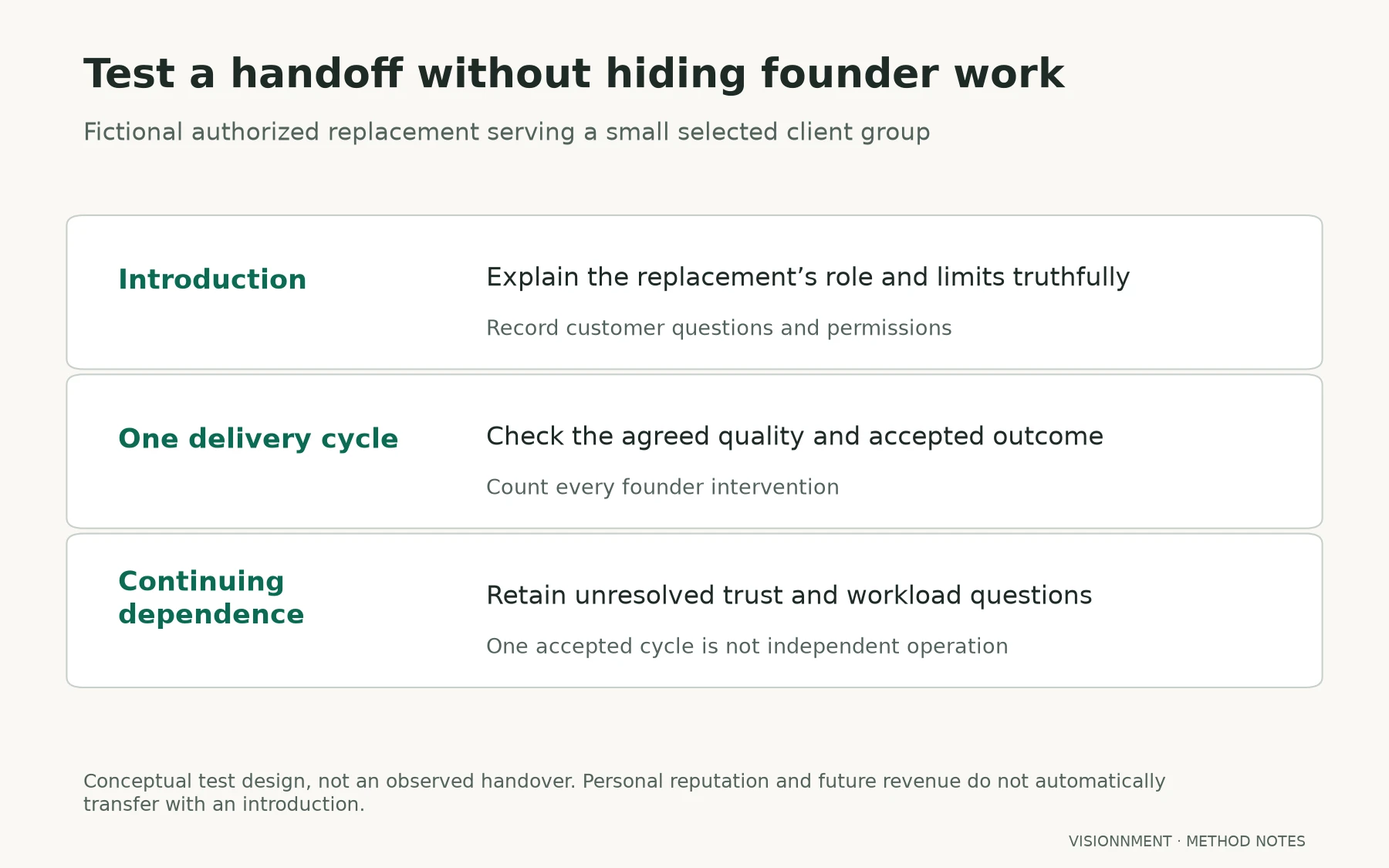
Choose a small appropriate group and a task that represents ordinary work. Obtain any necessary customer and internal authorization before introducing the replacement. Explain the change truthfully, including the founder's actual role during the test.
The fictional founder introduces the replacement for one agreed delivery cycle. The test records customer questions, delivered work, acceptance, founder interventions and support exceptions. It does not predict a future renewal rate.
Start with a clear handoff: named contact, responsibilities, escalation route and expected delivery. Avoid saying the founder is absent if they still review every important decision. Customers should understand who is accountable.
Observe the work without silently rescuing every issue. Intervene where needed to protect the customer, but record the trigger, time and missing capability. The intervention is useful evidence of what the system still requires.
If the cycle fails, diagnose whether the cause is instructions, competence, permissions, capacity or relationship expectations. Repair that specific gap or narrow the role, then repeat a bounded task. Do not scale an unresolved failure to the entire client base.
5. Preserve honest authorship and continuity messaging
Keep historical bylines and attribution accurate. A replacement taking responsibility for future operations does not become the author of earlier expert work. Likewise, the founder's past authorship does not imply review of every later update.
Write communications around the actual service benefit and responsibilities. Explain who will handle future work, how quality is maintained and how the customer can raise a concern. Avoid manufacturing founder endorsements or claiming an acquired reputation as a guaranteed asset.
Update public and private contact points consistently. A site can promise a team while support still forwards everything to the founder's personal mailbox. Verify the real routing and access before presenting the change as complete.
Keep sensitive relationship information within authorized access. Introductions and contact records are not a blanket right to reuse customer information for unrelated marketing.
For supplier-led trust, use the separate supplier-contract continuity guide. A friendly relationship and a contractual supply entitlement are different dependencies.
6. Measure work, customer outcomes and exceptions
Record the number of agreed tasks, tasks accepted, issues raised, founder hours, replacement hours and unresolved promises. Use the same definitions across cycles. A busy replacement is not necessarily reducing founder work.
Separate immediate task acceptance from retention. A customer can accept one delivery and still decline renewal later. One successful introduction establishes neither the transfer of personal reputation nor future revenue.
Inspect economics. Replacement wages or contractor fees are paid costs when incurred; unpaid founder supervision can be valued as imputed work. Keep those concepts separate in the cash and contribution views.
Ask whether quality depends on an undocumented founder judgement. Add a decision rule or an escalation where possible, and preserve the cases requiring actual expertise. Instructions should not pretend to automate judgement they cannot support.
If the replacement workload exceeds capacity, adjust the scope or staffing before another rollout. Founder independence that overloads one new person is fragile rather than transferable.
7. State what can transfer and what remains dependent
Build a limited conclusion from the observed evidence. The fictional test might support: “The replacement completed the specified delivery cycle with two recorded founder interventions.” It does not support “The business runs without the founder.”
Identify the remaining relationship, authority and expertise dependencies and the next review. If a sale is planned, disclose the actual support required and document any agreed ongoing founder role with qualified advisers.
Quiet Light's diligence discussion provides context for investigating operating relationships. Use your own evidence to show what happens in this business, rather than borrowing a generic claim of easy transfer.
Keep the map, training record, customer-safe test evidence and economics with sale preparation. The custom-stack guide addresses a related technical dependency, and the Empire Flippers selling guide covers a distinct provider route.
Common questions
Must I remove my name to make the business saleable?
Not automatically. Identify the actual rights and operating dependency. Honest attribution can remain while future delivery becomes less dependent on one person.
Does a successful introduction prove customer retention?
No. Observe accepted delivery and later decisions over the appropriate period. Keep each claim tied to its evidence.
What if customers insist on the founder?
Record the scope of that dependence and compare a defined continuing role, a changed offer or another transaction plan. Do not hide the condition in a claim of independence.