
Before you reinvest online business exit proceeds, separate money collected from headline consideration and reserve for obligations that remain. An earnout you might receive later cannot fund today's purchase, and a successful sale does not establish capacity to operate another asset.
Build a cash-and-obligation bridge, review the previous operating thesis and compare build, buy, hold and no-reinvestment options. This is a capital-readiness method, not a personal investment recommendation or tax calculation.
The $100,000 example is hypothetical. No sale, reserve, investment or return was observed. You need the final closing statement, actual receipts, contingent-payment schedule, professional tax advice, retained obligations and your current work and cash constraints.
1. Separate collected cash from headline consideration
Reconcile the signed consideration with actual receipts. Identify closing cash, financed amounts, holdbacks, earnouts, price adjustments and separately priced assets. Record which amounts are collected, due, disputed or conditional.
Use bank and settlement records rather than a congratulatory sale email. A payment initiated by a provider can still differ from unrestricted funds available in the intended account. Resolve material timing and currency differences.
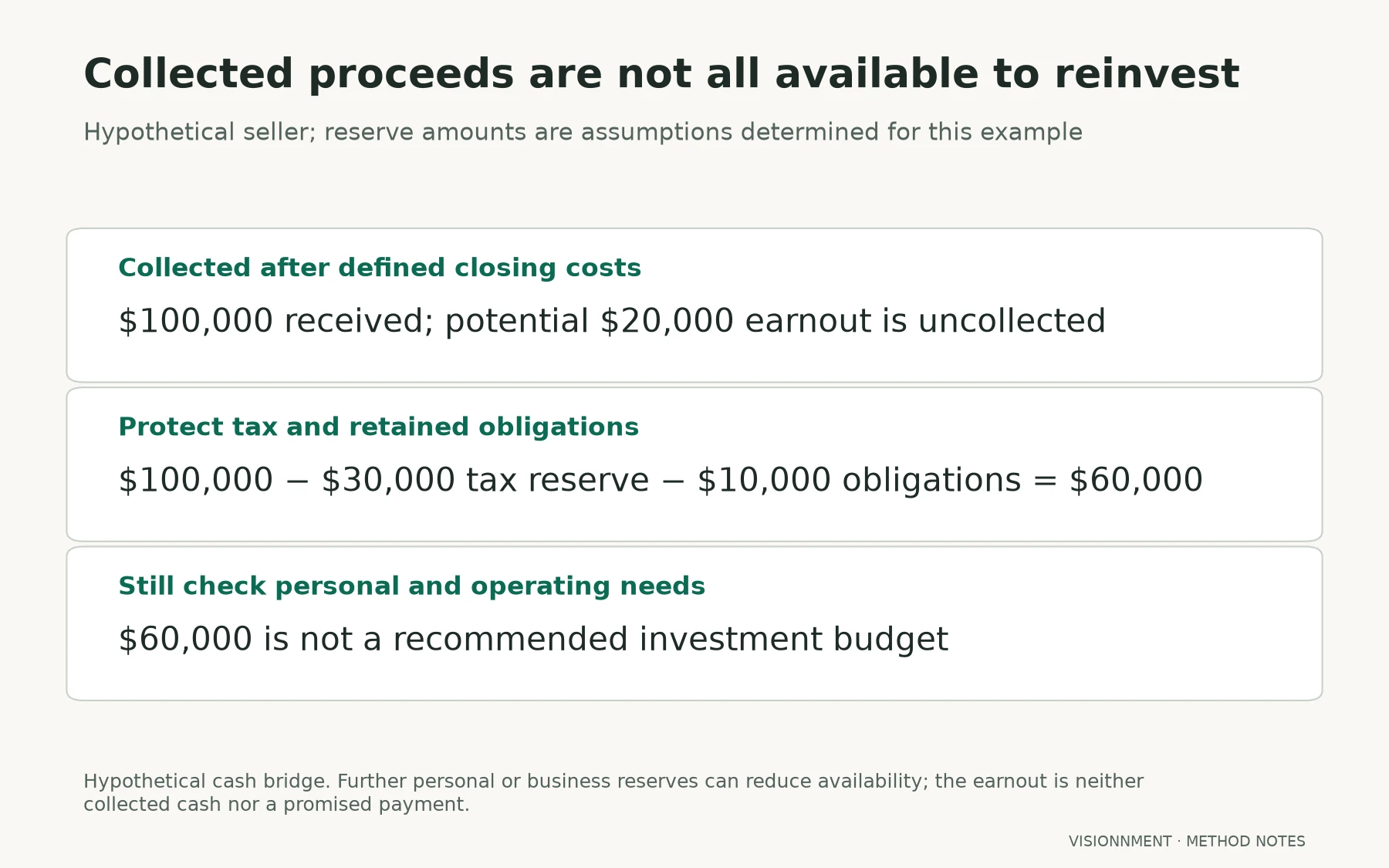
In the fictional case, $100,000 has been collected after defined closing costs. Another potential $20,000 is an uncollected earnout. The latter is not added to current available capital.
Empire Flippers' selling guide describes transaction and migration stages, but it does not establish that your proceeds are received or unrestricted. Use the actual deal and payment evidence.
Keep the historic sale price for reference. The capital decision begins with what you can lawfully and practically commit now, not the largest number the transaction ever contained.
2. Reserve for tax and retained obligations
Obtain qualified advice about tax, filing and payment timing under the actual owner, jurisdiction and transaction. Do not replace that review with a universal percentage of the sale price.
The hypothetical owner has a $30,000 adviser-determined tax reserve and $10,000 of retained obligations. Under those stated assumptions:
| Hypothetical bridge | Amount |
|---|---|
| Collected after defined closing costs | $100,000 |
| Adviser-determined tax reserve | −$30,000 |
| Retained-obligation reserve | −$10,000 |
| Unrestricted under these assumptions | $60,000 |
| Potential uncollected earnout | Excluded from available cash |
The $60,000 is not a recommended investment budget. The owner may need further personal or business reserves, and the inputs may change. Do not spend the tax or obligation reserve simply because its payment date is later.
The CRA's business-sale guidance illustrates why ownership, assets and administrative obligations matter in Canada. It does not set this example's $30,000 reserve or apply automatically to another jurisdiction.
List support, refunds, debt, legal costs, account closure and other surviving commitments with dates and responsible parties. If an item is unresolved, retain a specific reserve question rather than treating it as zero.
3. Review the previous operating thesis
Write why the sold business worked, what depended on the owner and why the owner exited. Distinguish repeatable skill from a favourable period, concentrated relationship or one-time market circumstance.
Review actual workload and stress points. If the sale was intended to reduce support demands, buying another support-heavy asset may contradict the purpose even if the headline multiple looks appealing.
Record what evidence changed during ownership: acquisition quality, contribution, recurring costs, customer concentration and transfer difficulties. Avoid rewriting the history as effortless because the exit ultimately completed.
For the fictional seller, the next question might be whether the same acquisition source and weekly workload remain acceptable. No extra money in the account creates more hours or technical competence.
Keep this review factual and useful. It is not a score of personal success; it is an operating input for choosing the next commitment.
4. Compare build, buy, hold and no reinvestment
Define the desired outcome and the evidence each route would need. A build requires demand validation and delivery capability. A purchase requires verified economics, transferable rights and an operating plan. Holding or making no new business commitment preserves optionality while other questions are resolved.
| Route | Immediate commitment | Evidence before expanding |
|---|---|---|
| Build | Bounded experiment and owner work | Real demand and accepted delivery |
| Buy | Purchase, review and operating capital | Verifiable earnings, rights and capacity |
| Hold | Agreed handling of uncommitted funds | Appropriate advice and review trigger |
| No reinvestment | Focus on other priorities | Clear reason and future decision point |
This table does not recommend a financial product or expected return. Ask qualified professionals about where money should be held and any personal financial questions outside the operating decision.
Compare equivalent objectives. A small prototype and a mature income-producing business are not interchangeable investments. Include the work and time needed to reach the intended evidence state.
If financing is involved, separate your equity cash, borrowing, interest, repayment and guarantees. BDC's acquisition-financing overview describes possible structures, not approval or terms for your situation.
5. Stress the next commitment and concentration
Model what happens if the first result disappoints. For a build, cap learning spend and owner hours. For a purchase, include review, transition, continuing obligations, replacement work and downside cash needs before setting the maximum price.
Ask whether the new asset shares the old dependencies. Two businesses can rely on the same search channel, payment provider, large customer or specialist operator. More asset names do not automatically diversify risk.
Do not assume an earnout arrives in time to rescue a shortfall. Keep the new plan workable on currently available capital or explicitly obtain an appropriate funded arrangement. A promised future receipt remains conditional.
Inspect capacity after closing obligations. The seller may still owe transition support while starting the next project. Include overlapping tasks rather than scheduling the same hours twice.
If the downside would require breaking a reserve or neglecting an existing promise, reduce the commitment, wait or decline. The objective is to preserve choice, not deploy every available dollar quickly.
6. Use a bounded decision record
Write the route, objective, current capital ceiling, protected reserves, maximum work, evidence gate, review date and stop condition. Identify what would justify a larger commitment later.
For the fictional owner, the record might state that only a limited portion of the $60,000 is available for a first evidence-building test after additional needs are checked. The example does not choose that portion or promise an outcome.
Before a purchase, distinguish an exploratory conversation from an offer or bid that can create commitments. Obtain appropriate adviser review and understand the actual terms. A spreadsheet calling the stage preliminary does not make it so legally.
If you choose to wait, set a factual review trigger: collected contingent consideration, resolved obligations, adviser instructions or restored operating capacity. Avoid indefinite browsing that consumes time without improving a decision.
Keep a no-action option at every review. Declining an unsuitable deal is an operating outcome, even though it produces no acquisition announcement.
7. Update the bridge as obligations resolve
When a reserve is paid, released or revised, preserve the supporting record and recompute available funds. Do not treat a smaller reserve as profit without understanding why it changed.
When an earnout is collected, reconcile its amount, conditions and any related obligations or tax questions before adding it to unrestricted capital. A missed payment needs its own adviser-led response under the actual agreement.
Retain the prior versions so another person can understand why the ceiling changed. This is particularly useful when company funds and personal funds have different constraints.
Use the website-selling guide for the broader exit process and the Empire Flippers seller route where applicable. Neither is an instruction to reinvest immediately or use a particular marketplace.
Have the person maintaining the cash bridge reconcile it with the adviser and operating-obligation calendar before each material commitment. If a balance is disputed, identify the amount and decision owner. A delay in resolving the old transaction should remain visible rather than quietly reducing the new business’s emergency reserve.
Common questions
Is the earnout part of my budget?
Keep it outside current available cash until collected and reconciled. Its contractual value and collection risk are separate questions.
Does selling once prove I should buy again?
No. Review skills, workload, capital and the new asset's evidence. Prior experience informs the process without guaranteeing another outcome.
What if I cannot choose a next business?
Preserve reserves, resolve obligations and define the smallest useful investigation. There is no requirement to turn an exit into an immediate new operating commitment.