
Supplier contracts before an ecommerce exit determine whether the buyer can keep obtaining products on the assumptions behind the earnings. A long relationship, recent invoice or warehouse stock does not establish future supply rights or approval of a new owner.
Inventory the relationships, read the actual terms and model only changes supported by evidence. You need contracts, purchase orders, invoices, supplier identities, brand permissions, stock records and the proposed transaction structure.
The $20 product example is hypothetical. No supplier was contacted, consent obtained or repricing observed. Contract interpretation and the legal effect of the transaction require qualified advice for the actual jurisdictions.
1. Inventory relationships beyond the supplier list
List manufacturers, wholesalers, distributors, brand owners, fulfilment providers and any intermediary controlling access. Identify the legal counterparty and the founder's personal contacts separately. A contact name is not the contracting entity.
Record which products depend on each relationship, what share of contribution they support and whether alternatives are genuinely qualified. Several apparent suppliers may rely on one underlying manufacturer or brand authorization.
For each relationship, collect the current agreement, amendments, price list, purchase orders, invoices and relevant correspondence. Preserve date and version rather than assuming the latest email supersedes every earlier term.
Quiet Light's diligence discussion identifies supplier and vendor relationships as matters to investigate. Your inventory should show the actual business's dependencies, including missing documents.
If no written contract exists, say so. Repeated purchases can establish operating history but do not justify inventing exclusivity, fixed pricing or perpetual supply. Counsel should assess the arrangement's actual legal position.
2. Verify authority, pricing and expiry
Identify who can agree to terms for the supplier and the selling business. Confirm product specifications, price units, volume bands, currency, freight, payment terms, minimum orders and lead times under the actual arrangement.
Separate quoted from accepted and invoiced terms. A draft price list may not govern an existing purchase order. A historic discount may depend on a volume or relationship condition the buyer cannot meet.
Use a terms register:
| Field | Evidence | Question for the buyer's plan |
|---|---|---|
| Product and specification | Contract or accepted order | Same item and quality? |
| Price and currency | Effective agreed schedule | Volume or timing conditions? |
| Delivery and freight | Order and logistics terms | Cash and delay exposure? |
| Renewal or expiry | Governing documents | What must happen next? |
| Brand permission | Actual authorization | Does the proposed buyer qualify? |
Amazon's reselling guidance provides platform context for sourcing and selling products. It does not independently establish a particular supplier's authority, brand permission or the buyer's account approval.
Where paperwork and actual invoices disagree, reconcile the difference. Do not simply choose the cheaper figure for valuation or the more recent number without understanding its scope.
3. Separate assignment, change of control and approval
Describe the proposed transaction to counsel. An asset sale, company-share sale and new purchasing entity can raise different contract questions. Read assignment, ownership-change, termination and approval terms at their actual scope.
Ask what must be communicated to the supplier, by whom and when. A seller's relationship contact may help coordinate but might lack authority to approve the legal change. Obtain the supported written confirmation where required.
Store or platform ownership is another layer. Shopify's ownership-transfer guidance separates store changes from third-party contracts and billing dependencies. Moving the store does not settle supplier continuity.
If the agreement permits the intended route, retain the relevant evidence and adviser interpretation. If consent is required, record requested, acknowledged, approved or denied as distinct states. An unanswered request is not approval.
Do not assume every supplier automatically reprices on a sale. Conversely, do not promise historic prices without evidence. The correct conclusion follows the actual terms and supported new-owner arrangement.
4. Work the unit-contribution sensitivity
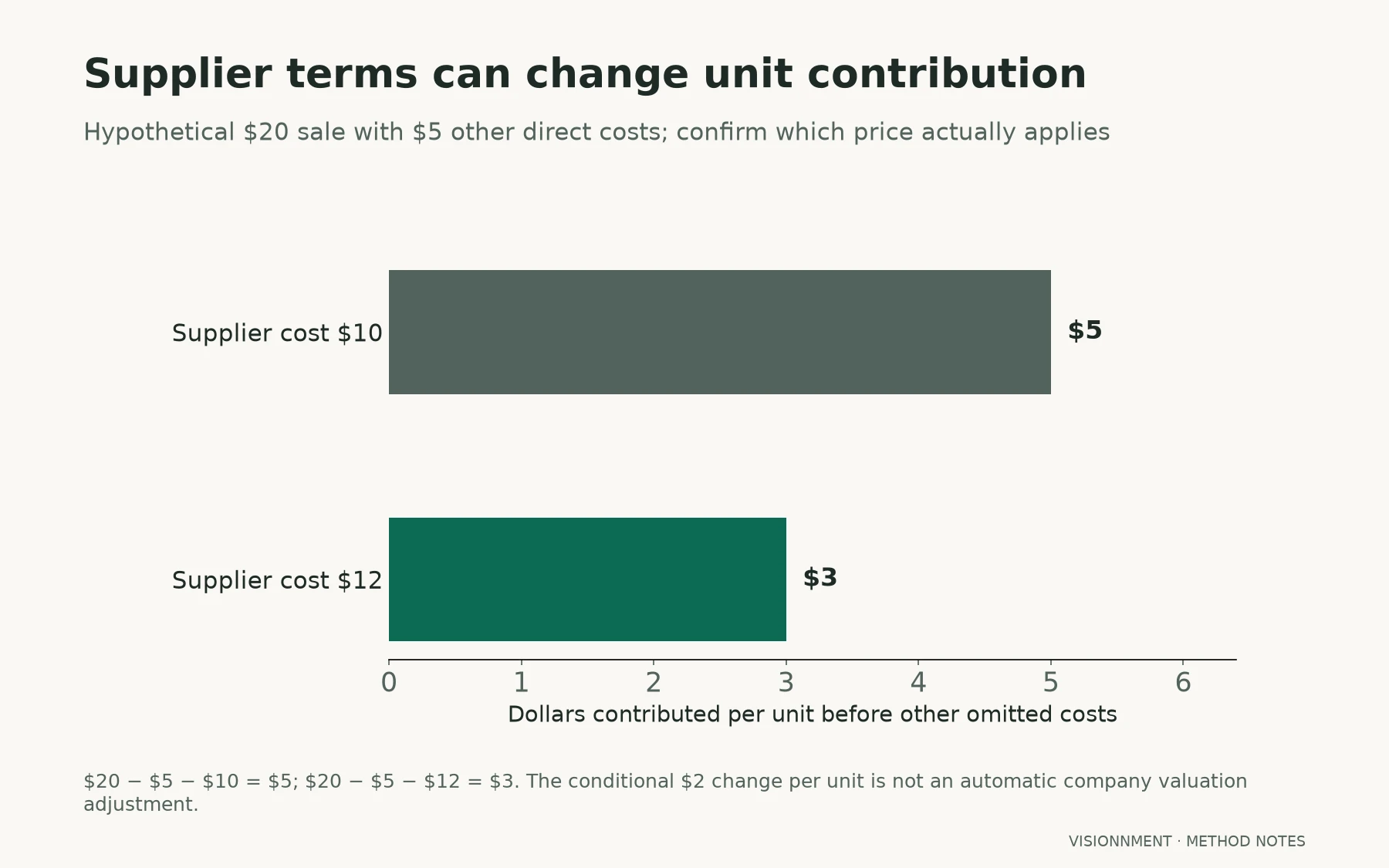
The fictional item sells for $20. Other direct costs are $5, and the current assumed supplier price is $10. Its contribution before other omitted costs is $20 − $5 − $10 = $5.
If evidence establishes that the buyer's applicable supplier price would instead be $12, contribution becomes $20 − $5 − $12 = $3.
| Hypothetical scenario | Selling price | Other direct costs | Supplier cost | Contribution |
|---|---|---|---|---|
| Current stated terms | $20 | $5 | $10 | $5 |
| Confirmed changed-price case | $20 | $5 | $12 | $3 |
The $2 reduction is per unit under the stated assumptions. It does not establish a company valuation change without volume, overhead, working capital and other evidence. It also does not mean a supplier change actually happened.
Preserve the original price and the source supporting any revision. If $12 is only a stress assumption, label it hypothetical rather than “the buyer's new price.” Separate known facts from the downside scenario.
Inspect whether the $5 other-direct-cost assumption remains valid. Changed order quantities, shipping, quality checks or returns can move several components at once. Reconcile those effects instead of subtracting the same cost twice.
5. Model interruption and working-capital needs
Map stock on hand, committed orders, production lead time, transit and the next reorder. Confirm which stock is owned, saleable and available rather than merely present at a warehouse.
A supply interruption can affect revenue, cash and customer obligations on different dates. Existing stock may support deliveries temporarily while new orders remain uncertain. Do not describe a warehouse count as a long-term supply solution.
Estimate the cost of an alternative only when its specification, quality, permission and delivery can be assessed. A supplier discovered in a search result is not a qualified replacement. Include samples, testing, minimum orders and transition work where applicable.
Keep the reserve separate from purchase consideration. A buyer who spends all cash on the asset may be unable to fund the first supported reorder even if the business remains profitable on paper.
If the seller proposes placing an unusually large order before closing, have advisers review ownership, funding, valuation and unsold-stock risk. More inventory is not automatically more protection.
6. Preserve and disclose unresolved conditions
Build a short register: issue, affected product, evidence, economic consequence, responsible party and next action. Include missing agreements, expiring terms, uncertain consent and unqualified alternative supply.
Disclose material changes through the agreed transaction process. Do not continue using the old maintainable-profit presentation after a confirmed price or supply change undermines it. Update the economic base once and explain the adjustments.
Keep confidential supplier information within authorized access. Agree who may contact the supplier and what may be said before revealing a sale process or customer information. Uncoordinated outreach can create confusion without resolving consent.
For relationships depending on the founder personally, use the founder-dependence guide to test the actual handover. An introduction is useful but does not establish the contractual rights or commercial terms.
If uncertainty cannot be resolved, compare repair, changed transaction terms, waiting or no sale with advisers. Do not hide the condition in a generic assurance that suppliers are happy to continue.
7. Align the contract schedule with closing acceptance
For each critical relationship, state what completion requires: effective agreement, approval, accepted new-owner account, current price confirmation or another defined outcome. Match those conditions to the transaction documents and actual deadlines.
Rehearse a representative order under the intended arrangement where a safe, authorized procedure exists. Confirm specification, payer, recipient, timing and records. A small order can demonstrate one operating cycle, not perpetual supply.
Separate operating acceptance from payment release and legal completion. The agreement and payment instructions govern the actual consequences of an incomplete condition. Obtain counsel's direction rather than improvising a unilateral remedy.
Retain the current terms, consent evidence, stock schedule, contribution model and unresolved items. The Empire Flippers selling guide can help organize the chosen provider route, but supplier acceptance remains its own evidence track.
Check the calendar immediately before closing as well as during early diligence. A price-list expiry or reorder deadline can pass while legal work continues. Record whether the original confirmation remains effective and obtain an update through the authorized contact if necessary. Avoid presenting an outdated quotation as the buyer’s current supply arrangement.
Common questions
Does years of buying prove the buyer can continue?
It proves historic activity under its recorded circumstances. Verify the actual transaction and new-owner terms separately.
Should I assume every transfer causes a price increase?
No. Use evidence for known changes and label stress assumptions as hypothetical. Neither automatic repricing nor guaranteed continuity is justified.
Which issue should be resolved first?
Prioritize relationships supporting material contribution or essential delivery. A small paperwork gap and an unavailable critical product do not have the same decision impact.