
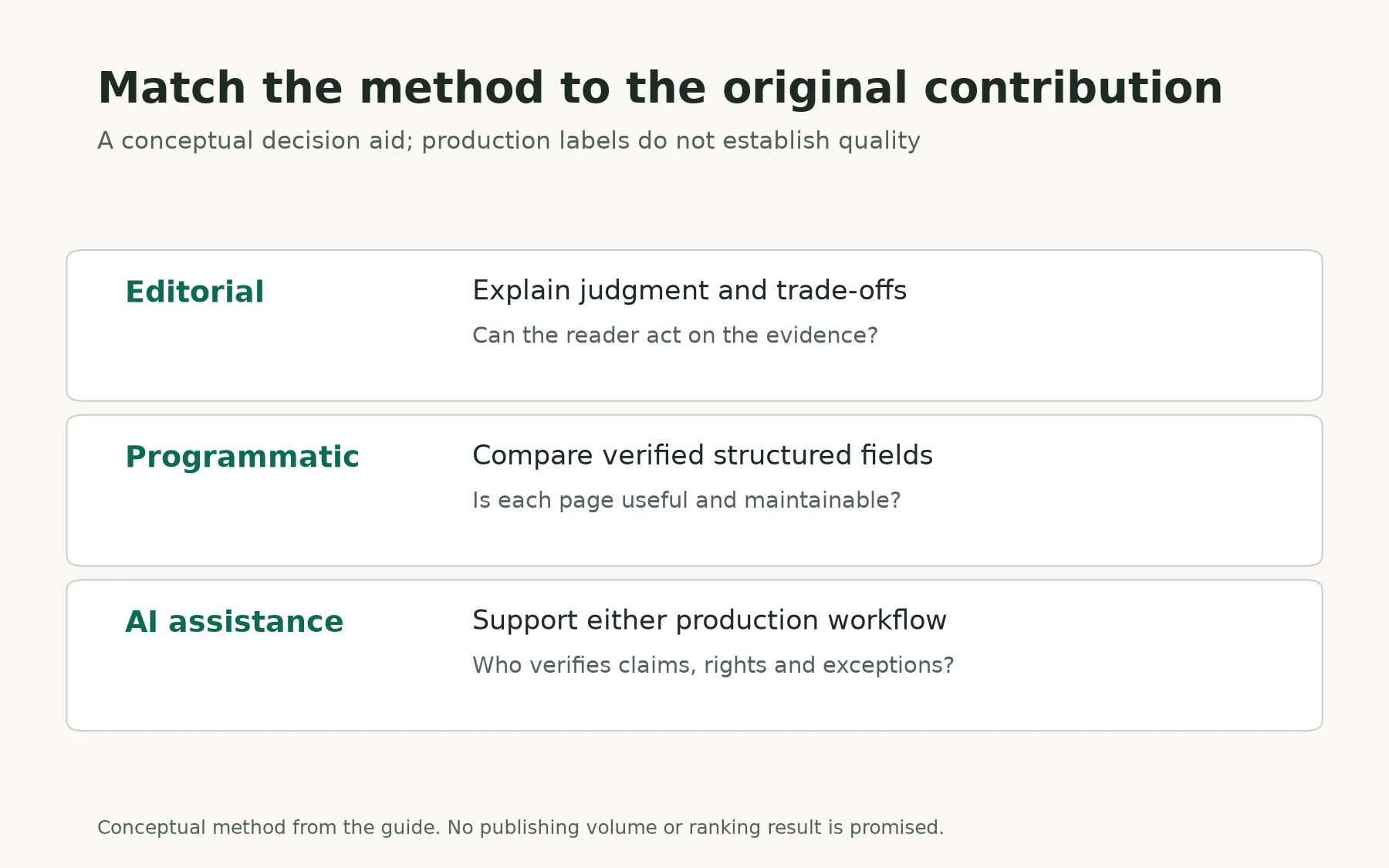
The programmatic vs editorial content decision depends on what the reader needs and what evidence you can maintain. AI assistance can be part of either workflow. None of these labels establishes usefulness, search eligibility or a ranking advantage.
Choose the production method after defining the page's original contribution. A structured directory can help readers compare verified fields; an editorial guide can explain the trade-offs those fields cannot express. Both fail when their claims are unsupported or their information becomes unusably stale.
This guide uses a hypothetical 20-record directory. No search experiment, audience outcome or software evaluation was performed. You need a reader task, source records, permission information, a reviewer and a realistic maintenance budget before scaling.
1. Define the reader job and the contribution
Write the reader's task in a sentence that can be checked. For example: “A small publisher can identify which providers meet its required capability and which facts still need confirmation.” Avoid “create pages for every keyword,” which describes output rather than a reader result.
Next, name the contribution of each page. It might be a normalized comparison, a documented procedure, an explanation of conflicting definitions or original analysis of source records. Rewording a vendor description without adding decision value is a weak foundation for scale.
Google's people-first content guidance asks about original information, completeness and value for an intended audience. Use those questions to challenge the proposed format. They are not a checklist that guarantees search visibility.
For the fictional directory, define a small set of fields readers actually need: supported capability, constraint, source date and unresolved question. If two entries differ only in name while the useful answer is identical, ask whether one comparison page would serve the reader better.
The deliverable at this stage is a clear page purpose and an acceptance question. If a reviewer cannot explain what the reader can do after using the page, do not begin bulk production.
2. Separate the method from the quality decision
Editorial production is useful when a topic needs interpretation, interviews, context or careful explanation. Programmatic production can help when a meaningful, maintained dataset supports repeated page structures. AI assistance can organize material or suggest wording, but the publisher remains responsible for verifying the resulting claims.
| Method | Suitable underlying input | Characteristic failure |
|---|---|---|
| Editorial | Sources requiring analysis or explanation | Fluent assertions without evidence |
| Programmatic | Consistent fields with useful differences | Large sets of interchangeable or stale pages |
| AI assisted | Bounded source material and human review | Plausible details absent from the sources |
Choose a hybrid where it helps. A verified table may sit inside an editorial explanation of how to choose. There is no reason to force qualitative judgement into a generated field merely to keep the workflow uniform.
Do not use cost per page alone. Include source acquisition, normalization, editing, corrections and later updates. A cheap first render can create an expensive maintenance obligation when a shared source changes.
If you are still establishing the publishing business, use content-site first revenue to connect the resource with an actual audience. Production scale is a later operating decision, not evidence that a business model works.
3. Build provenance into the records
For each substantive field, retain the source, retrieval or review date, exact scope and the person responsible for checking it. Keep observed facts separate from vendor claims and your own interpretation. Add a conflict field where sources disagree.
A source saying “supports exports” does not establish that every plan exports every field. Store the limitation beside the capability. If the evidence only covers a public product description, do not convert it into a claim that your team performed a successful export.
Check rights as well as accuracy. Access to a page or dataset does not establish permission to republish its full text, images or underlying data. Resolve the proposed use under the applicable terms and qualified advice where necessary.
Give generated text a claim-to-source check. If the draft says a provider offers a specific integration, the reviewer should locate supporting evidence at the correct plan and date. If no source supports it, remove the claim or obtain evidence; adding “typically” does not fix it.
Plan for updates at the field level. A shared pricing change may affect many pages. Keep a way to identify the affected records and review them without rereading an entire website from memory.
4. Compare a small sample before expanding
In the hypothetical directory, there are 20 source records. Six are stale, and three generated descriptions contain unsupported details. These counts describe different defect types; they might overlap, so they do not automatically mean nine distinct bad pages.
Freeze expansion. Mark the six records as requiring current review and trace each unsupported statement back to the generation or editing step that introduced it. Repair the sources or withhold the affected facts. Do not regenerate the same unsupported material with more confident wording.
Prepare an editorial comparison that explains the same reader decision. It may reveal that a table plus one guide is more useful than 20 stand-alone pages, or that some records deserve distinct pages while others do not.
Use the same acceptance tasks for both formats. Ask a reviewer to locate a supported option, identify a limitation, find the date and distinguish unknown information. Record where the reviewer gets stuck and what evidence is missing.
A successful sample is an accepted reader task with traceable claims, not simply pages that render without errors. If a format fails, change the data, scope or presentation and repeat the bounded review before adding records.
5. Check policy exposure and correction cost
Google's spam policies describe scaled content abuse in terms of large-scale content created primarily to manipulate rankings rather than help users, regardless of how it is produced. Neither “human written” nor “AI generated” is a blanket compliance verdict.
Examine your intended pages for repeated low-value variations, misleading facts and gaps between the title and actual answer. The policy question and the usefulness question overlap, but they do not turn into an exact ranking formula.
Estimate maintenance using the sample defects. How long did current source review take? Which updates required specialist judgement? How many pages shared a fragile field? Record actual review effort when you have it; until then, label estimates as assumptions.
Assign a correction procedure: receive the report, assess the claim, locate affected records, correct or withdraw the unsupported information, and verify the rendered result. A named reviewer needs authority and time to act, not merely a credit line.
If maintenance exceeds your capacity, narrow the corpus or simplify the promise. A smaller set of current, distinct answers can be a stronger operating choice than an expanding backlog of unverified pages.
6. Scale the accepted method in controlled batches
Choose the next batch size based on review capacity and the consequences of error. State the fields that can be reused automatically and the claims requiring manual review. Keep an explicit stop condition for source failures or repeated unsupported assertions.
Measure accepted pages and correction workload rather than raw word count. Keep an issue log that distinguishes missing evidence, wrong interpretation, presentation defects and obsolete information. Different causes require different repairs.
If search traffic appears later, treat it as an observed outcome for the recorded period. It does not establish that your chosen method caused the result or will work for unrelated topics. Preserve other changes and seasonality in the record.
The maintained sources, reviewer responsibilities and correction history also support continuity when you prepare a website for sale. A buyer needs to know how the corpus stays useful, including work that does not appear in a page-count report.
Your final decision should name the format, reader result, evidence source, reviewer, update trigger and expansion limit. If one of those is missing, the next useful output is a repair—not another thousand pages.
Common questions
Can AI write the first draft?
It can assist a bounded workflow, but its wording still needs evidence and editorial review. Do not claim tests, comparisons or experience that nobody performed.
Are programmatic pages automatically thin?
No. Their value depends on the underlying information, differences and reader task. A structured method cannot rescue meaningless data, and a repeated layout does not automatically make useful data valueless.
What if a source disappears?
Review the affected claim and whether retained evidence is still sufficient for the promise. Mark uncertainty, remove unsupported current assertions or withdraw the affected page if it can no longer fulfil its purpose.