
Debt for a digital-business acquisition should be evaluated against cash available after the business’s real operating needs. Positive accounting profit does not establish that scheduled principal and interest can be paid. Eligibility, lender approval, contractual priority and downside capacity are separate questions.
Build a sources-and-uses schedule, a monthly cash model and a list of lender conditions. Gather the proposed purchase perimeter, financial records, replacement operating costs, working capital, capital needs and actual financing terms. The worked numbers below are hypothetical scenarios. They are not loan quotes, approvals or expected investment returns.
Separate funding sources and their priority
List every proposed funding source: buyer equity, senior debt, seller note, other subordinated funding and any contingent consideration. State who provides it, when it becomes available, its repayment or ownership terms and the conditions that remain. A possible lender conversation is not a committed source.
BDC’s acquisition financing guide explains a capital structure containing sources with different priorities and repayment characteristics. Its educational example is not a universally available package. A small online business may have a different collateral base and lender assessment.
Build the uses side beyond the purchase price. Include diligence, closing costs, working capital, immediate technical or operational repairs and reserve. If the transaction requires $300,000 of consideration plus additional costs, a $300,000 funding package is incomplete unless those other uses are funded separately.
Record security, guarantees and intercreditor questions for professional review. A seller note described as flexible may still have enforceable payments, acceleration rights or restrictions. The label alone does not establish its priority or the buyer’s freedom to defer it.
Check borrower, target and country eligibility
Identify the borrower, beneficial ownership, operating location, business activity and purchase structure. Ask the proposed lender which eligibility rules apply to those actual facts. A U.S. customer base or company registration alone should not be treated as sufficient evidence for a particular programme.
The SBA’s 7(a) programme overview includes eligible uses involving ownership changes and explains that applications go through participating lenders. The programme has business, creditworthiness, repayment and other requirements. Confirm current official rules and lender interpretation for the specific borrower and target.
Keep U.S. programme questions separate from Canadian financing. BDC’s discussion provides Canadian institutional context, not an SBA approval route. A Canadian owner considering a U.S. acquisition may need cross-border legal, tax and financing advice beyond the target’s domestic operating documents.
Build an eligibility question sheet with each answer’s source, date and responsible adviser or lender. Mark questions unresolved until supported. Do not plan an unconditional purchase around an assumed programme qualification that has not been checked.
Avoid using promotional approval stories as evidence. Another buyer’s loan, a broker’s introduction or a business category on a marketplace does not determine the terms available to this transaction. Ask for the lender’s actual document requirements and decision process.
Rebuild cash available for debt service
Start from a reconciled earnings base and explain every adjustment to cash. Include replacement operator work, necessary maintenance, working-capital movements and other relevant operating needs. Keep owner-time valuation separate from paid wages; both can affect the decision, but only actual cash payments enter the same cash line.
Define the coverage measure used. In this guide, simplified debt-service coverage equals stated annual cash available for debt service divided by annual debt service. A lender may calculate its covenant differently. Use the actual loan definition for contractual compliance.
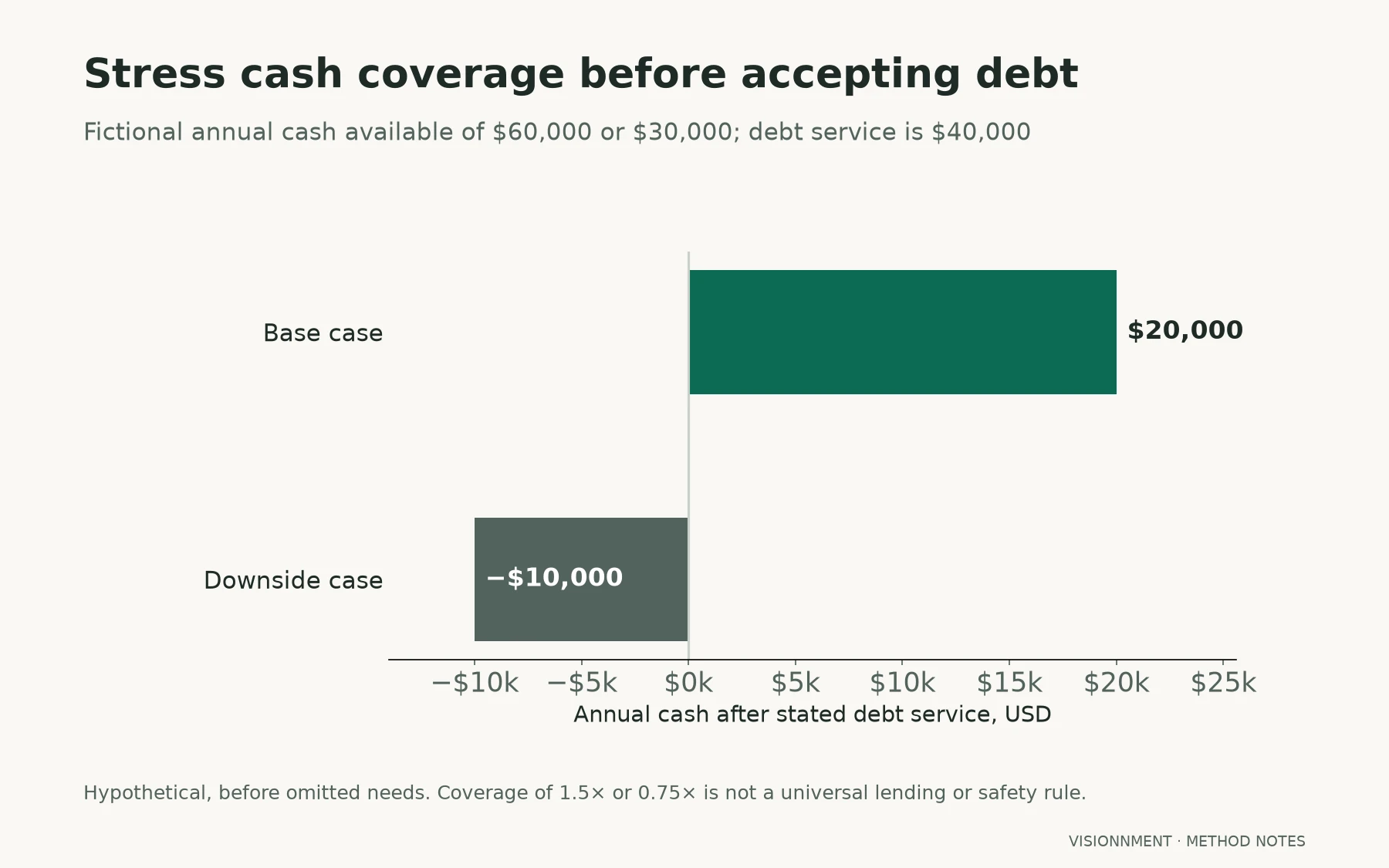
Assume a fictional $300,000 purchase funded by $100,000 equity and $200,000 debt. Further assume annual cash available after stated operating needs is $60,000 and annual debt service is $40,000. These are teaching inputs, with transaction costs and additional funding needs still to be assessed.
| Hypothetical case | Cash available | Annual debt service | Simplified coverage |
|---|---|---|---|
| Base | $60,000 | $40,000 | 1.5x |
| Downside | $30,000 | $40,000 | 0.75x |
The base leaves $20,000 after the stated debt service, before any omitted needs. The downside has a $10,000 shortfall. Neither result establishes loan eligibility or an adequate reserve. A positive cash-availability figure can still be insufficient for the required payments.
Prepare monthly timing too. An annual total can conceal an early cash shortage, especially where advertising payouts, supplier purchases or annual subscriptions create uneven receipts and obligations. Debt payments may fall due before the revenue assumed to fund them is collected.
Compare seller notes, senior debt and other capital
Compare actual proposed terms on the same purchase and operating assumptions. Record principal, rate basis, amortization, maturity, payment frequency, fees, security, guarantees, covenants and prepayment conditions. Where terms remain unknown, use a clearly labeled scenario rather than a fabricated quote.
A seller note can reduce cash paid at closing while creating future payment obligations. An earnout can make part of consideration depend on an agreed result, but its definition, measurement and disputes require careful drafting. They should not be treated as interchangeable labels for risk-free deferred payment.
Equity may avoid scheduled loan payments while granting ownership and governance rights. Other subordinated funding may involve different costs and control terms. Ask qualified advisers to explain the actual rights and priorities rather than ranking sources by interest rate alone.
Read the interaction between agreements. A senior lender may restrict seller-note payments or further borrowing. A refinancing assumption may conflict with a covenant or depend on future valuation and lender appetite. Preserve those dependencies in the model.
Compare cash burden under realistic timing. A lower periodic payment with a large maturity balance can move the risk rather than remove it. Show the amount due at maturity and the source expected to repay it. Future refinancing remains an assumption until supported by an available commitment.
Stress revenue, integration and refinancing pressure
Use the identified business risks to build downside. For a concentrated customer base, model the actual contribution lost if that customer leaves. For ecommerce, include stock and supplier timing. For software, consider continued service and specialist work even when new sales weaken.
In the fictional example, cash available falls from $60,000 to $30,000 while the $40,000 debt service stays unchanged. Coverage falls from 1.5x to 0.75x. The business remains cash-generative before financing, yet cannot fund the stated annual debt service from that cash alone.
Identify the response before relying on the base case. Would the buyer contribute more equity, retain a larger accessible reserve, reduce the purchase scope or negotiate different terms? None is automatically available. Record the required counterparties and approvals.
Add integration costs and delayed receipts as separate stresses. Do not hide predictable transition work in a generic contingency and then exclude it from the cash model. A business can require duplicate systems or seller assistance during the same period that debt payments begin.
Test a refinancing delay without assigning unsupported probabilities. If a maturity payment cannot be refinanced when hoped, identify the lawful and practical alternatives with advisers. A future sale price should not be treated as guaranteed repayment capacity.
Preserve concentration and operating capacity alongside the arithmetic. A nominal reserve may be inaccessible or committed elsewhere. A low-cost operator may lack the skill to manage a disruption. Financing cannot by itself repair an unsuitable operating plan.
Reconcile the payment schedule to the model line by line. Separate interest, principal, fees and any maturity balance. Do not assume principal repayment is an operating expense or that accounting treatment changes the amount of cash the borrower must pay. Ask the accountant and lender to resolve classification and covenant questions.
Obtain actual lender terms before relying on leverage
Ask the lender to specify the borrower, eligible use, amount, conditions, fees, security, guarantee requirements, covenant definitions and closing process. Confirm which documents are preliminary and which create commitments. Adviser review should cover obligations the buyer may not understand from a summary sheet.
Rebuild the model using the actual terms and source records. Reconcile the full purchase and transition uses to available sources. Verify that reserves remain available after closing rather than counting the same equity twice.
The digital-business investment memo guide helps preserve the financing decision, evidence gaps and conditions. If a broker-assisted route is relevant, the Empire Flippers buying-process guide explains its surrounding stages. Broker involvement does not replace lender approval or qualified advice.
The useful decision is whether the proposed borrower can fund and operate the acquisition under supported terms, including a credible downside. The hypothetical 1.5x base case is a calculation to inspect, not a threshold that guarantees safety, financing approval or an attractive return.