
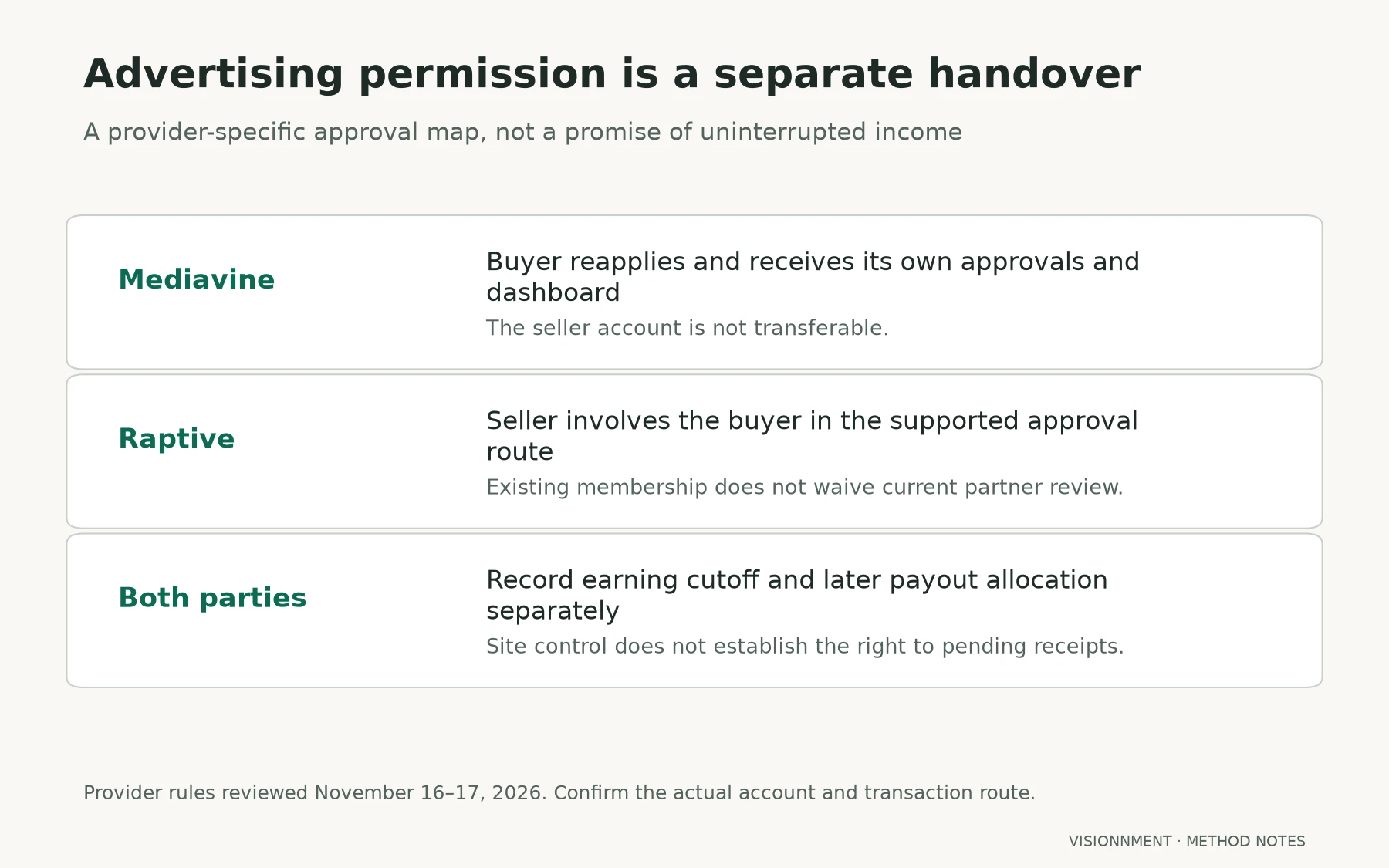
Treat a Mediavine or Raptive website sale transfer as an approval process with a financial cutoff. Buying the domain and receiving administrator access does not establish permission to keep the seller’s monetization arrangement. Agree who contacts the network, what the buyer must complete, and where earnings belong before choosing the closing date.
The practical output is a dated register covering approval, site control, earned revenue and later receipts. Gather the seller’s actual programme agreement, network correspondence, daily earnings exports, pending payments and proposed transaction schedule. This is coordination work for the buyer, seller and provider; legal interpretation and allocation terms belong with qualified advisers.
Identify the actual network and transaction perimeter
Start with the publisher account and programme name shown in the seller’s documents. A site running familiar advertising scripts may still have a different contractual arrangement from another site using the same brand. Record the legal publisher, domain, account owner, current payee, included properties and any shared administration.
Write down whether the transaction buys selected assets or changes ownership of an entity. Do not assume the network treats those events identically. Describe the actual change to its support team and request the supported route. A seller’s description of a previous transfer is useful background, but the provider must address this transaction.
Separate everything the seller can convey from everything requiring an independent approval. The domain, content and hosting can sit in one transfer schedule, while advertising permissions sit in another. The website handover checklist helps coordinate these wider control dependencies.
Prepare the financial perimeter at the same time. Include unpaid earnings, adjustments, disputed amounts and the recipient bank account. Decide which records the buyer needs to verify historical trading without acquiring the seller’s tax or banking credentials. Export reports with a clear date range and currency rather than sharing unrestricted personal access.
Separate buyer application from monetization approval
Mediavine’s site-sale guidance says websites changing owners must reapply, approval is not guaranteed, and accounts cannot be transferred. A buyer needs its own partner approvals, terms and dashboard. Taking over the existing dashboard is therefore an unsuitable workaround for a delayed application.
Ask Mediavine how the planned sale date, required notice and buyer application will fit together. Its guidance also states that the previous owner’s loyalty bonus does not carry over. Historical earnings that included that benefit should not silently become the buyer’s operating assumption.
Raptive’s transfer procedure uses a different route: the account or site owner contacts the team and includes the buyer. The buyer does not complete a new application through that procedure, but still needs approval, appropriate terms and advertising-partner acceptance. No new application does not mean no review.
Assign a person and evidence item to each gate. “Buyer submitted information” and “provider confirmed approval” need different rows. Keep an unresolved identity check visible instead of describing the whole transfer as nearly complete. The buyer should understand which remaining condition could interrupt income or prevent continued service.
Compare the two provider-supported owner-change routes
Use this comparison to organize questions, then confirm the current instructions for the named account. It is based on provider material reviewed November 16, 2026, and is not a substitute for transaction-specific correspondence.
| Question | Mediavine route | Raptive route |
|---|---|---|
| How does the buyer start? | Reapplication and independent evaluation | Seller contacts support and includes buyer |
| Does seller access convey permission? | Existing account is not transferable | Provider coordinates approved ownership change |
| Which approval matters? | Buyer’s own partner approvals and agreement | Buyer eligibility and ad-partner approval |
| What needs a financial schedule? | Seller’s unpaid earnings and new buyer earnings | Ownership form and agreed ad-payment allocation |
The Raptive eligibility policy, reviewed November 16, 2026, gives different branches:
| Buyer’s Raptive status | Published transfer conditions | Conditional timing guidance |
|---|---|---|
| Already an active account holder | Site must satisfy the shared ownership, content and approval conditions below | Transfers can be processed in 1–2 business days; confirm the actual schedule |
| Not an account holder | Site needs at least 25,000 pageviews or $500 creator revenue in the past 30 days, plus shared conditions | May take up to 30 days, depending on Google-account/verification status |
The site must have been onboarded with Raptive for at least six months or associated with the current owner of record for at least six months. Creators can transfer at most three sites within 12 months. All transfers are new onboarding events for advertising partners, reviewed under current standards; content policies, partner approval and applicable Google identity verification still apply. The buyer’s Google monetization identity must match the Raptive payee. Existing membership does not waive those requirements.
The transfer procedure, reviewed the same date, requests 30 days’ notice. It also announces a transfer-processing pause from December 24, 2026, through January 4, 2027, unless arranged in advance. These published timing descriptions are conditional guidance, not a service guarantee. Confirm the actual dates before committing to closing. They concern ownership changes; do not substitute a separate new-applicant entry threshold.
Do not copy a payment arrangement from one provider to the other. Mediavine describes paying unpaid earnings on its normal schedule. Raptive describes documenting a payment agreement and following its net-45 schedule. Those routes create different coordination tasks, even where the commercial allocation between buyer and seller is similar.
Build a dated cutover and pending-earnings register
Create one row per event rather than one row called “ads transferred.” Include the event date, responsible person, relevant earning period, intended recipient, evidence and unresolved dependency. Preserve the time zone used in both the earnings report and purchase agreement.
The following is a hypothetical coordination design, not a provider timetable or a transfer performed by Visionnment.
| Event | Hypothetical date | Evidence required | Accounting question |
|---|---|---|---|
| Seller stops earning for its own account | December 1 | Agreed cutoff and daily export | Which accrued amount belongs to seller? |
| Buyer receives site control | December 1 | Handover acceptance | Does monetization permission also exist? |
| Buyer approval becomes effective | December 11 | Provider confirmation | When may buyer earnings begin? |
| Earlier earnings reach a bank | Later scheduled date | Payout and bank records | Which earning period produced the receipt? |
Keep the last row separate from the approval row. A payment arriving after closing might relate entirely to seller-period trading. Conversely, new buyer earnings can exist before the cash reaches the bank. Reconcile both by earning period and payment identifier.
If the parties choose a settlement adjustment for outstanding earnings, ask advisers to document the amount, calculation, recipient and later reconciliation. Do not rely on leaving someone’s bank details unchanged without a supported provider process and an explicit agreement. Record who handles later corrections or revenue adjustments.
Work an income-interruption scenario
Assume, solely for planning, that buyer approval takes ten days beyond the chosen control date. If the model assumed $100 of daily advertising revenue during those days, the arithmetic exposure is $1,000 of gross revenue. Neither the delay nor the daily amount is a forecast or a provider service commitment.
Translate that exposure into cash requirements. Hosting, contractors and essential maintenance may remain payable while new earnings are interrupted. A pending seller payout cannot automatically fund those buyer obligations. Set aside an accessible buyer reserve rather than counting the same outstanding money in both parties’ closing schedules.
Then ask what happens if approval is refused. Options might include delaying the transaction, changing its terms or assessing a different monetization arrangement. Whether those options are available depends on the agreement and provider rules. Obtain qualified advice before treating an approval condition as a right to cancel or recover money.
Keep a sensitivity column for recovery after approval. Resumed advertising does not establish the same yield, buyer costs or profit as the seller’s prior period. The network arrangement, traffic, seasonality and site changes can affect the operating result. Preserve a baseline so differences can be investigated rather than attributed automatically to the sale.
A useful failure check is to remove the pending payout from the buyer’s cash forecast. If the buyer cannot cover essential bills after doing that, the plan relies on money it has not established a right to use. Resolve that before committing to the cutover.
Accept reporting and ownership separately
Close the advertising workstream only after the responsible parties have evidence for its separate parts: provider approval, correct owner information, agreed domain transition, appropriate reporting access and a reconciled earnings allocation. The existence of an ad unit on a page proves none of those financial or contractual details by itself.
After the approved transition, compare the first available daily reports with the site baseline. Check the dates, domain, payee information and any unexplained absence of reporting. Route a discrepancy to the named network contact with its relevant evidence; avoid making repeated script or account changes while the cause remains unknown.
Preserve exports before access changes. Mediavine’s sale guidance says the seller dashboard is deactivated at the end of its 30-day notice period, leaving limited information access; export the needed date ranges ahead of that point. Its buyer reapplication route remains separate from transferring the seller’s account. Raptive describes removing the seller when its approved dashboard transition occurs. Both parties need lawful accounting records without retaining inappropriate access to the other party’s future activity.
The final acceptance note should name the next payout reconciliation date, the person checking it and the escalation condition. “Approval confirmed, pending seller earnings still to reconcile” is a useful status. “Transfer complete” conceals too much.
If the transaction uses a broker-assisted route, the Empire Flippers buying-process guide explains the surrounding acquisition stages. The immediate task remains the network-specific approval and earnings register. Completing that record improves control over the handover; it does not guarantee future advertising income or business success.