
A digital-business acquisition sourcing pipeline should improve the quality of decisions, not simply increase the number of listings reviewed. Separate discovery, mandate fit, evidence access and operating capacity. A candidate becomes actionable only when it passes the relevant gate with a named decision-maker and a record explaining why.
The output is a repeatable sourcing register with workload limits and rejection reasons. Begin with the acquisition mandate, available capital, operating skills, adviser capacity and approved information-handling process. The example funnel below is fictional. No outreach, private database access or automated deal sourcing was performed for this article.
Define mandate, buy box and decision authority
State the purpose of the acquisition in operational terms. Identify the business models, geography, earnings basis, purchase range, required capabilities and risks the team can accept. Include the kind of work the buyer is prepared to perform after closing. A price ceiling alone is an incomplete buy box.
BDC’s acquisition framework recommends a clear plan with objectives, budget, responsibilities and target characteristics. Use that plan to reject unsuitable opportunities before detailed diligence consumes the team. Preserve a route for deliberate exceptions rather than quietly changing the mandate to fit an appealing listing.
Assign authority for sourcing, initial screening, evidence requests, exclusivity and capital commitments. A team member permitted to collect public information should not automatically be allowed to make an offer or accept a confidentiality agreement. Ask advisers to define material commitment boundaries.
Document disqualifiers separately from preferences. An unsupported provider transfer may be a stop condition. A less familiar interface may be manageable with training. Clear categories prevent the same candidate from receiving different treatment depending on who first opened the listing.
Separate marketplace discovery from proprietary sourcing
Record where each opportunity originated. Public marketplaces, broker introductions, existing relationships and owner-authorized conversations provide different evidence and access conditions. Calling an introduction proprietary does not establish exclusivity, seller willingness or a better price.
Acquire.com’s buying guide explains using acquisition criteria, building a shortlist and progressing into deeper diligence. Empire Flippers’ marketplace provides another discovery route. Neither public discovery channel proves that a candidate meets the buyer’s operating mandate.
Keep source information separate from the evidence packet. A marketplace summary may support a preliminary screen while financial exports require authorized access. Mark claims as seller-reported until the relevant records are reviewed. Do not convert a platform badge or listing category into a conclusion about underlying earnings quality.
For relationship-led sourcing, obtain appropriate permission before collecting or sharing confidential materials. Do not scrape private contact details or describe an owner as willing to sell without an actual conversation. Use the organization’s approved outreach and privacy process where outreach is separately authorized.
Track introductions without double counting the business. The same asset may appear through a broker, marketplace and referral. Assign a stable candidate identifier and preserve all source relationships, including any fees or representation conflicts that need review.
Track introductions, permissions and conflicts
Build a register with candidate identity, source, date, contact authority, confidentiality status, evidence-access scope and next permitted action. Record which party represents whom. A broker’s compensation or adviser conflict can affect how information should be interpreted, even where the introduction is useful.
Keep personal and commercial data proportionate to the stage. An initial screen rarely requires a complete customer list or employee file. Ask for the evidence needed to answer the specific gate, using appropriate access controls and adviser support. More collected data is not automatically better diligence.
Preserve the terms governing information access. If a seller declines further discussion, record the decision and handle retained materials according to the applicable agreement and policy. Do not keep contacting the owner merely because the candidate remains attractive.
Use a status that describes reality. “Introduction made” means an introduction occurred. “Evidence access granted” means the agreed records are available. “Negotiation” should not mean someone sent an unanswered message. Precise states prevent an inflated pipeline from becoming a misleading management report.
Catcha Digital’s August 2024 investor deck illustrates one company’s disclosed sourcing and internal approval process. Its stages and historical counts are a corporate example, not universal standards or conversion targets for a small acquisition team.
Build a reproducible first screen and rejection reasons
Use a short screen tied to the mandate: model fit, geography, price scope, claimed earnings basis, operating work, concentration and obvious transfer dependencies. Record the evidence source and uncertainty for each answer. Unknown is a valid state; it is not a pass or an accusation of wrongdoing.
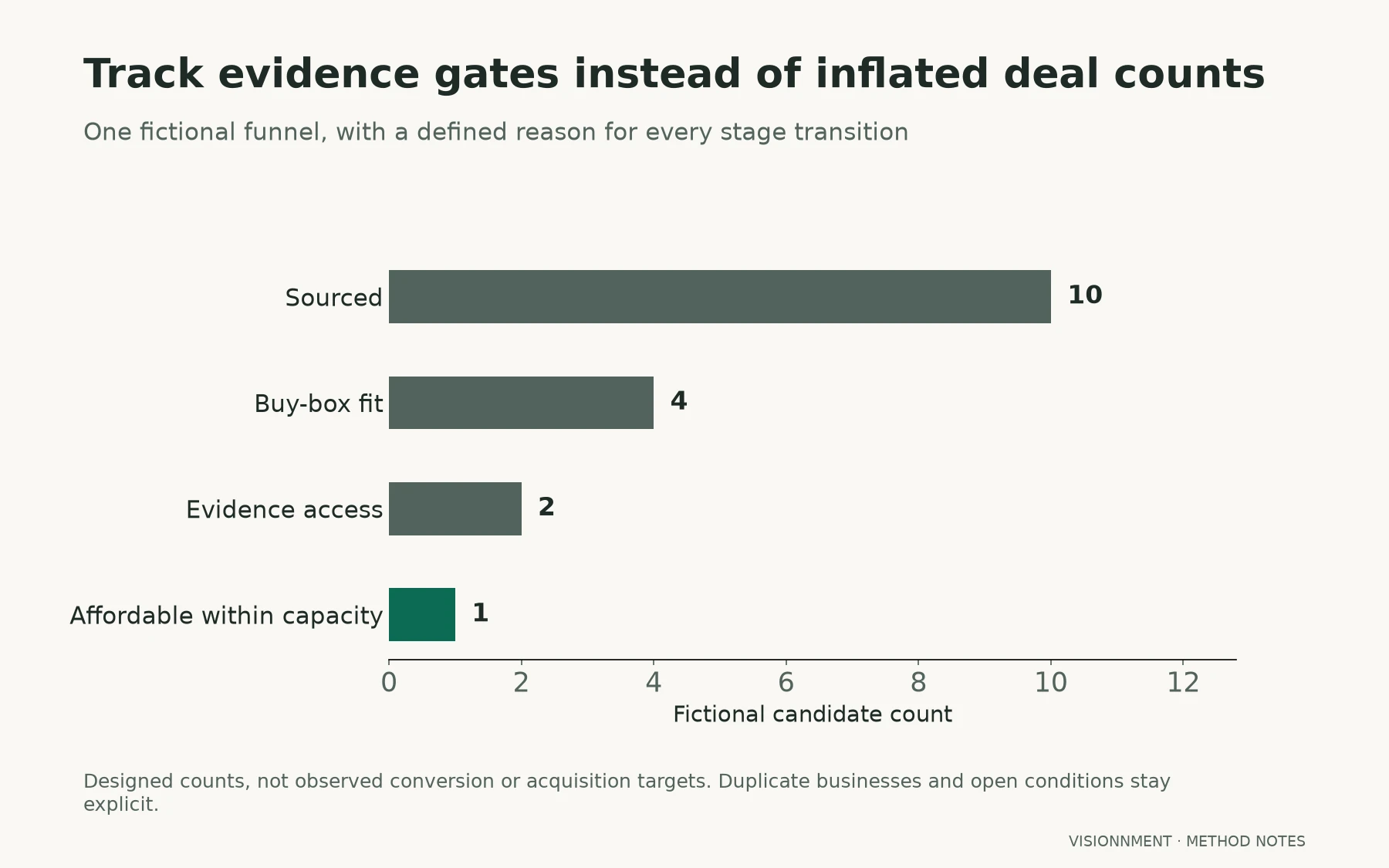
The fictional funnel begins with ten sourced candidates. Four match the stated buy box, two provide adequate evidence access, and one fits both affordability and operating capacity. These counts are teaching inputs, not observed conversion rates or expected performance.
| Gate | Fictional count | Required decision evidence |
|---|---|---|
| Sourced | 10 | Identified asset and legitimate source |
| Buy-box fit | 4 | Recorded match to the mandate |
| Adequate evidence access | 2 | Available records for the next review |
| Affordable within capacity | 1 | Funded purchase and workable operating plan |
Attach reasons to the six candidates rejected at the mandate gate. Examples might include an excluded business model, unsupported geography or a workload outside the buyer’s skills. Do not write “poor quality” when the real reason is simply that the asset does not fit this buyer.
For the two fit candidates lacking adequate evidence, distinguish refusal, delay and inaccessible records. A seller may reasonably require confidentiality or qualification before access. Decide whether the team can meet those conditions rather than interpreting every barrier as fraud.
For the last capacity rejection, show the actual constraint. An apparently cheap asset can still need specialist work or working capital the buyer cannot supply. Preserve that reason so a lower asking price does not automatically reopen a structurally unsuitable opportunity.
Limit diligence work to actual team capacity
Set a work-in-progress limit by the team’s real review capacity. Count legal, financial, technical and operating availability rather than only the sourcing lead’s calendar. A candidate waiting for a specialist remains a queue item, not completed diligence.
Allocate a bounded initial review budget and define what justifies deeper work. Require a fresh decision when the scope expands or a material assumption changes. This prevents sunk review costs from becoming an argument for pursuing a weakening deal.
Track exclusivity and response deadlines carefully. Have advisers explain the actual obligations before the team accepts them. A sourcing spreadsheet cannot extend a signed deadline or authorize parallel negotiations that the agreement restricts.
Give each active candidate a next evidence question, owner and due date. If nobody can answer that question within the available capacity, pause or defer the candidate. Keeping it nominally active does not create progress and can conceal missed commitments.
Use an investment memo when a candidate reaches a material decision. The digital-business investment memo guide joins financial, operating and downside evidence into a reviewable recommendation. The sourcing register should supply its history, assumptions and unresolved conditions without replacing the deeper analysis.
Version the screening criteria when the mandate changes. Preserve the version used for each decision so an old rejection is not judged against rules adopted later. Reopening a candidate should require a recorded reason and current evidence.
Review source quality and conversion between evidence gates
Review the funnel at consistent definitions and periods. Measure how many candidates reach useful evidence gates, why they stop, how much review effort they consume and what conflicts emerge. A source producing many introductions may create less value than one producing fewer mandate-matched opportunities.
Separate stage movement from deal success. Signing an offer or entering exclusivity is not an investment outcome. A later decision to stop can demonstrate effective screening, especially when the recorded reason concerns unsupported earnings, permissions or operating fit.
Interpret small counts cautiously. In the fictional ten-candidate example, one capacity-qualified opportunity does not establish a 10% future success rate. Differences between sources may reflect business mix, timing or access conditions rather than source quality alone.
Review the rejection register before changing the buy box. If almost every candidate fails the same constraint, the mandate, available capacity or chosen source may need revision. Make that an explicit decision with its own rationale, rather than weakening screening one exception at a time.
For a specific assisted marketplace route, the Empire Flippers buying-process guide explains its surrounding steps. The sourcing system’s immediate task is to preserve a legitimate introduction, a reproducible screen and a workload the team can actually handle. More deal flow is useful only when the organization can make sound decisions about it.