
Comparing a digital business with commercial property requires more than two advertised yields. Identify the ownership interest, rebuild cash flow after the work and costs each asset requires, and examine the risks using evidence appropriate to that asset. Neither category has one universal workload, liquidity profile or return.
The practical output is two comparable cash-flow worksheets and two separate diligence lists. Gather the actual transaction perimeter, accounts, financing proposals, contracts and required professional reports. The examples below use invented annual amounts in the same currency. They are illustrations of omitted costs, not evidence of comparative market yields or a recommendation to invest.
Compare ownership interests and operating obligations
Define what is being acquired. A digital transaction might convey selected assets, shares, intellectual property or a contract-dependent operation. A property transaction might convey a particular legal interest subject to leases, title restrictions and local obligations. Those interests cannot be reduced to a shared label such as digital real estate.
List the obligations that continue after purchase. For the business, include customer service, software or content maintenance, supplier relationships and provider permissions. For the property, identify occupancy arrangements, building responsibilities, insurance, taxes and maintenance. Ask qualified advisers to establish the legal perimeter.
BDC’s commercial property budgeting guidance discusses costs such as financing, utilities, taxes, insurance and maintenance. It is a budgeting source, not a study comparing investment-property returns with online businesses. Use its cost categories where relevant without importing an unsupported yield conclusion.
Separate owner-occupied property from property held for rental income. Their cash flows and commercial purposes differ. Likewise, distinguish buying yourself a full-time operating job from acquiring a business with funded management. A comparison becomes misleading when one side includes replacement labor and the other assumes the owner works for free.
Rebuild cash flow after financing, maintenance and replacement work
Start from a clearly defined earnings or cash measure for each asset. Identify what the headline excludes, then deduct applicable operating costs once. Keep maintenance spending, capital investment, financing and taxes visible rather than mixing them into an unexplained net yield.
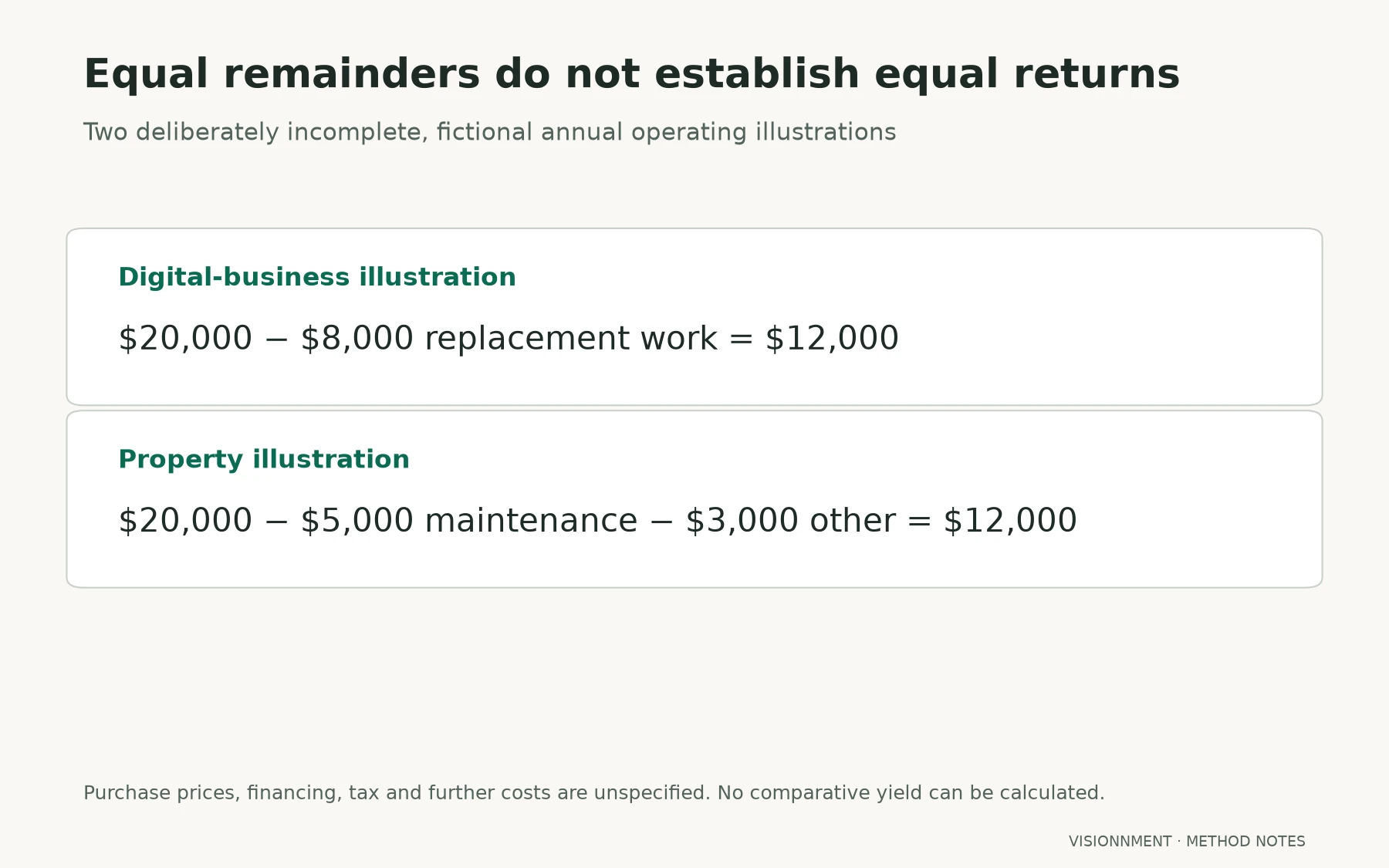
Consider this limited hypothetical comparison. Each asset starts with $20,000 annually before specified omitted costs:
| Annual item | Digital business | Commercial property |
|---|---|---|
| Stated starting amount | $20,000 | $20,000 |
| Replacement operator work | ($8,000) | Not included in this illustration |
| Maintenance | Not separately assumed | ($5,000) |
| Other stated operating costs | Not separately assumed | ($3,000) |
| Amount before financing and further items | $12,000 | $12,000 |
Both reduce to $12,000 under these assumptions. That equality does not establish equal value or risk. Purchase prices, taxes, additional costs, capital needs, financing and sale proceeds are unspecified. No meaningful comparative investment return can be calculated from this table alone.
Replace every invented amount with evidence before using the method for a real decision. For the business, price the work currently performed by the seller and confirm the proposed operator can do it. For the property, obtain relevant bills, condition information and professional estimates. An allowance without supporting scope may understate both cost and uncertainty.
Then build cash timing. Debt principal payments and major repairs can reduce available cash even where the headline profit remains positive. A business receivable or expected rent is not cash collected. Maintain a reserve for the actual obligations rather than spending the apparent annual surplus in advance.
Separate liquidity, collateral and concentration
Ask how the owner could sell each specific interest, what evidence a buyer would need and which approvals might delay completion. Do not assume every online business sells quickly or that every property always has a ready buyer. Marketing time, diligence, financing and legal work depend on the asset and conditions.
Review collateral using an actual lender proposal. BDC’s acquisition financing explanation describes different capital sources and priorities. It does not establish that a particular digital business qualifies for the same borrowing structure as a property purchase.
Map concentration separately. A business may depend on one major customer, search channel, supplier or technical operator. A property may depend on an occupier, local market, building condition or a particular permitted use. The important question is the specific loss mechanism and its cash effect.
The traffic and revenue concentration guide helps identify business dependencies. For property, use the appropriate local legal, surveying, environmental and financial review rather than translating a website traffic checklist into building diligence.
Avoid treating physical form as proof of capital protection. A building can require expensive repairs or have use restrictions; a digital asset can have durable contractual relationships or fragile provider dependence. The evidence must establish what the owner controls and what remains exposed.
Stress vacancy or customer loss without equating the assets
Build a downside case around an identified dependency. For rental property, a vacancy scenario should reflect the lease, obligations, local conditions and supported reletting assumptions. For a business, customer loss should reflect its concentration and the costs that do or do not fall with revenue.
Do not apply an identical percentage reduction and declare the assets equally stressed. Losing one large customer can affect workload and variable costs differently from losing an occupier. A vacant building may still require fixed property costs; a software business may still owe service to prepaid customers.
Trace each scenario through the same sequence: changed receipts, unavoidable operating payments, required replacement work, financing payments and available reserve. Show timing by month where delays matter. Keep scenario assumptions separate from historical observations and professional estimates.
Add a second-order question. Could the owner perform the extra work during the disruption? A property problem may require local professional attendance. A business incident may require specialist technical support. Cash without accessible skill can leave an urgent obligation unresolved.
Finally, test a delayed exit. If either asset cannot be sold when hoped, can the owner continue funding and managing it? A projected sale is not a source of current liquidity. Record the response to the shortfall rather than assuming refinancing or a buyer will appear.
Identify the expertise each diligence process requires
For the digital business, review financial quality, customer evidence, traffic or acquisition sources, technical recoverability, intellectual property, key people and transfer permissions. Select specialists according to the actual model. A content website, SaaS product and ecommerce operation require different depth in those areas.
For property, obtain the locally appropriate work on title, leases, permitted use, condition, environmental matters, taxes, insurance and financing. The scope depends on the property and jurisdiction. This article cannot determine which reports or legal protections a particular transaction requires.
Use valuation tools carefully. Empire Flippers’ public valuation tool is an estimate route for eligible online-business inputs, not an appraisal of commercial property or proof of an eventual closing price. A calculator result should not fill an evidence gap in either worksheet.
Commission advice with a clear scope, fee and conflict disclosure. Ask advisers to identify what they verified, what they assumed and what remains unresolved. A professional report is useful within its stated coverage; its existence does not establish that every commercial risk has been examined.
Prepare a joint question list for financing, ownership and tax interactions. A Canadian owner considering a U.S. business or property may face questions beyond the asset’s location. Obtain qualified cross-border advice where appropriate instead of assuming an entity choice creates a particular tax saving.
Keep disposal costs and continuing obligations in the eventual exit comparison. An advertised sale value is not the same as owner cash after financing, adviser costs and any obligations retained under the actual transaction.
Choose the next investigation rather than a universal winner
Compare the completed worksheets on consistent periods, currencies and ownership boundaries. Show owner work separately from paid expenses, and cash receipts separately from accounting earnings. If the evidence remains unequal, identify the missing work before ranking the choices.
In the hypothetical $20,000 examples, the immediate conclusion is modest: omitted costs consume $8,000 on each side under the stated assumptions. The next investigation concerns the missing purchase, capital, financing and risk evidence. There is no demonstrated superior yield.
Write a decision note with the owner’s capital limits, available time, skills, concentration tolerance and required professional findings. A financially possible purchase may still be unsuitable if the owner cannot perform or fund the continuing obligations.
For the business side, the digital-asset valuation methods guide develops the next question once an appropriate earnings basis is supported. For property, use the relevant local valuation and diligence process. The comparison succeeds when it produces better questions and a fundable operating plan, not when it forces two different assets into a universal return claim.