
Domain acquisition due diligence and offer decisions should separate three questions: can the seller transfer the exact name, does the evidence support the price and can you afford the whole commitment? An appraisal or an attractive comparable does not provide legal clearance or a guaranteed resale buyer.
Define the intended use and domain-only perimeter, inspect authority and rights questions, then set a fully loaded offer ceiling. You need the exact name and extension, seller authority, transfer conditions, price evidence, renewal terms and qualified legal help for material uncertainty.
Affiliate disclosure: Visionnment may earn a commission from qualifying Flippa referrals, including eligible buyer or seller activity under its programme terms. That does not determine the analysis. Eligibility and payment depend on current conditions and an actual qualifying event.
The $5,000 asking price and $1,000 budget below are hypothetical. No registrant, domain, appraisal or legal clearance was investigated or purchased.
1. Define the intended use and exact perimeter
Write the exact domain, extension and spelling, including any internationalized-name details that matter. Identify whether the transaction includes only the registration or also a website, content, brand rights, traffic, email accounts or business contracts.
Do not assume buying a domain includes the seller's trademark, social profiles or customer list. Conversely, do not value a domain-only transaction using the earnings of a business that will not follow it.
State your intended use and why this name matters. A name for an existing operating brand, an experiment and speculative resale have different needs and evidence. Do not assume future resale merely because you have an attractive use in mind.
Flippa's listing-pricing guidance supplies marketplace context. Category or pricing rules do not appraise the name or clear the proposed use.
If the perimeter is ambiguous, clarify it before an offer. A precise amount offered for an imprecise asset can still produce a difficult dispute.
2. Verify registrant authority and transfer feasibility
Ask for evidence that the seller can authorize the transfer, using a supported process and appropriate privacy controls. Domain control, beneficial ownership and authority to sell can be different questions.
ICANN's name-holder transfer FAQ explains important registrar and transfer considerations. Confirm the actual registrar, relevant locks, expiry, authorization and supported route for the specific name rather than assuming all extensions and circumstances behave identically.
Check whether the intended transaction uses an account move or a registrar transfer and what each party must do. Record who controls the destination and how access will be recovered. Avoid exchanging a seller's personal master credentials.
Inspect expiry and renewal timing before agreeing a closing schedule. A pending transfer does not remove the need to preserve the registration. Confirm the applicable rules rather than borrowing a deadline from another name.
If authority or transfer eligibility cannot be established, pause. A seller responding quickly or providing a screenshot does not replace the actual supported evidence.
3. Investigate prior use and material rights questions
Review relevant history and intended use with appropriate expertise. Identify reported disputes, suspicious changes, confusing similarities and claims that could affect operation. Historical traffic or links should be verified at the scope claimed rather than inherited as assumed value.
ICANN's UDRP information describes a domain-dispute framework. It is not a search tool that issues clearance or a substitute for qualified legal analysis of trademark and other rights.
Provide counsel the exact domain, proposed use, relevant geography, branding and known competing names. Do not assume that registration availability or a marketplace listing proves the name can be used for any business.
Keep legal risk separate from transfer mechanics. A name can be technically transferable while raising a material rights question. It can also have a benign intended use while a registrar restriction delays the move.
If the investigation remains incomplete, state the gap and its decision impact. Do not make an offer that depends on a fictional assurance of universal clearance.
4. Separate asking prices, appraisals and completed sales
Record what each price observation actually is. An ask is the seller's proposal. An appraisal is an estimate under stated methods and limits. A completed comparable sale needs credible evidence of the asset, amount, date and relevant conditions.
Sedo's appraisal service and appraisal terms distinguish a valuation estimate from a guaranteed transaction outcome. An appraisal does not establish legal clearance or compel a buyer to pay that figure.
The fictional name is offered at $5,000. Its two supposed comparables use a different extension and lack confirmed closing dates. Those observations do not validate the asking price.
Build a comparable record:
| Field | What to verify |
|---|---|
| Asset | Exact spelling, extension and included rights |
| Status | Asking, appraised or actually sold |
| Date | Relevant transaction or observation period |
| Amount | Currency and confirmed consideration |
| Context | Buyer purpose and material differences |
If a field is missing, lower the evidential weight rather than filling it with an estimate presented as fact. Several weak comparables do not become strong evidence merely by averaging them.
5. Test whether a comparable answers your question
Compare extension, length, meaning, language, commercial use, period and transaction perimeter. A short brandable name and a long descriptive name can serve different buyers even if both contain one keyword.
A buyer with a strategic reason may pay an amount that another buyer would not. If that context is unknown, state it rather than treating the sale as a reusable price formula.
Do not compare a name sold with a revenue-producing website against a bare registration. Remove neither the business nor its value silently. The closest-looking string may be the wrong economic comparison.
If useful comparable evidence is unavailable, you can still make an affordability decision. Do not rename a personal willingness-to-pay limit as an objective appraisal.
Keep the no-purchase option. Another name or a smaller experiment may serve the intended task without requiring an unsupported bet on resale value.
6. Calculate carrying, review and settlement costs
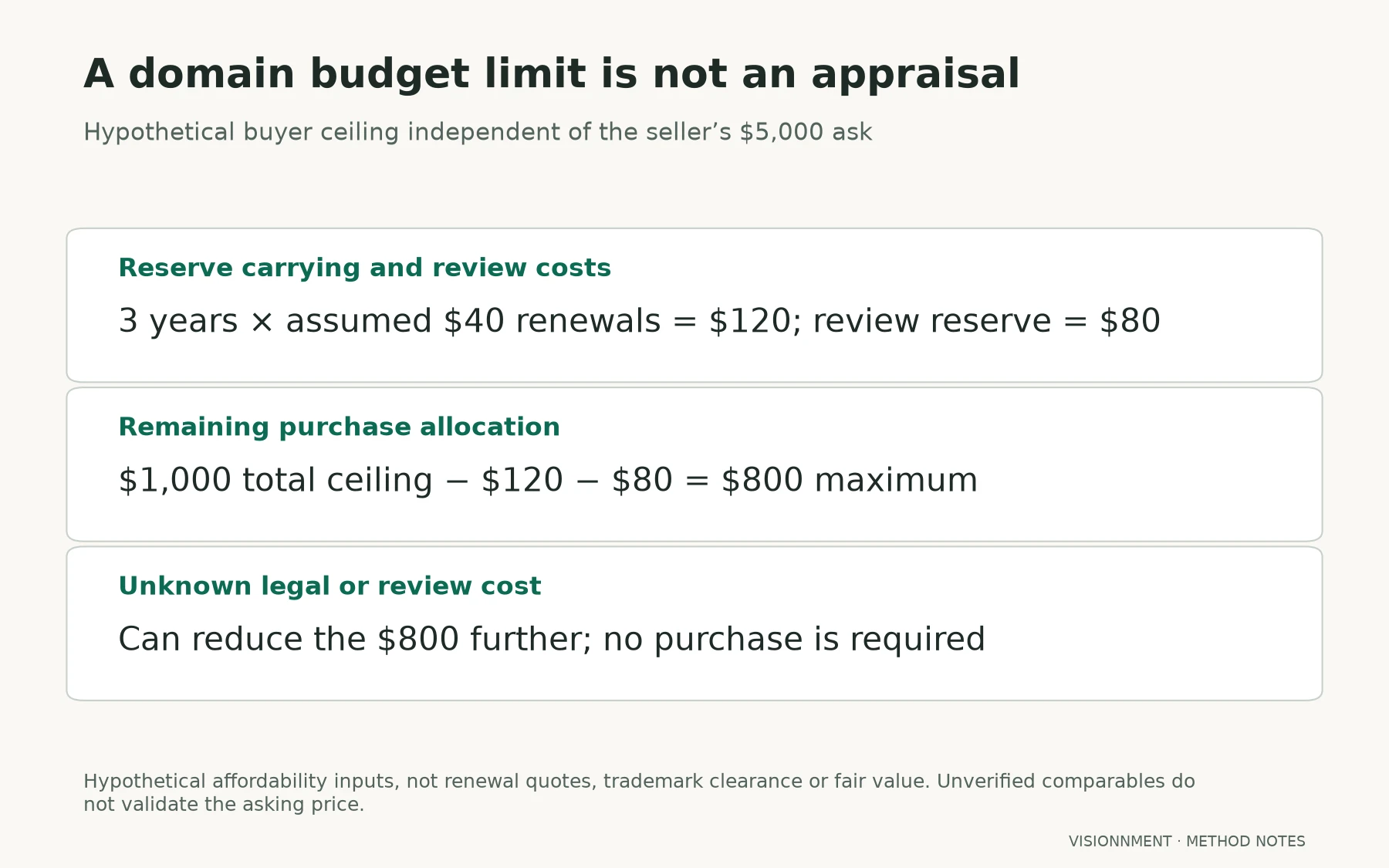
The hypothetical buyer chooses a total ceiling of $1,000 independently of the seller's $5,000 ask. They reserve $120 for three years of assumed $40 renewals and $80 for assumed closing and review costs.
$1,000 − $120 − $80 = $800 remains for purchase, before any unresolved legal or additional review cost.
| Hypothetical allocation | Amount |
|---|---|
| Total ceiling | $1,000 |
| Three assumed renewals | −$120 |
| Assumed closing/review reserve | −$80 |
| Remaining purchase allocation | $800 maximum |
These are invented budget inputs, not current renewal or provider quotes. Obtain the actual extension's initial, renewal and any relevant premium pricing. Unknown legal costs can reduce the $800 further.
Include development and operating costs separately if the intended use needs a website or service. A domain purchase alone does not fund the business that will use it.
7. Plan registrar, DNS and email acceptance
Prepare the destination account, supported transfer sequence, ownership verification and renewal responsibility. Separate registration control from DNS configuration, hosted content and email continuity.
If the name already serves a business, inventory records and dependencies before changing them. A registrar transfer can succeed while email fails because necessary records were removed. Use an appropriately qualified operator and a rollback plan where relevant.
Write acceptance conditions for the actual perimeter: domain control, correct destination, preserved required services and evidence of completion. An appraisal and traffic forecast do not belong in the same short acceptance test as registrar control.
Use the actual payment and inspection instructions with advisers. Do not assume silence prevents release indefinitely or that a domain can always be returned without complication.
Before offering, reconcile two independent blockers: legal uncertainty and transfer feasibility. A favourable appraisal cannot cure either, and a registrar confirming a supported transfer does not resolve trademark questions. If a material review cost remains unknown, reduce the available offer allocation or wait rather than spending the reserved amount first. Record the reason for choosing another name as clearly as the reason for buying.
Choose an offer, another name or no purchase
Record evidence quality, rights questions, transfer conditions, full costs and the maximum you can fund. An offer at or below $800 in the example is still optional and may be inappropriate if material questions remain.
The Flippa buying guide and platform review address the separate marketplace route. If suitable, explore Flippa and confirm current domain-sale terms. Public Flippa referral terms require at least a $5,000 listing price and other eligibility conditions; do not change an honest offer to fit a publisher incentive.