
Affiliate disclosure: Visionnment may earn a commission from qualifying referrals to Empire Flippers, including eligible seller or buyer referrals under its programme terms. That commercial relationship does not determine our analysis. Referral eligibility and payment depend on the provider's current conditions.
The useful Empire Flippers vs Acquire.com comparison starts with the same business, transaction structure and required support. A lower published fee can leave a different amount of work with the seller; a managed route still leaves legal, financial and operating questions for the parties to resolve.
Use this method to choose the next investigation, not to declare a universal winner. Public terms reviewed on November 16–17, 2026 provide a dated starting point. No account, private quote or completed acquisition was tested.
You need a business description, trailing financials, ownership and rights information, expected transaction size, cash-versus-contingent structure and a list of work you can perform yourself. The worked $300,000 SaaS sale below is hypothetical.
1. Define one comparable transaction
Write a single-page deal description before contacting either provider. Include the model, revenue and profit periods, owner workload, customer concentration, technical dependencies and preferred sale structure. Identify whether the price includes stock, receivables or other assets.
For the fictional SaaS, assume an established subscription product, documented earnings and an assumed $300,000 asking and closing price. The seller wants help coordinating buyer conversations and technical handover, but will retain independent legal and accounting advisers.
Do not compare this with a pre-revenue project on another route and call the fee difference a platform advantage. Eligibility, buyer expectations and the acquired evidence are different. Likewise, a share transaction and an asset purchase can require different documents and approvals even when the displayed price matches.
Record non-negotiable constraints. A founder unable to answer technical diligence needs a qualified technical lead, regardless of which marketplace is selected. A hard cash need cannot safely be matched to a hoped-for earnout without considering the collection risk.
The output is a consistent request that both providers can answer. If their quotes cover different deliverables, reconcile the difference before comparing totals.
2. Check eligibility before calculating fees
The Empire Flippers requirements page states earnings, revenue-history and analytics conditions, alongside model-specific and discretionary criteria. Its reviewed earnings gate is at least $2,000 monthly net profit averaged over the last twelve months. That is one necessary screen rather than acceptance of the fictional SaaS.
Acquire.com's seller FAQ, carrying a July 2023 update date, describes operating revenue-generating models including SaaS, ecommerce, Shopify apps, mobile apps and marketplaces. Use its dated scope cautiously and confirm the actual current category. Unlike Empire Flippers' stated twelve-month earnings/history screen, Acquire's detailed pre-revenue route can consider certain functioning products without an established revenue business.
The detailed pre-revenue policy allows functional SaaS or AI products: live, usable, transferable and solving a defined problem. It excludes mere ideas and pre-revenue ecommerce, services, marketplaces and content projects. Approval remains discretionary. It describes conservative pricing as often below $25,000; that is not the same as an unconditional hard cap. The older FAQ instead says SaaS-only and below $25,000. Preserve that first-party conflict and obtain confirmation for a pre-revenue application rather than silently choosing the more permissive wording.
Our fictional $300,000 sale concerns an established SaaS, so it should not be evaluated through a starter-project exception. The asking price alone still establishes neither the earnings history Empire Flippers needs nor the revenue needed for Acquire's enhanced service.
Ask each provider the same questions: is this business model supported, what evidence is required, which service route applies, what buyer access is available and which conditions could prevent listing or closing? Request answers about the actual business rather than a generic assurance that online businesses are welcome.
If one route declines the asset, record why. A history shortfall may support waiting while building evidence. A restricted category or non-transferable critical entitlement can require a different decision. Relabelling a business does not cure either issue.
3. Build a dated fee worksheet
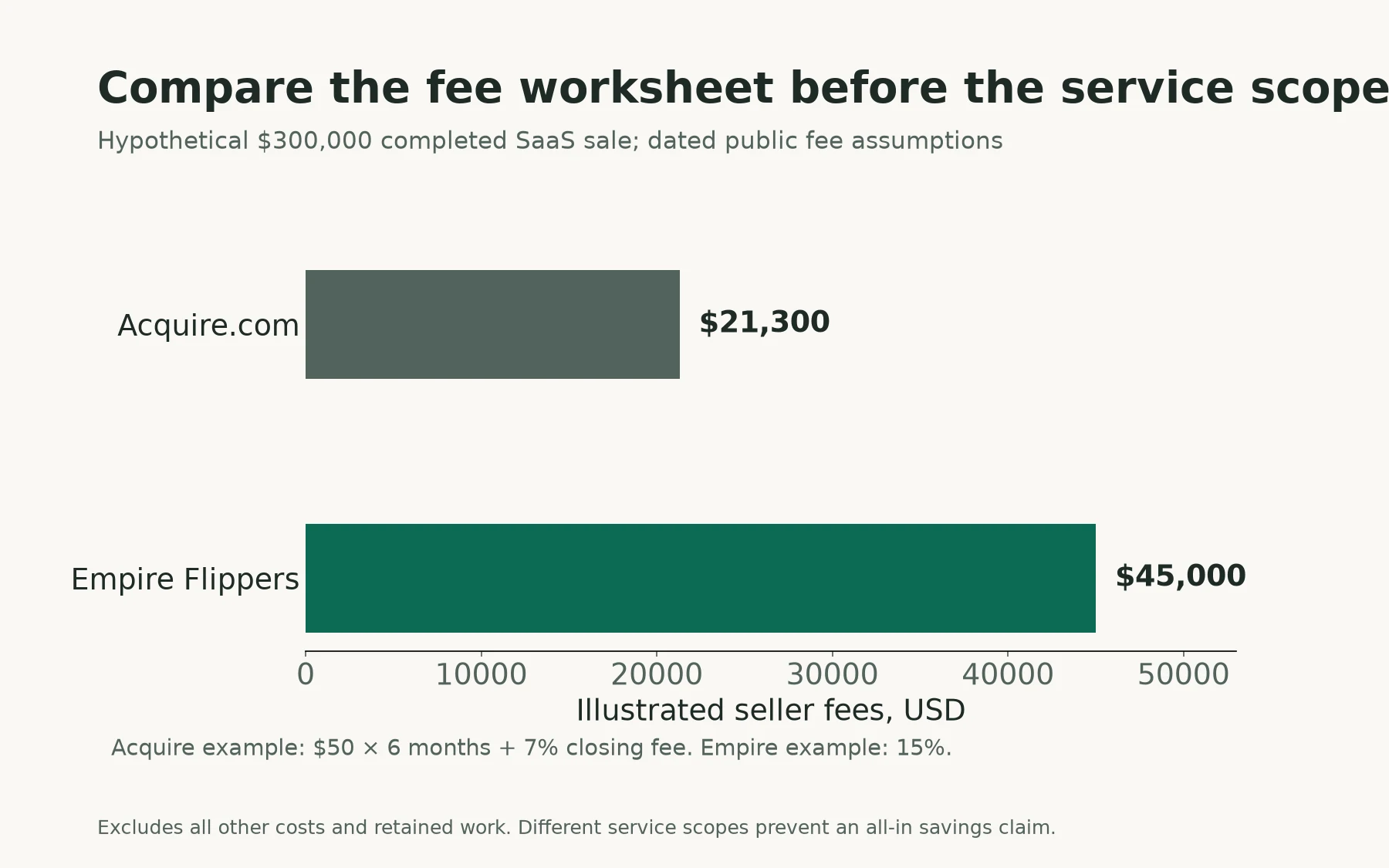
Acquire.com's seller pricing reviewed for this comparison shows a $50 monthly listing fee and 7% closing fee in the asking-price band containing $300,000. Its fee help page explains that listing and closing fees are distinct. Confirm the actual band, transaction-value definition and route before relying on the calculation.
Empire Flippers' public valuation and commission explanation describes a 15% commission on sales up to $700,000, with a minimum and lower progressive rates above that band. The example here stays inside the 15% band.
| Hypothetical $300,000 sale | Calculation | Limited total |
|---|---|---|
| Acquire.com listing for six months | $50 × 6 | $300 |
| Acquire.com closing fee | $300,000 × 7% | $21,000 |
| Acquire.com combined illustrated fees | $300 + $21,000 | $21,300 |
| Empire Flippers illustrated commission | $300,000 × 15% | $45,000 |
The arithmetic difference is $23,700. It is not demonstrated savings for a real transaction. Six months is an assumption, not a predicted sale time, and the assumed closing price equals the asking price only to make the comparison readable.
These totals exclude every other cost: legal and accounting work, tax, financing, stock or working capital, transfer costs, ongoing operating costs, owner time and any route-specific extras. A buyer's access costs are also separate from a seller-fee comparison.
Ask how fees apply to deferred consideration, a changed asking price, a partial sale, cancellation or a deal sourced during an exclusivity period. Leave a question open if the public page does not resolve it. Do not fill a contract gap with a general marketplace slogan.
4. Assign the work explicitly
Make a responsibility table for preparation, marketing, buyer screening, financial questions, technical questions, negotiation, documents and transfer. In each row, name the accountable party and the expected deliverable.
Empire Flippers' selling guide describes vetting, buyer communication, negotiation support and migration. Acquire.com's seller-fee guidance describes listing support, advisers, buyer marketing and transaction resources. These are provider descriptions of their services, not evidence that every task will be done for every seller.
Acquire's current seller-pricing page describes baseline listing tools, metrics integrations, legal-document builders, escrow and customer-success guidance. Its Guided by Acquire service is a more hands-on M&A advisory route for profitable SaaS businesses with at least $100,000 in trailing twelve-month revenue. Keep that condition separate from the general included help. A $300,000 asking price does not prove the fictional seller qualifies; verify actual revenue, profitability and service acceptance before comparing a Guided scope with Empire Flippers' managed route.
For the fictional SaaS, ask who reproduces the application deployment, who verifies subscription continuity and who answers a disputed revenue-recognition question. If the answer is “the seller,” price the work and identify the person who can perform it.
Do not subtract an imagined value of saved labour from one fee total. Estimate actual required hours and obtain a quote where specialist work is necessary. Some support may reduce coordination while leaving the substantive verification unchanged.
A route fits when its service boundaries match the seller's capacity and the deal's needs. A polished dashboard cannot replace missing authority to assign a customer contract or missing rights in the source code.
5. Compare buyer access, diligence and closing controls
Ask what a buyer can inspect publicly, what requires identity or funds verification, when confidentiality applies and how information is shared. Access controls can protect a business, but their presence does not prove earnings or eliminate the buyer's diligence responsibility.
Walk the transaction in order: initial information, authorized deeper access, offer, adviser review, financial and technical diligence, agreed documents, funding, transfer, acceptance and payment release. Identify the evidence needed to move from one step to the next.
For a SaaS sale, separate code delivery from an operable deployment and subscription continuity. A buyer receiving a repository has not necessarily received supported hosting, billing, domain control or customer permissions. List each dependency and its acceptance condition.
Read escrow and agreement provisions for the chosen route rather than assuming all platforms provide the same protections. Confirm deadlines, deficiency handling, who authorizes release and what happens to unfunded later payments. Independent counsel should review the actual transaction structure and governing terms.
If a provider cannot state who handles a material task, treat the work as unresolved. The next action may be a clarified quote or specialist engagement, rather than choosing the lower headline percentage.
6. Record a conditional choice
End the comparison with a short decision note: the business is eligible subject to named review, the selected service covers specified tasks, the seller retains specified work and the remaining quote questions have owners.
For the fictional SaaS, Acquire.com's illustrated lower fees might justify deeper investigation if the founder can perform the retained diligence and coordination. Empire Flippers may merit investigation if its current managed service fits the business and reduces a real capacity gap. Neither conclusion follows from the fee table alone.
Keep a no-sale option. Repairing records or reducing owner dependence before approaching buyers may fit better than either immediate listing. The broader digital-asset marketplace comparison helps when the business belongs to a different category or scale.
If the business qualifies and its support needs fit, explore Empire Flippers and request the applicable route and quote. Compare that response with Acquire.com's current offer using the same deal description.
Common questions
Is Acquire.com always cheaper?
The dated example has lower illustrated seller fees. Different asking-price bands, durations, structures, extra work and quotes can change the comparison. No universal all-in conclusion follows.
Does a managed route replace my advisers?
No service description establishes that your financial, legal, tax or technical questions have been independently resolved. Assign those responsibilities before accepting a transaction timetable.
Which comparison result is strong enough to act on?
A dated, business-specific eligibility answer and quote with clear responsibilities. Use that to choose the next diligence step; retain the option to stop if the underlying asset or transaction is unsuitable.