
To buy a pre revenue software project, verify what it can do, what rights you receive and what it will cost to make useful. A working demo does not establish customers, revenue, profitable acquisition or a transferable operating business.
Compare the purchase with an equivalent rebuild or commissioned result, then design a separate customer-validation test. You need an agreed capability description, authorized code and dependency access, rights records, a controlled test environment and a complete cost comparison.
The $500 project below is hypothetical. No third-party project was reproduced, security-tested, purchased or sold. The example teaches an acceptance process and leaves demand evidence unknown.
1. Separate a working project from proven demand
Describe the acquired object concretely: source code, documented build, design files, domain, data, supported integrations or other specified deliverables. Distinguish included assets from services the seller merely uses under their own account.
Then list business evidence separately. Are there actual paying customers, repeated accepted outcomes, acquisition records or support history? If not, state that the object is pre-revenue and the commercial job remains unproven.
Flippa's starter-site advice provides context for buying capability without an established operating result. Marketplace visibility does not turn a starter project into a proven business.
Avoid giving a demo an earnings multiple based on imagined future customers. Replacement capability and a bounded validation plan are more relevant at this stage than annualizing nonexistent subscriptions.
If the seller's description blends actual features with a roadmap, separate them before pricing. A promised integration belongs in future work unless the agreed acceptance test can demonstrate it now.
2. Reproduce the claimed capability safely
Write a small set of acceptance tasks. For a fictional reporting application, these might be installing from the agreed repository, loading authorized synthetic inputs, producing a specified output and handling an expected failure. Define success before the demonstration.
Use a controlled environment and obtain permission for the scope. Avoid connecting the project to live customer systems or payment accounts just to see whether it runs. A demonstration should not create real billing, disclosure or destructive actions.
Ask a competent specialist to check that the inspected source produces the demonstrated build. Record version, dependencies, environment requirements and manual steps. A seller's running hosted instance is not proof that a buyer can reproduce it.
The OWASP Web Security Testing Guide is a source for structured security-testing approaches. A small reproduction check is not a penetration test, security certification or complete code audit. Define the actual specialist scope and remaining limits.
If the build fails, document the failed task and cause if known. Request a repair, change the scope or stop. Do not treat a video of the seller's environment as acceptance of an unreproducible deliverable.
3. Trace code, data, design and dependency rights
Create a rights register for original code, third-party libraries, assets, fonts, data and commissioned work. Record creator or owner, licence or assignment, relevant version and restrictions. Include components outside the repository.
GitHub's dependency-graph documentation describes a useful source of supported dependency information. A dependency graph is an input, not a complete runtime inventory or legal clearance for every component.
Inspect manifests and lockfiles alongside the deployed services. A library can have a licence different from the seller's own code. A dataset or stock image can carry separate use and transfer limitations. Obtain qualified advice for material uncertainty.
For commissioned contributions, examine the actual agreement. Payment does not by itself establish all required commercial or assignment rights. Ask what background materials the contributor retained and what the buyer needs to use, modify and distribute the project.
If rights are unresolved for a core component, preserve the dependency and replacement question in the cost model. Do not call the issue harmless merely because the code is publicly downloadable.
4. Map services, billing and continuing support
List hosting, authentication, email, storage, payments, analytics, APIs and any other external capability. For each, record account owner, contract, plan, usage, credentials, supported transfer or replacement route and current cost evidence.
Source-code delivery does not move the seller's service agreements. A free trial may expire or lack the capacity the demo assumes. A personal API entitlement may require a new application or replacement rather than a login handover.
Identify who can operate the project after purchase. Include updates, backup, incidents, customer support and third-party changes. Price specialist work the buyer cannot perform rather than valuing it at zero.
Ask how the software handles failed dependencies and missing configuration. A controlled test should show the agreed failure path, but it cannot prove every future outage will be handled correctly.
If a critical service is unknown, leave the capability conditional. The buyer needs a bounded route to useful operation before treating the project price as the main cost.
5. Compare buying with a matched rebuild
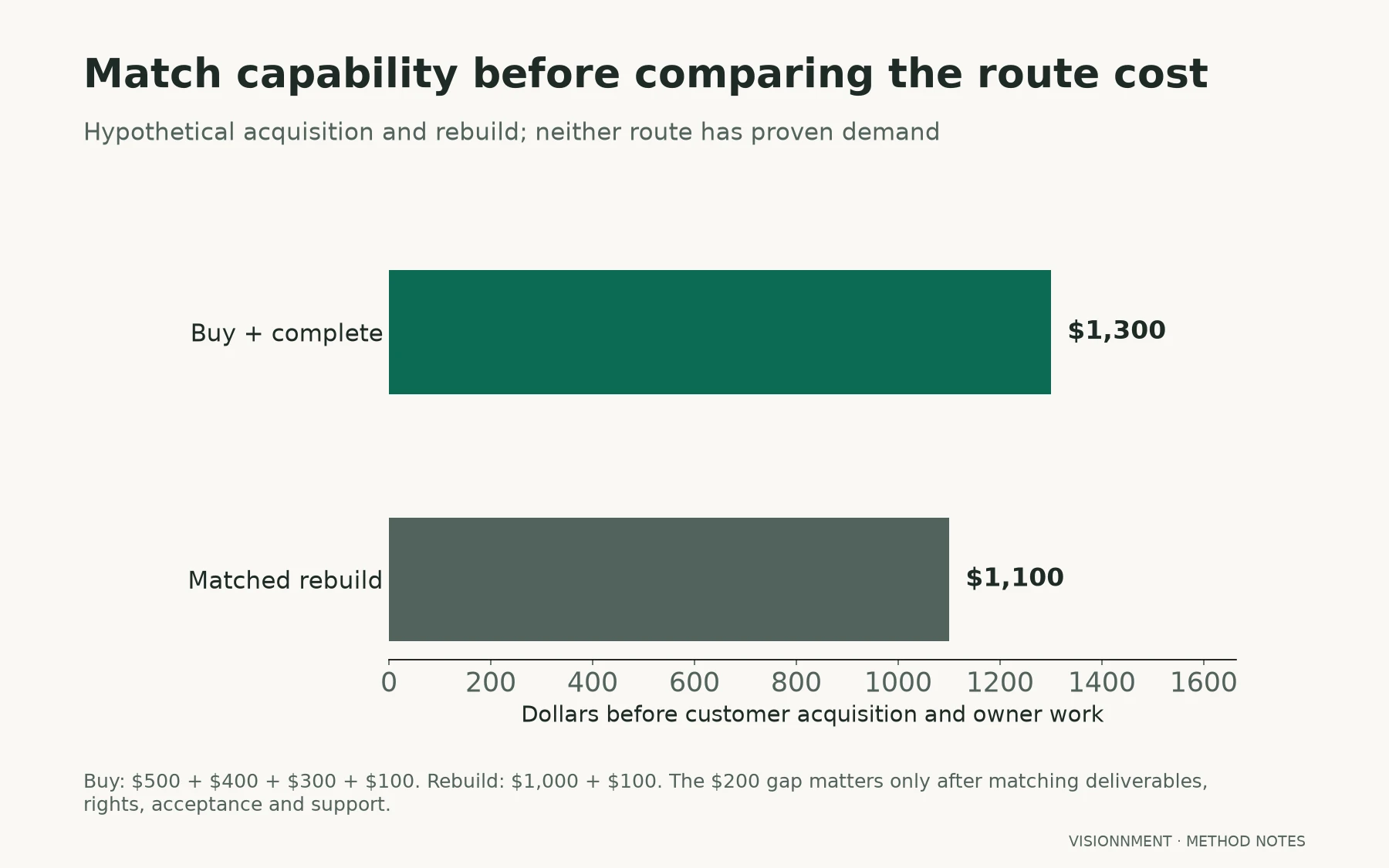
The hypothetical purchase price is $500. Add $400 for a controlled specialist reproduction review, $300 for a missing integration and $100 of first-90-day service costs.
| Hypothetical purchase route | Amount |
|---|---|
| Project price | $500 |
| Specialist reproduction review | $400 |
| Missing integration | $300 |
| First-90-day services | $100 |
| Limited total | $1,300 |
An alternative quote is $1,000 to rebuild the matched capability plus the same $100 services, or $1,100. The apparent $200 difference is meaningful only after matching deliverables, rights, documentation, integration, acceptance and support.
These totals exclude customer acquisition and owner work, both still unknown. They also do not establish that the quoted scope is complete or that either provider will deliver successfully. Compare timelines and failure or revision terms through the actual agreement.
Do not compare a documented working purchase with an informal “I could code that” estimate. Likewise, do not give the purchased project credit for features the rebuild scope excludes. Use the build-versus-buy guide to keep the desired outcome consistent.
If neither route fits your capital or skills, no purchase is a valid result. A low sticker price does not justify an open-ended repair obligation.
6. Keep marketplace categories separate from project acceptance
Flippa's listing-pricing rules and prohibited-business guidance contain public category and limitation information. That does not approve an individual project or establish its rights, security or economic value.
The detailed Projects/Concepts rule linked in the reviewed research was inaccessible. General Site Rules are different material and do not supply the missing detailed acceptance terms. Confirm the actual route instead of inventing an approval checklist.
Do not raise a project price or misstate maturity to fit a referral incentive. Flippa's public referral terms require at least a $5,000 listing price and other eligibility and actual qualifying-event conditions. Useful smaller-project learning can remain useful without a commission.
Accept the acquired capability first, then validate whether appropriate customers will use and pay for its result. If either stage fails, record the unresolved condition and stop or narrow the plan.
7. Plan the smallest credible customer-validation test
Once the capability is accepted, identify a real customer job and the current workaround. Ask appropriate prospects what triggers the need, how they handle it and what result would justify switching. A polite response is not a paid customer.
The SBA business-planning resources support organizing demand and cost questions. They do not establish that this project's audience exists or that a particular test size guarantees validation.
Define a truthful, bounded pilot with an accepted output, support scope, time and cash limits, and a review date. Do not promise production reliability or integrations that the project has not demonstrated. Keep any payment and data handling within supported and authorized arrangements.
Record prospects, agreed pilots, delivered outcomes, actual payments, repeated use and support separately. A demo that runs still has no revenue until a real qualifying transaction occurs, and one payment does not establish durable retention.
Use the SaaS first-customer guide for the next commercial learning task and the SaaS asset guide for the broader operating framework.
Accept the capability or stop with the unresolved record
Finish with a signed-off deliverable list, reproduced tasks, rights register, service map, matched alternatives and remaining risks. State who checked each part and the limits of that review. A file transfer alone is insufficient.
Choose purchase, request a specific repair, commission an equivalent result or stop. Keep customer demand in its own evidence track. The strongest outcome is a clear view of what you would own and operate, including what the attractive demo has not yet proved.