
A mobile-app acquisition transfer checklist must cover more than the store listing. Developer-account authority, source code, subscriptions, authentication, analytics and infrastructure can follow different routes. An app that remains downloadable can still depend on services controlled by the seller.
Create a transfer matrix before closing. Gather both developer-account identities, app identifiers, current platform criteria, subscription configuration, source and build assets, connected services and historical reports. Involve the authorized account holders, developer, operating owner and relevant advisers. The worked register below is hypothetical; no app was transferred, built, charged or tested for this article.
Verify both accounts and the current app-transfer criteria
Choose the correct store route for each app. Apple’s transfer overview requires the app to meet its transfer criteria and assigns initiation and acceptance to the respective Account Holders. A person with limited development access may not have the authority needed to perform those steps.
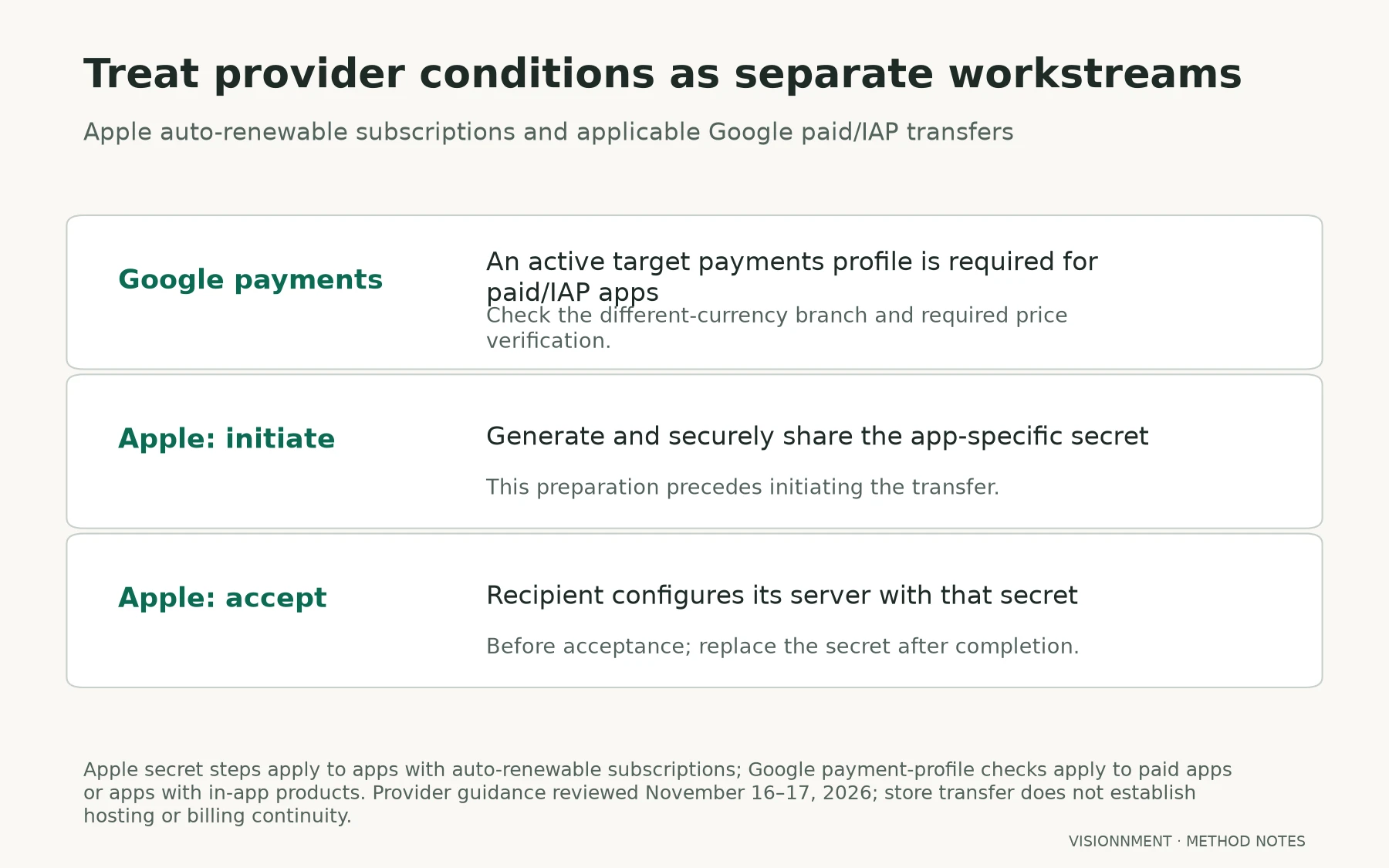
Google Play’s transfer guide, reviewed November 16, 2026, requires registered, active original and target accounts. For paid apps or apps with in-app products, the target account must have an active payments profile. Record that buyer prerequisite before scheduling the request; signing in alone does not establish payment readiness.
The same guide separates the different-default-currency branches:
| Google Play configuration | Published condition to plan for | Acceptance record |
|---|---|---|
| Paid app or in-app products | Active payments profile in the target account | Authorized buyer confirms the target profile is active |
| In-app-purchases-only app; target default currency differs | Google applies currency updates and unpublishes the app after transfer until it is published again | Buyer verifies updated target-account prices, then republishes through the supported process |
| Paid app; target default currency differs | Google automatically applies default-currency updates to app prices | Review the updated prices; do not import the in-app-only unpublishing branch into every paid-app transfer |
Keep pricing and availability acceptance open until the applicable checks are evidenced. This is a dated provider process, not a promise of uninterrupted availability or a transfer performed for this guide.
Record the app’s exact bundle or package identifier and the account currently controlling it. Match the store listing to the source repository and production services. A similarly named project is not evidence that the buyer will receive the code producing the current app.
List capabilities that create special requirements. These can include subscriptions, authentication, payments, cloud services, testing and signing. Have the developer examine the actual app configuration against the current store documentation. The presence of an acquisition category on a marketplace does not override the platform’s criteria.
Keep rights review separate. Store-transfer eligibility does not establish ownership of every library, design, dataset or trademark. Qualified advisers should review material intellectual-property and contract questions, while technical reviewers verify the build and service dependencies.
Back up the reports and identifiers that may not move
Inventory historical records before initiating the store change. Identify what the seller must retain, what the buyer needs for diligence and which reports will be available afterward. Export through authorized routes with appropriate privacy and retention controls.
Google’s guide says some historical export, payout and earnings reports do not move with the app. It also distinguishes historical orders from the information transferred to the target account. Preserve the necessary records and supported refund route before access changes.
Apple’s overview describes different visibility for sales, payment and analytics information after transfer. Do not assume the recipient receives every historical financial report merely because the app’s public listing remains available. Define the accounting evidence each party needs and preserve it lawfully.
Save identifiers and configuration references in the transfer matrix. Include the app identifier, subscription products, relevant project identities and the source revision used for the current release. Keep secrets in an approved secure channel rather than placing them in the general register.
Record the export date, time zone and reporting period. A payout received after transfer can relate to an earlier sales period. Without that distinction, the buyer can mistake historical settlement for newly earned income and the seller can lose the evidence needed for reconciliation.
Map subscriptions, entitlements and linked services
Start with a customer’s complete service path: installation, sign-in, purchase or renewal, entitlement, use and support. Identify the system responsible for each step. An app-store subscription record does not by itself prove the back-end service recognizes the customer correctly.
Apple’s transfer overview, reviewed November 16, 2026, says apps offering auto-renewable subscriptions must use an app-specific shared secret. Its order matters:
| Apple subscription stage | Required app-specific preparation | Responsible role |
|---|---|---|
| Before initiating transfer | Generate the app-specific shared secret and share it securely with the recipient, then initiate | Transferor’s authorized account holder/developer |
| Before accepting transfer | Obtain that app-specific secret and update the recipient’s servers to use it for verifying auto-renewable subscriptions | Recipient’s authorized account holder/developer |
| After transfer completes | Generate a replacement app-specific shared secret so people outside the recipient’s organization no longer have access to it | Recipient’s authorized developer |
Use secure configuration references and handover confirmations as matrix evidence, not the secret itself. Do not substitute an account-wide secret covering unrelated apps. Plan supported receipt-verification checks and reconcile the server configuration with the replacement after completion. No secret was generated, shared or tested here.
Apple also identifies capability-specific issues involving services such as Sign in with Apple, keychain sharing and Apple Pay. Review only the capabilities the app actually uses, then create their own acceptance tasks. A working installation before the next update may not establish continuity after that update.
Google’s guidance distinguishes app transfer from linked service permissions and configuration, including analytics, cloud projects, Firebase and advertising integrations. Map those dependencies explicitly. Their ownership and linkage do not all change automatically when the app moves between developer accounts.
Use this hypothetical matrix:
| Dependency | Current condition | Buyer requirement | Acceptance evidence |
|---|---|---|---|
| Store listing | Seller account | Supported transfer accepted | Correct recipient and identifier |
| Subscriptions | Existing customer products | Supported continuity configuration | Authorized entitlement and renewal checks |
| Authentication | Seller-linked service | Buyer-controlled supported route | Existing-user access plan verified |
| Analytics | Separate project | Appropriate buyer permission | Expected data access confirmed |
| Hosting | Seller infrastructure | Approved operational control | Recovery and deployment evidence |
In the fictional case, the listing moves while hosting remains seller-controlled. The store workstream can be complete while operating acceptance remains open. Label that precisely rather than marking every dependency green because users can still download the app.
Assign sender, recipient and developer responsibilities
Name the person performing each action and the person approving it. Separate account-holder steps from developer configuration and financial reconciliation. Include a backup contact and the support route for blocked platform actions.
Build the sequence from the actual requirements. Historical exports may need completion before the seller loses access. Connected-service preparation may precede the store request. Certain post-transfer configuration should follow the supported platform order. Do not invent one universal sequence for Apple and Google.
Ask the developer to identify the artifacts needed for maintenance: repository, build instructions, dependencies, signing arrangements, release process and environment configuration. Apple’s overview explicitly separates exchange of code and build assets from the store transfer. Possession of the listing is therefore an incomplete maintenance handover.
Document the seller’s bounded assistance commitment. Record the tasks, availability, secure channels and escalation process. Ask advisers to align material deliverables with the transaction agreement. An internal checklist does not create enforceable support rights or extend a closing deadline.
Include responsibility for historical refunds and disputes. Google’s guide explains that pre-transfer orders remain associated with the original account and describes supported refund access. Decide who will perform those actions and how their financial allocation is governed, without retaining unnecessary access to unrelated future activity.
Rehearse supported continuity and recovery checks
Prepare an authorized test design using appropriate non-production or platform-supported methods. Define expected installation, sign-in, entitlement, notification, update and recovery behavior. Where sandbox behavior does not prove live renewal or settlement, state the limit.
Trace both a new-user and an existing-user path where supported. Existing users may depend on identifiers, authentication mappings or entitlements that a fresh installation does not exercise. A successful new signup can therefore miss a material continuity problem.
Verify the maintenance route as well as customer access. The buyer’s authorized developer should be able to reproduce the relevant build and follow the supported release process. If source, licensing or signing questions remain, record them as unresolved conditions rather than treating a demonstration on the seller’s machine as sufficient.
Plan a failure response. Name who pauses an update, handles a broken entitlement or contacts the store. Identify which prior configuration can be restored and which actions cannot simply be undone. A rollback of back-end code does not reverse every store or account change.
In the hypothetical case, hosting control remains unresolved, so the team holds final operating acceptance. It verifies the supported buyer destination and recovery path before removing the seller’s essential access. This is a proposed coordination method, not evidence that a transfer or recovery test occurred.
Accept store presence, billing and operating control independently
Use separate acceptance notes for the listing, billing and operations. Store acceptance confirms the correct recipient and identifiers under the supported route. Billing acceptance addresses subscriptions, entitlements, historical obligations and settlement records. Operating acceptance covers maintenance, connected services, access and recovery.
Review the first authorized operating cycle against the matrix. Investigate discrepancies using identifiers and dates rather than assuming every problem resulted from the transfer. Preserve the distinction between a configured service, a safely tested behavior and an outcome still unobserved.
The website handover checklist coordinates the broader digital assets around these store-specific tasks. If an assisted purchase route is relevant, the Empire Flippers buying-process guide explains the surrounding acquisition stages. Neither grants platform approval or substitutes for the current app-specific criteria.
The completed matrix should make any remaining seller-controlled dependency visible even while the app remains available. That is the useful decision: what has actually moved, what can be operated and what still requires evidence. A supported transfer does not guarantee future downloads, subscription retention or business success.