
Mobile app monetization economics begins with the job a person wants completed and the obligation your charge creates. A one-time utility, an ongoing service and an advertising-supported app can have different cost and support patterns even when their download counts match.
Choose a bounded test after modelling gross payments, applicable store or programme fees, refunds, service use and support. Do not use one assumed app-store percentage for every country, transaction or programme.
You need a defined user task, applicable store terms, transaction records or a clearly labelled forecast, a service-cost model and an authorized test environment. The occasional-use utility and continuing service below are hypothetical. No app, purchase or subscription was tested.
1. Start with the occasional or recurring user job
Describe what the user receives, when the job is complete and why they might return. An export utility may complete a task in one session. A monitoring service may provide continuing alerts and stored history. Neither should inherit the other's charging model merely because subscriptions are fashionable.
Identify the ongoing obligation. Does the app need hosted processing, new data, customer support, security updates or compatibility maintenance? A one-time payment does not necessarily eliminate later work, and a subscription does not make every maintenance task valuable to the user.
For the fictional utility, the promise might be one authorized file transformation. For the service, it might be a continuing monitored workflow. Write acceptance conditions for both before choosing a price.
Apple's subscription guidance describes auto-renewable subscriptions and their continuing value proposition. It is a source for that programme, not an endorsement of turning every occasional feature into a recurring charge.
If you cannot state the difference between the initial deliverable and continuing value, repair the offer. A monetization experiment should not require misleading the user about why they will keep paying.
2. Compare advertising, one-time purchase and subscription
Evaluate how the mechanism interacts with the task. Advertising requires monetizable attention and may interrupt a short utility flow. A one-time purchase can fit a bounded deliverable but must cover its attributable costs. A subscription needs ongoing service that customers understand and can manage.
| Mechanism | Primary economic input | Obligation to inspect |
|---|---|---|
| Advertising | Eligible ad revenue under the actual arrangement | Usable experience and permitted data handling |
| One-time purchase | Net receipts per accepted purchase | Delivery, refunds and continuing compatibility |
| Subscription | Retained recurring payments | Continuing value, billing and cancellation |
Do not compare advertising revenue per thousand impressions with subscription revenue per customer without a complete user-level bridge. Likewise, cumulative installs are not paying users or monetizable active sessions.
For the utility, inspect whether the paid transformation delivers accurately and promptly. For the service, inspect whether the monitoring outcome continues after initial setup. A user opening the app is not proof that either promise was fulfilled.
If two models require materially different products, compare their full development and support scope. A subscription test that depends on building an entirely new service is not a simple pricing experiment.
3. Use actual store and billing definitions
Record the store, country or storefront, product type, applicable programme, eligibility and current terms. Then identify the fee or proceeds rule that applies to the actual transaction. Preserve the distinction between customer price, store deductions, developer proceeds and bank settlement.
Apple's subscription documentation explains how proceeds can depend on subscription history and programme circumstances. Do not turn those conditions into a global flat rate. Confirm the terms applicable to your developer account and territory before projecting receipts.
Keep refunds, taxes and currency effects separate where the reports do. A store report may define proceeds differently from a gross sales chart. Read the report definitions rather than subtracting a guessed percentage twice.
Use a transaction worksheet:
| Field | What to enter |
|---|---|
| Customer payment | Actual gross amount and currency |
| Applicable deductions | Current rule or statement evidence |
| Refund or reversal | Actual event and attribution period |
| Service consumption | Matched direct delivery cost |
| Support | Actual time or explicit forecast assumption |
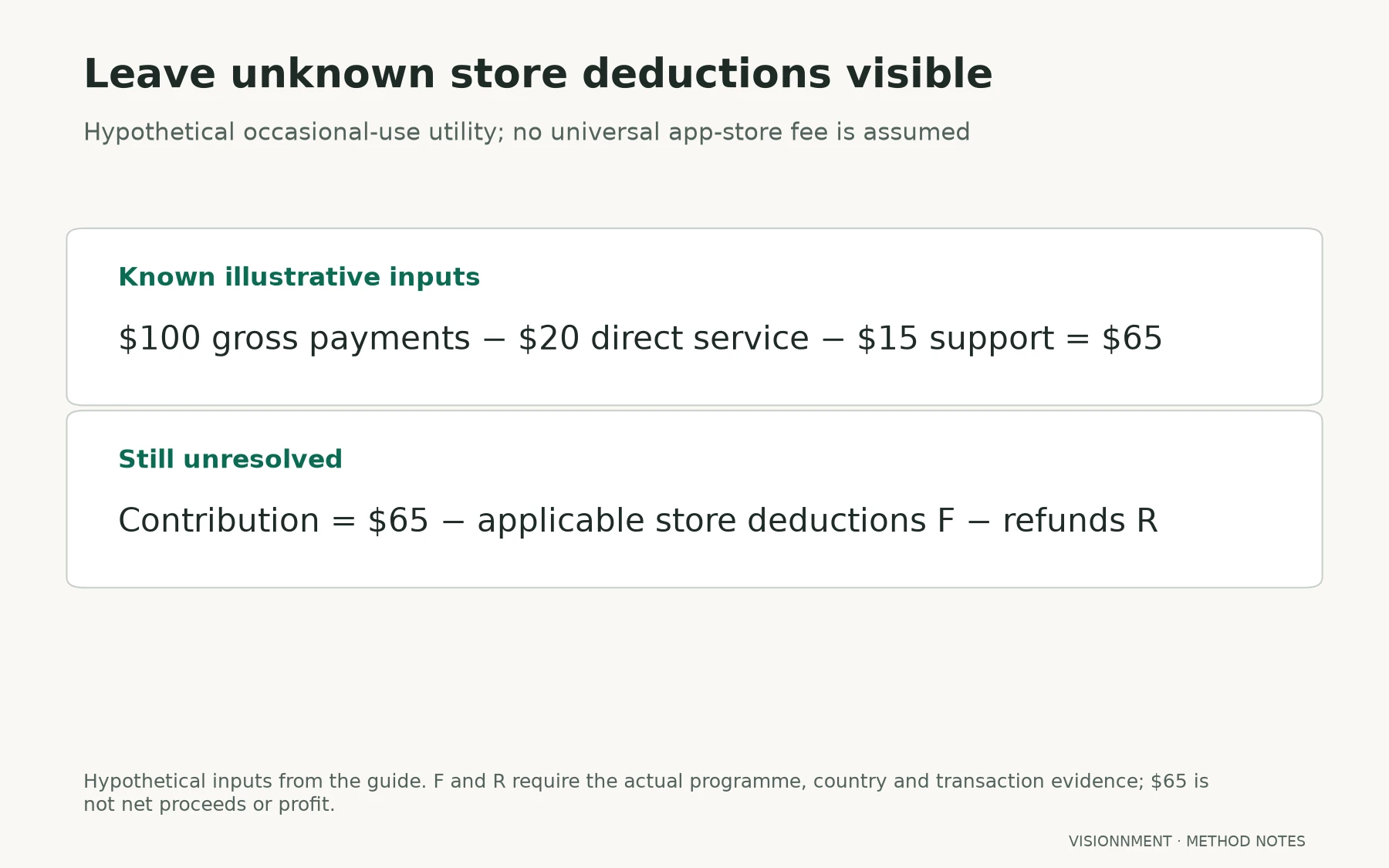
If the programme or country rule is unresolved, leave the relevant deduction unknown and request confirmation. Precise-looking net revenue built on an invented fee is weaker than an honest incomplete model.
4. Model contribution by equally mature cohorts
Group users by a defined acquisition or first-payment period and observe them for the same elapsed time. Separate first purchase, renewal, cancellation, failed payment and refund. Download counts do not provide this economic history.
For an illustrative worksheet, suppose the utility has gross customer payments of $100, applicable store deductions represented by F, refunds by R, direct service cost of $20 and support valued at $15. Contribution before other costs is $65 − F − R. F and R stay unresolved until the applicable evidence exists.
For the continuing service, repeat the calculation for each observation period and sum only the periods observed. Do not assume six months of future renewals from the first payment. Price continuing hosting, data and support even if the initial code already exists.
Stripe's customer-lifetime-value discussion can frame forward-looking economics, but an LTV estimate is not lifetime value already achieved. Keep forecast retention assumptions beside the calculation and compare them later with collected evidence.
Inspect exceptions. A small set of high-support users or refunds can change the economics materially. Record the spread rather than hiding it inside an average that assumes every customer costs the same.
5. Check platform, service and data dependencies
Map the components that let the app fulfil its promise: store record, identifiers, source code, signing and release controls, authentication, analytics, hosted services and billing. Possessing source code or seeing an app in a store does not establish control over all of them.
For a buyer, use the provider's supported transfer route. Google's app-transfer guidance describes requirements and considerations for transferring apps. It does not make every connected service or customer entitlement automatically transfer with the listing.
List each dependency with its account owner, terms, ongoing cost, migration requirement and acceptance check. If a third-party API contract remains personal to the seller, mark continuity unresolved until the supported route is confirmed.
Inspect data permissions separately from technical access. Being able to copy a database does not establish the right to use it for a new purpose. Obtain qualified advice for jurisdiction-specific privacy and transaction questions.
If a critical service cannot follow the intended transaction, model an authorized replacement and test its capability. Do not value uninterrupted subscription earnings while leaving the service that delivers them unconfirmed.
6. Choose a bounded monetization test
State the audience, task, charge, entitlement, observation period and refund or support limits before implementation. Use supported non-production purchase testing to verify the workflow before real user charges. Do not experiment with live card actions merely to see whether a new setting works.
For the utility, acceptance might require purchase, transformation and receipt of the promised output. For the service, add continued delivery, renewal-state handling and a usable cancellation path. Verify the user-facing explanation as well as the developer dashboard.
Track the full path: eligible users, offer views, accepted purchases, delivered outcomes, refunds, support and net receipts. Keep the denominator consistent and record concurrent changes to acquisition or product behaviour.
If a test has a small sample or no controlled comparison, state the observed outcome and uncertainty. A few purchases do not prove that the model will scale, and a subscription start does not establish durable retention.
Choose keep, revise or stop based on accepted delivery and contribution. If a payment mechanism creates disproportionate support or confusion, repair the offer before inviting more users.
Preserve the earning mechanism for future decisions
Keep the product promise, applicable terms, economic definitions, cohort records and dependency map together. The app metrics guide provides the related measurement context; do not substitute installs or updates for accepted customer outcomes.
When you eventually prepare the asset for sale, show what the buyer must operate and fund to preserve earnings. A recurring line becomes more understandable when the associated continuing work is explicit.
Common questions
Is subscription revenue inherently more valuable?
The label alone does not establish retention, contribution or transferability. Inspect the useful continuing service and its evidence.
Can a one-time app avoid future support costs?
Only if the actual promise and operation support that conclusion. Compatibility, refunds and security work may continue after purchase.
What should I do when fees are unclear?
Confirm the current programme and transaction scope. Keep the model conditional until the applicable statement or provider terms resolve the deduction.