
A payment-processing fee audit should explain what accepting payments costs on the business’s actual transaction mix. A lower percentage rate can still produce a higher total bill. Fees, refunds, reserves and delayed settlement also affect different parts of the financial picture, so calculate operating cost and available cash separately.
You will need the applicable agreement, pricing schedule, transaction export, disputes, refunds, processor balance movements, payouts and bank records. Add subscription-platform and payment-related app invoices where relevant. The goal is a reproducible comparison and a safe operating decision, not a recommendation to switch providers based on a headline rate.
Collect the applicable country and product agreement
Record the merchant entity, account country, settlement currency and payment products in use. Identify whether the business accepts domestic cards, international cards, wallets, bank payments or subscriptions. An advertised rate from another country or product is not a quote for this account.
Stripe’s pricing page is a starting point for identifying charges and additional products. Confirm the relevant regional page and any negotiated agreement. Do not assume that a familiar brand has one global price or that a public schedule overrides the merchant’s actual terms.
For PayPal, use the agreement governing the particular account. The United States user agreement applies to U.S. accounts and incorporates additional terms and fee information. Its scope should remain explicit rather than becoming a statement about every PayPal merchant worldwide.
Save the quote date, effective date, renewal conditions and exclusions. Record monthly minimums, fixed charges, currency conversion, cross-border pricing, disputes and payment-method differences where applicable. Mark unknown terms for clarification. Zero is a cost assumption, so do not enter it merely because a quote omitted a field.
Join transaction, dispute and payout records
Choose a reporting period and currency. Begin with gross payment transactions, then link refunds, dispute events, fees, processor adjustments and payouts using their identifiers. Keep original transaction dates as well as payout dates. Settlement in another month should not turn into a missing sale.
Reconcile the opening processor balance plus receipts and adjustments, less refunds, fees and payouts, to the closing balance. Then match the payout total to the bank, explaining currency or timing differences. This is a control schedule; accounting classification remains a separate review.
Distinguish an unsuccessful payment attempt from a captured payment. Count the transactions relevant to the proposed pricing model, including any separately charged events. A fee quoted per successful transaction cannot be compared accurately using the count of checkout visits or authorization attempts.
For disputes, retain the original payment, amount disputed, fee, outcome and recovery. Separate the reversal of revenue from the fee charged for managing the dispute. Treating both as processing fees can obscure the commercial reason the business lost money.
Where the export lacks a stable joining key, document the matching rule and remaining exceptions. A guessed match that makes the total balance is weaker evidence than a clearly identified unresolved row. Preserve enough detail for a reviewer to reproduce the calculation without accessing unnecessary customer information.
Separate processing, currency, subscription and exception costs
Build cost categories before calculating one effective rate. Include core processing, fixed transaction charges, currency conversion, cross-border charges, recurring-billing products and applicable exception fees. Keep platform or app subscriptions visible even if a different company invoices them.
Shopify’s app-billing documentation describes different app charging arrangements. Reconcile those invoices with payment-related functionality in use. A billing app charge can remain relevant to the payment workflow even when it does not appear in the processor’s transaction export.
Use two explicit measures. The processing-only rate equals defined core processing fees divided by the stated payment base. The all-in acceptance-cost rate uses the wider agreed cost boundary. Label both denominators and treatment of refunds. Neither is automatically the business’s profit margin.
Keep reserves outside the fee subtotal unless the evidence establishes an actual expense. A retained balance can reduce cash available without reducing accounting profit by the same amount. Track reserve additions, releases and restrictions in a separate cash bridge.
Similarly, a refund returns customer money and may have distinct fee treatment. Do not assume every provider refunds the original processing charge or applies the same rule to every product. Check the governing terms and reconcile the actual bill before drawing a comparison.
Compare an actual quote on the same payment mix
Use a historical transaction mix as a common input, then apply each actual quote’s complete rules. Hold transaction count, values, payment methods, countries, currency and dispute assumptions constant. Where a provider cannot serve part of the mix, show the gap instead of excluding the difficult transactions.
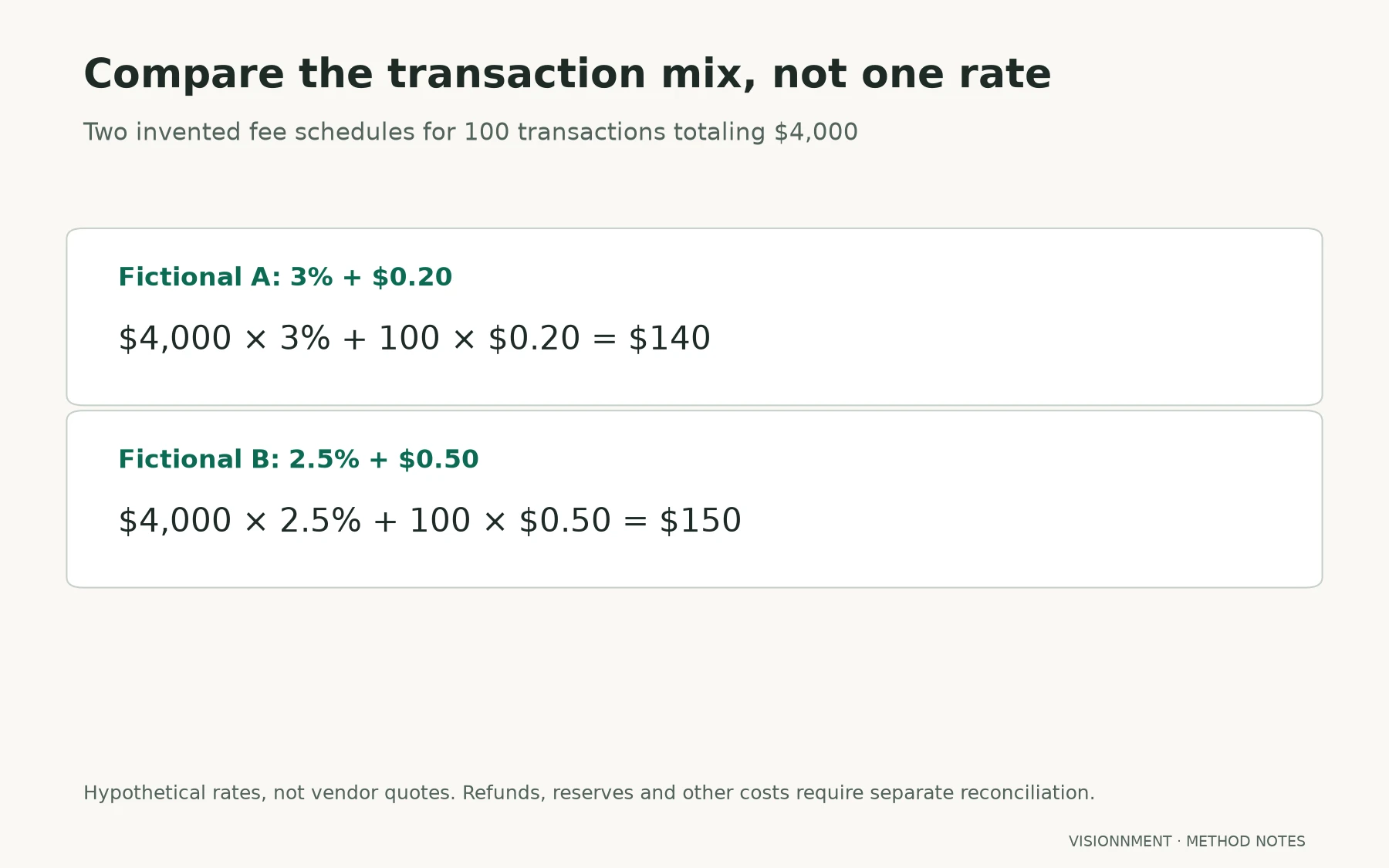
The following rates are invented for teaching; they are not current Stripe, PayPal or Shopify prices. Assume 100 transactions totaling $4,000:
| Hypothetical quote | Percentage component | Fixed component | Total |
|---|---|---|---|
| A: 3% plus $0.20 | $120 | $20 | $140 |
| B: 2.5% plus $0.50 | $100 | $50 | $150 |
Quote A’s effective cost on this limited base is 3.5%; quote B’s is 3.75%. The lower percentage in B does not overcome its higher fixed charge for this assumed mix. These figures exclude other costs and say nothing about provider quality or eligibility.
Add the applicable agreement-specific extras in separate rows. If cross-border volume or disputes are uncertain, show at least two stated scenarios. Do not describe the lowest modeled total as a saving until the business has an actual supported quote and understands implementation costs.
Check whether price reductions depend on volume commitments, minimums or a limited introductory period. Include the cost after that period and any required ancillary product. A comparison that prices only the first month may misstate the continuing operating choice.
Include customer behavior as a separate uncertainty. A technically supported checkout might still be unfamiliar or unsuitable for part of the audience. Do not invent a conversion loss or uplift to complete the spreadsheet. Identify what would need observation before assigning a financial effect.
Check average transaction size as well as total volume. Two businesses processing $4,000 can have very different fixed-fee exposure if one takes ten payments and the other takes 100. Preserve the individual transaction mix in the comparison so a later change in order size can be priced without rebuilding the audit.
Test continuity and customer friction before switching
Build a transition dependency list covering subscriptions, payment methods, refunds, disputes, retained balances, reporting and bank settlement. A new checkout does not transfer every old obligation. Identify which historical actions remain with the existing provider and who will retain authorized access to perform them.
Request the provider’s supported migration route for customer payment arrangements. Do not copy card details or assume a new merchant identity can charge every old subscription. Legal and customer mandate questions need provider confirmation and appropriate advice.
Use a safe, authorized test plan for the new path. Define expected authorization, confirmation, entitlement or order status, refund handling and reconciliation. Where sandbox behavior cannot establish a live outcome, record that limit. This article describes a plan; no payment or customer test was performed.
Specify a stop condition and fallback before changing the primary payment route. Examples include missing settlement confirmation, incorrect customer entitlements or duplicate billing risk. A fallback must itself be supported; simply restoring a button may not reverse an actual charge or migration.
Budget overlap and implementation work. Technical changes, customer communication, reporting adjustments and temporary duplicate subscriptions can exceed a small modeled fee difference. Record these as real decision inputs instead of treating all switching work as free owner time.
Reconcile the resulting bill
After any authorized change, repeat the same reconciliation on an actual operating period. Compare expected and charged fees by category, using the same denominator. Investigate mismatched tiers, excluded products, minimums or currency treatment before calling the quote inaccurate.
Check the cash bridge independently. Confirm where retained balances remain, when payouts arrive and whether refunds or disputes still affect the old account. A lower processing bill does not establish that every held balance has become available.
Save a decision record with the agreement versions, source exports, calculation, implementation cost and unresolved questions. Give the next review a date or trigger, such as a material change in payment mix or quoted terms. The method should remain reproducible when a new operator takes over.
The earnings quality guide helps distinguish recurring acceptance costs from unsupported add-backs. If the audit informs a sale or purchase, carry the reconciled earnings basis into the valuation methods guide. The useful outcome is a defensible operating cost, not a promise that changing a processor will improve profit.