
Source-reviewed platform guide
Empire Flippers Review: Fees, Minimums and Who It’s For
A curated broker and migration process fits qualifying established businesses when the support justifies the commission and minimum fee.
This is a source-reviewed guide, not a claim of hands-on product testing. Confirm current prices, eligibility, and terms with the provider.
Decision snapshot
Fit before features.
Use these fields as a shortlist filter. The full review below explains evidence, tradeoffs, transfer implications, and alternatives.
Best for
Established, profitable businesses that meet the current requirements and benefit from a coordinated broker and migration process.
Not for
Early or sub-threshold assets, sellers for whom the minimum commission is uneconomic, or buyers unwilling to complete access checks.
Cost lens
Checked November 8, 2026: no listing fee; $10,000 minimum commission through $66,666.66, 15% through $700,000, 8% on the next portion to $5 million and 2.5% above $5 million. Confirm transaction-specific treatment of inventory and deferred consideration.
Public terms last fact-checked: 2026-11-08. Pricing may change between checks.
Affiliate disclosure: Visionnment may earn a commission if you use an affiliate link below and complete a qualifying purchase or sale. We assess the platform independently; check the provider’s current prices and terms before committing. This review uses public sources, rather than an account or transaction test.
Our verdict: Empire Flippers suits a qualifying, established business
Empire Flippers is worth considering when a profitable, established business needs a managed sale, or a buyer wants a curated starting point. The main benefit is a coordinated process from qualification through migration. The main drawback is the seller commission, especially its $10,000 minimum on smaller sales.
Use it for: qualifying businesses whose owners value broker support and buyers prepared to verify funds and investigate a shortlisted deal. Look elsewhere first if: your asset is early, below the profit/history requirements or too small for the minimum fee to make sense.
Our November 8, 2026 update includes public marketplace, seller-requirement and commission screenshots. This remains a source-reviewed assessment; we did not log into an account or complete a transaction.
Check Empire Flippers seller eligibility
Opens the official seller page. Compare your readiness and likely net proceeds before applying. Referral link; Visionnment may earn a commission from qualifying activity.
Buying instead? Browse public Empire Flippers listings. Public summaries are visible before the platform’s detailed-access process.
Where the broker process helps
| Useful advantage | Trade-off to decide now |
|---|---|
| A narrower, curated inventory | Some otherwise saleable businesses do not qualify. |
| A coordinated broker and migration process | The seller pays a material commission when a sale completes. |
| Controlled access to confidential listing details | Buyers must complete the applicable identity and funds checks. |
| A starting evidence package for diligence | You still need to test costs, rights, transferability and operating fit. |
A look at the public marketplace
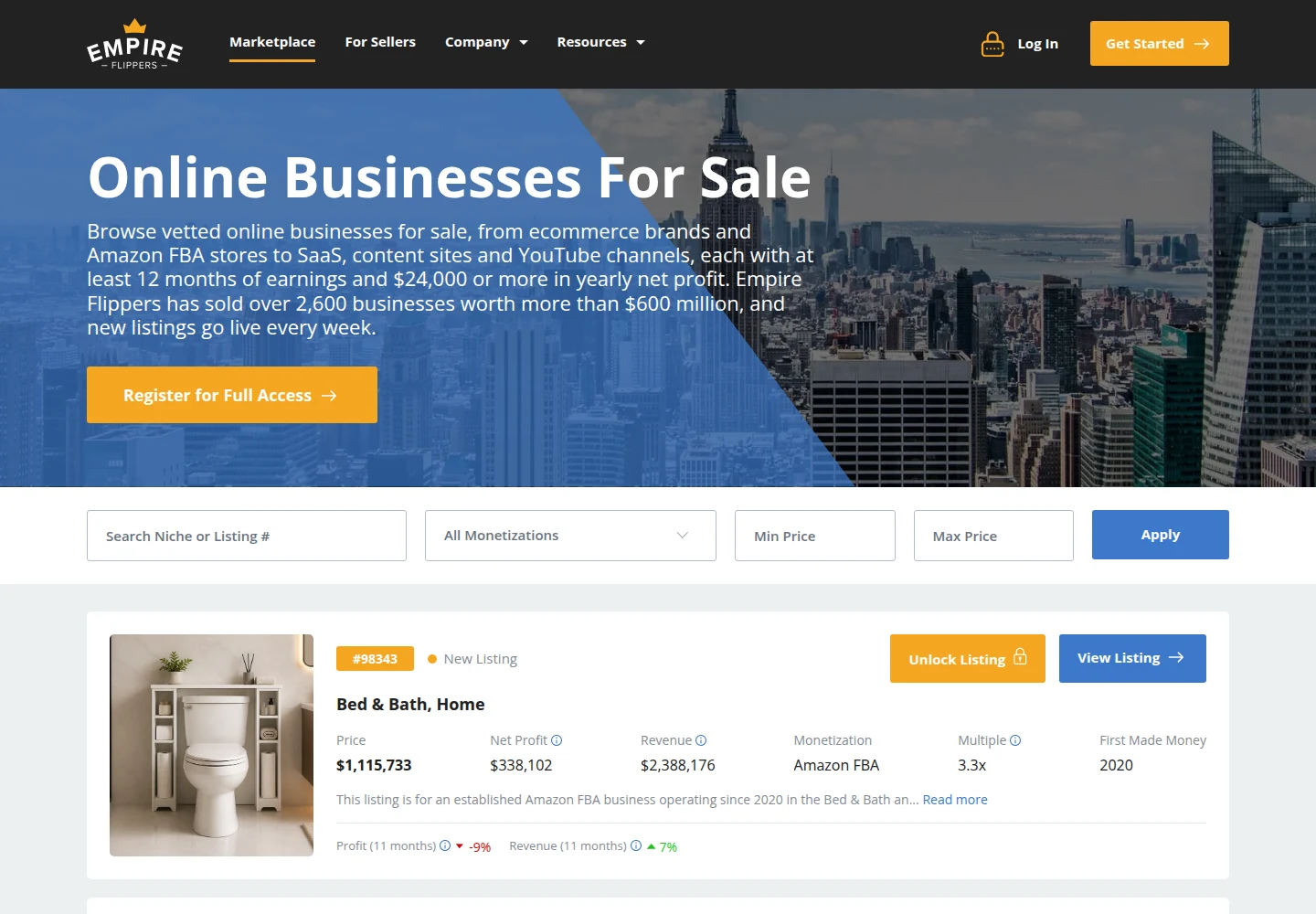
The public screen lets you narrow by monetization, niche and price before going deeper. Read the periods beside profit and revenue; a multiple only makes sense when its underlying period is clear. The displayed business is an interface example, not our acquisition recommendation.
Who Empire Flippers is for
Empire Flippers is a curated marketplace and brokerage for online businesses. Its published process combines seller qualification, pre-listing vetting, buyer access controls, adviser-led negotiation, and a managed migration after sale.
The model is not designed for every website. The published listing requirements call for at least $2,000 in average monthly net profit over the preceding 12 months, with at least 12 months of revenue history. Advertising and affiliate sites also face a same-domain history requirement. Meeting the thresholds does not ensure acceptance.
That filter is central to the value proposition: buyers see a narrower set of businesses, while sellers receive more process support. It is also the main constraint. A small content site, starter asset, or unprofitable growth project may need a broader marketplace or private route.
A quick seller eligibility screen
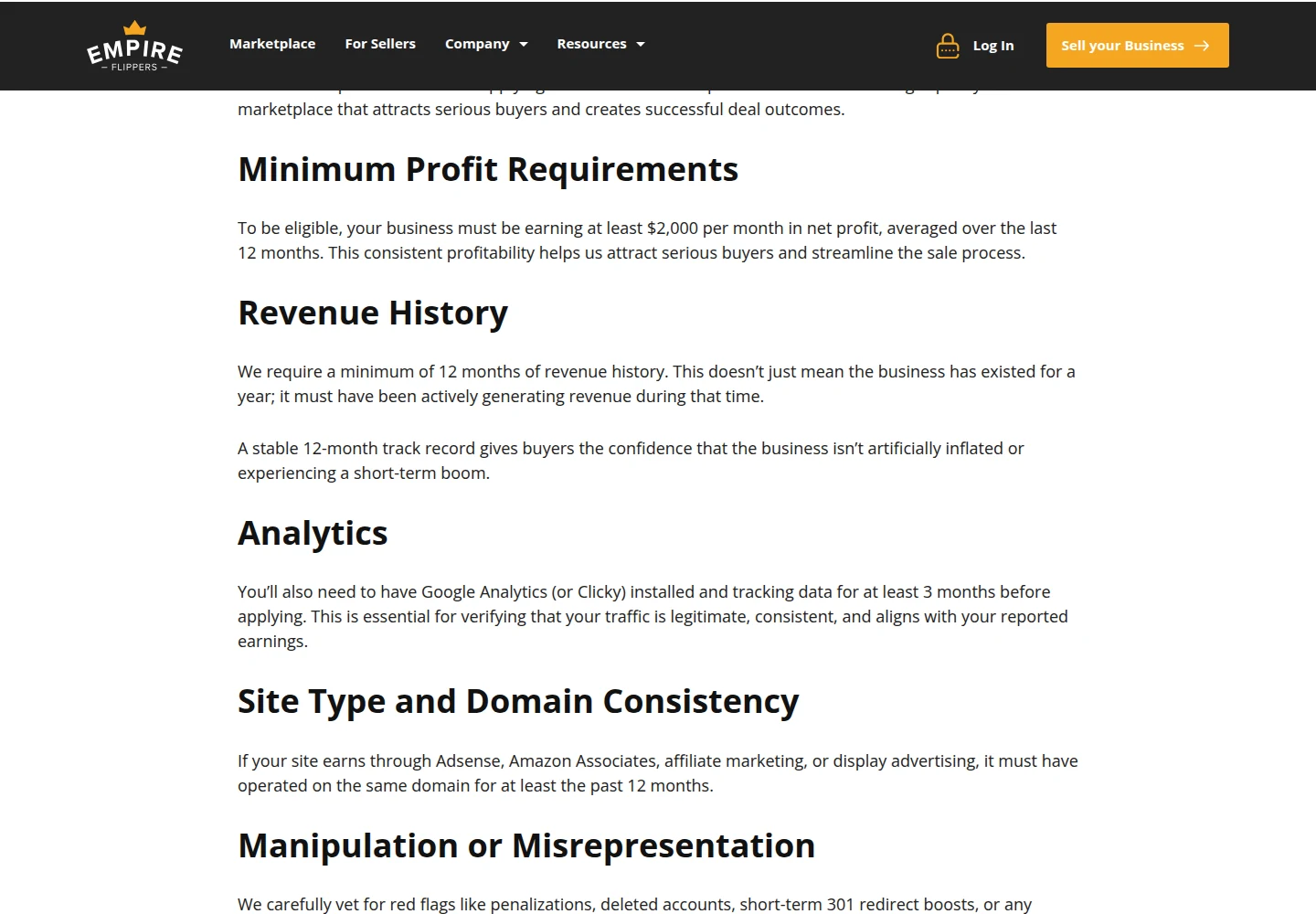
The current requirements also call for at least three months of Google Analytics or Clicky data. Advertising and affiliate sites need the required same-domain history. Prepare the records before an application; a recent high-earning month cannot replace a documented operating history. Read the full current eligibility rules for model-specific restrictions.
Test a website value and selling-readiness scenario if you are still deciding whether to begin an exit process.
Features and workflow
Pre-listing qualification and vetting
Empire Flippers states that it reviews submitted businesses before they reach the marketplace. Sellers should expect requests for financial, traffic, operating, and ownership evidence. Buyers should still ask what was verified, over what period, and what fell outside the review.
The distinction matters when checking profit. Empire Flippers’ terms place independent diligence on the buyer and say the platform does not independently verify business expenses. Reconcile the costs you would actually incur, including replacement operator time, rather than accepting a displayed profit figure as your own likely earnings.
Controlled buyer access
The platform uses account verification and proof-of-funds controls before buyers access more detailed deal information. This can reduce casual inquiries and help protect confidential business data.
It also adds friction. Be ready to provide current identity and funds evidence through the supported process rather than using shared credentials or informal documents.
Broker and negotiation support
Empire Flippers positions its team between seller and buyer through valuation, listing preparation, calls, offers, and negotiation. That can help a first-time seller keep the process organized while continuing to run the business.
The broker represents a process with its own incentives and commission. Buyers and sellers should retain their own legal, tax, financial, and technical advisers where the risk warrants it.
Managed migration
Empire Flippers’ migration guide describes a team that coordinates the transfer of domains, content, accounts, trademarks, email lists, supplier relationships, and other agreed assets. Its current terms say migration typically takes two to eight weeks but can take substantially longer.
The terms also recognize that some assets may not transfer in whole. This is why an asset schedule and pre-close transfer check remain necessary even with managed migration.
Referral program
Empire Flippers publishes a referral program for approved partners and eligible transactions. Some links in this review use our referral destination. This explains how the review may be funded; it does not establish that any particular listing is a suitable acquisition.
Empire Flippers fees: commission and seller net proceeds
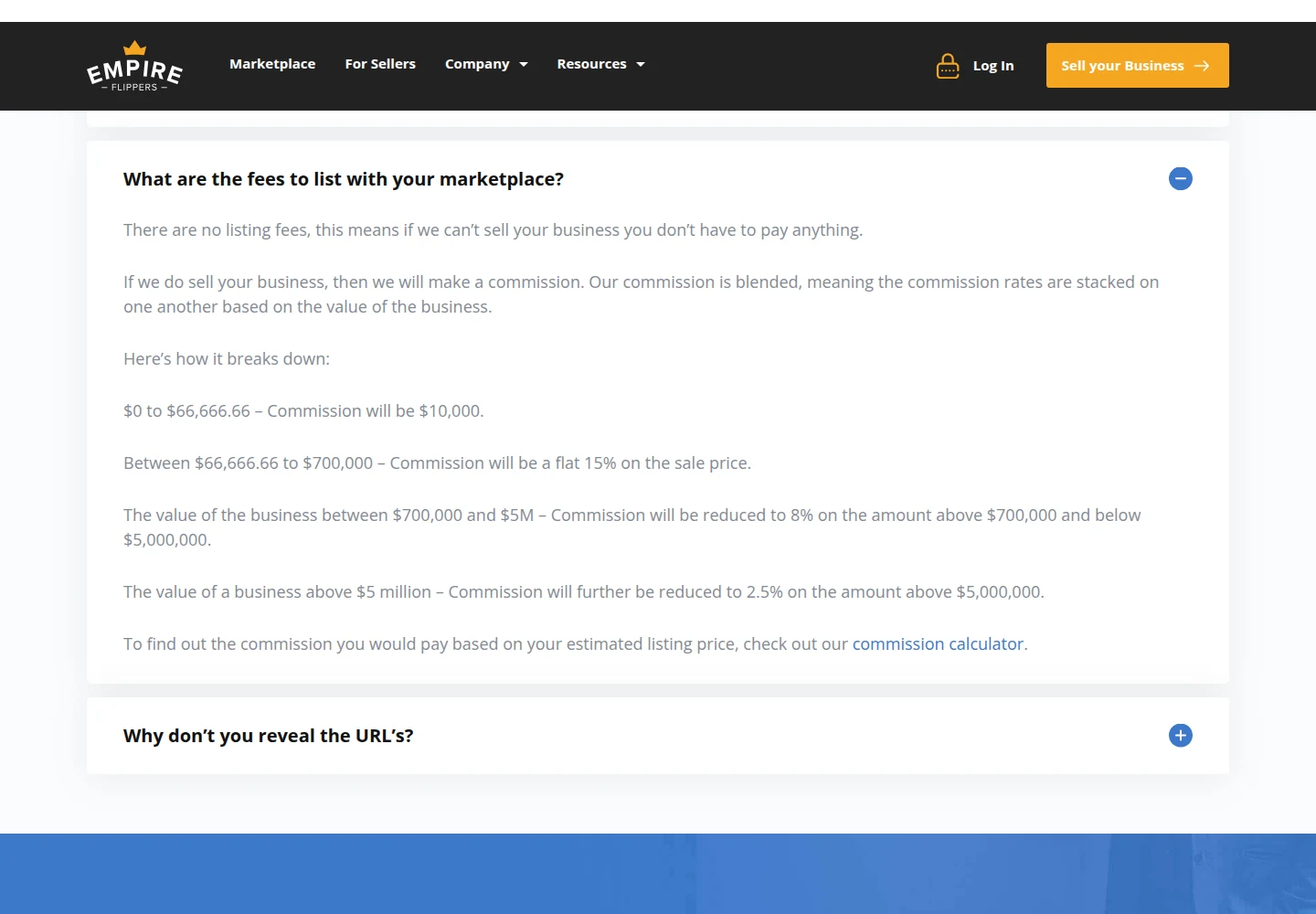
The seller fee FAQ, checked November 8, 2026, publishes a tiered USD commission:
| Sale-price portion | Published seller commission |
|---|---|
| $0 to $66,666.66 | $10,000 flat |
| $66,666.66 to $700,000 | 15% |
| Portion above $700,000 and below $5 million | 8% on that portion |
| Portion above $5 million | 2.5% on that portion |
The schedule is progressive across larger bands. Confirm the current calculator and engagement agreement before signing.
These simple calculations show why the sale price matters. They assume cash consideration and exclude inventory, tax, advisers, payment charges and every other deal-specific cost; they are arithmetic examples, not sale-price forecasts.
| Illustrative completed sale price | Published-schedule commission | Amount before all other costs |
|---|---|---|
| $50,000 | $10,000 | $40,000 |
| $100,000 | $15,000 | $85,000 |
| $800,000 | $105,000 on the first $700,000, plus $8,000 | $687,000 |
A deferred payment or inventory-heavy deal needs a different worksheet. Also read the written listing term: the general agreement describes two months of exclusivity and continuation while the business remains listed. Ask how delisting, termination and introduced-buyer provisions apply to your engagement; do not assume every obligation disappears after two months.
The $10,000 floor matters. At a $50,000 sale, it equals 20% of the price; at the published $24,000 annual-profit threshold, valuation and price still determine the effective fee. Sellers should compare net proceeds, probability-weighted terms, workload, and support, not commission alone.
Inventory in ecommerce deals and deferred consideration can be treated separately under the platform's terms. A real seller needs a transaction-specific net-proceeds model and tax advice. Buyers of stock-holding stores can use the inventory due-diligence worksheet to separate stock payment, count evidence and next-order cash.
Is the support worth the fee for your situation?
| Illustrative situation | Useful next step |
|---|---|
| A site averages $1,200 monthly net profit | Build the qualifying operating history or compare a smaller-asset route first. |
| An eligible seller considers a $50,000 sale | Decide whether broker support justifies a $10,000 commission and $40,000 before other costs. |
| An established seller considers a $100,000 sale | Compare the $85,000 before-other-costs outcome with the workload and terms of other proposals. |
| A buyer wants an operator-led business | Browse by operating model, then verify workload, replacement costs and transfer dependencies. |
These are decision examples, not approvals or valuations. Ask what the team will handle and which tasks stay with you; that answer is more useful than comparing commission percentages alone.
Review the Empire Flippers seller process
Bring a reconciled profit schedule and the fee questions above to the next step. Referral link; Visionnment may earn a commission from qualifying activity.
Fit, alternatives, and decision
| Platform | Strongest fit | Qualification | Process support | Main trade-off |
|---|---|---|---|---|
| Empire Flippers | Established profitable online businesses | Current profit/history minimums plus approval | Broker-led sale and migration | Selective access and tiered commission |
| Flippa | Broad asset types and price points | Wider self-service access | Self-service through broker-led options | More seller/buyer screening workload |
| Quiet Light | Established owner-operated online businesses | Adviser assessment | Adviser-led confidential brokerage | Fee and fit depend on engagement |
| FE International | Larger technology, SaaS, ecommerce, and content deals | Adviser-led qualification | Full M&A process | Often more process than a small asset needs |
Flippa: broader access and more self-direction
Our Flippa review with current pricing screenshots shows the smaller-asset route, its listing fees and the screening work that stays with the operator.
Flippa supports more asset types and smaller listings through self-service packages. That helps sellers outside Empire Flippers' minimums, but buyers and sellers typically carry more screening and diligence responsibility.
Quiet Light: adviser-led alternative
Quiet Light also uses an adviser model for established online businesses. Compare sector experience, proposed valuation, buyer reach, exclusivity, engagement scope, fees, and the individual adviser's plan rather than relying on brand familiarity. Our Empire Flippers vs Quiet Light comparison provides a written-proposal scorecard for that decision.
FE International: stronger fit for larger or more complex deals
FE International's current process emphasizes confidential adviser-led sales, a formal prospectus/data room, and a broad buyer network. It may fit larger or more complex transactions; small sites can be over-processed by a full M&A workflow. Use Empire Flippers vs FE International to compare advisory scope, closing cash and the work retained by a SaaS founder.
For a self-service-versus-curated decision, use Flippa vs Empire Flippers.
Is Empire Flippers legitimate?
Empire Flippers is an established brokerage with published eligibility, commission, terms, referral, and migration materials. That establishes an operating process, not a guarantee that every listing, offer, or transfer will meet your needs.
Its Trustpilot profile showed 4.3/5 from 122 reviews on October 20, 2026. Trustpilot noted that the company had not invited customers recently and the reviews might not be representative. Recent feedback was mostly positive about guidance and migration, while some reviewers raised concerns about onboarding friction or particular listing disclosures.
Those are user reports, not adjudicated facts. The useful conclusion is narrower: independently verify the specific business, included assets, transfer limits, and written terms. Read the website due diligence checklist before making an offer.
What the curated process does not decide
The platform's vetting and broker support can make evidence easier to review, but several decisions remain outside a neutral marketplace conclusion:
- whether the business matches your operating skill and time;
- whether reported add-backs are economically removable for you;
- whether traffic, customer, supplier, or platform concentration fits your risk limit;
- whether the asset and entity structure create acceptable legal or tax outcomes;
- whether code, content, data, contracts, and accounts transfer for your intended use;
- whether deferred payments, inventory, or working-capital terms are acceptable.
Ask the team for the scope and period of its checks, then build your diligence plan around what is not covered. A curated listing can reduce search costs without converting the broker into the buyer's fiduciary or specialist adviser.
Check current readiness without replacing independent review
Before applying as a seller, match the published requirements to the actual business: profit/history, analytics evidence, domain continuity where applicable and model-specific restrictions. A first useful product, first sale or automated estimate is not the same as a qualifying operating record.
For a buyer, keep broker vetting, source financial reconciliation, provider permission and working-control acceptance as separate decisions. The buyer process supplies an evidence sequence; the seller preparation guide supplies a fitting readiness packet. Neither makes a current listing or proposed transaction suitable automatically.
Deal structure matters as much as the multiple
Empire Flippers' public terms address deferred payments, inventory, migration, and commission. Compare offers by cash at close, contingent consideration, security, control, and collection risk—not the headline price alone.
For an earnout or seller note, define the metric, reporting source, operating covenants, due dates, dispute process, and what happens if the buyer sells or materially changes the business. Sellers should model the possibility that deferred amounts arrive late or not at all. Buyers should model the operational restrictions needed to protect the seller.
The commission treatment of deferred consideration and inventory should be confirmed in the current engagement and transaction documents. Do not infer it from an example calculator.
How to start with Empire Flippers
As a seller
Use our guide to selling a business on Empire Flippers for the evidence pack, seller-net worksheet and agreement questions behind these steps.
- Confirm that the business meets current profit and history requirements.
- Reconcile at least the requested financial period and prepare source access.
- Inventory traffic, operations, contracts, intellectual property, and transfer dependencies.
- Run the published commission against likely price and deal structures.
- Review exclusivity, representations, migration, deferred payment, and termination terms with advisers.
- Keep operating performance stable through the sale and migration.
As a buyer
Our Empire Flippers buying-process guide turns the overview into evidence requests, offer decisions and transfer acceptance checks.
- Complete the required identity and funds-verification steps.
- Define your buy box before unlocking listings.
- Treat the platform package as a starting evidence set.
- Reconcile financials and traffic, inspect IP/technical risk, and test transferability.
- Put assets, diligence, price, payment, migration, and support into written terms.
A useful first marketplace visit
Choose one monetization model, a maximum price and the workload you can operate. Read a few public summaries before seeking confidential details. For each candidate, write down the first fact you would verify: costs, traffic concentration, customer dependence or a transfer restriction.
Browse Empire Flippers businesses
Opens the public marketplace. Account, identity and funds checks apply to detailed access. Referral link; Visionnment may earn a commission from qualifying activity.
Frequently asked questions
What is the minimum to list on Empire Flippers?
The requirements guide states at least $2,000 in average monthly net profit over the preceding 12 months and at least 12 months of revenue history. Business-model, domain-history and other eligibility checks still apply, and acceptance is discretionary.
Does Empire Flippers verify businesses?
It performs a pre-listing vetting process, but buyers should confirm the scope and independently investigate matters relevant to their decision. Vetting is not an audit, legal opinion, or promise of future performance.
Who pays the commission?
The published seller schedule deducts Empire Flippers' commission from the transaction. The definitive agreement and deal structure govern the actual amount, timing, inventory treatment, and deferred consideration.
How long does migration take?
The current terms say migration typically takes two to eight weeks, but can take substantially longer. Asset type, third-party approvals, account rules, buyer/seller responsiveness, and transfer problems can change timing.
Does Empire Flippers have a referral program?
Yes. The published program sets eligibility, attribution and compensation conditions for approved partners. A tracked click is not itself an earned commission; the qualifying event and applicable terms matter.
Verdict
Empire Flippers is strongest when a qualifying, established business benefits from curation, buyer controls, broker support, and managed migration. Those services can justify the commission when they improve net outcome or reduce execution burden.
It is not the automatic choice for small assets, sellers focused on the lowest fee, or buyers who want anonymous browsing without verification. Compare the actual net proceeds and workload against Flippa, Quiet Light, FE International, or a private process.
This review is based on public sources, rather than a completed transaction.
See whether Empire Flippers fits your exit
Start with the seller process and eligibility checks; an application or estimate is not an offer to buy your business. Referral link; Visionnment may earn a commission from qualifying activity.
Keep comparing
A tool should fit the asset and the decision.
Compare alternatives on actual workflow, total cost, control, and the steps needed to transfer an asset later.