
SaaS expansion revenue is useful when existing customers receive additional value at an acceptable continuing cost. It can hide a weak retained base if the report mixes upgrades with new customers or ignores support and infrastructure work.
Start with a recurring-revenue bridge, identify an outcome customers can use, then test one expansion offer. You need account-level billing changes, a fixed opening cohort, contract terms, usage or outcome evidence and the direct costs of delivery. Reconcile the bridge before changing packaging.
All figures in the worked bridge are hypothetical. No subscription change, customer test or revenue outcome was performed.
1. Reconcile the recurring-revenue bridge
Define monthly recurring revenue, or MRR, consistently before using it. State how you handle discounts, annual contracts, currency and one-time services. Keep billed amounts and collected cash in their own records rather than treating a recurring metric as a bank balance.
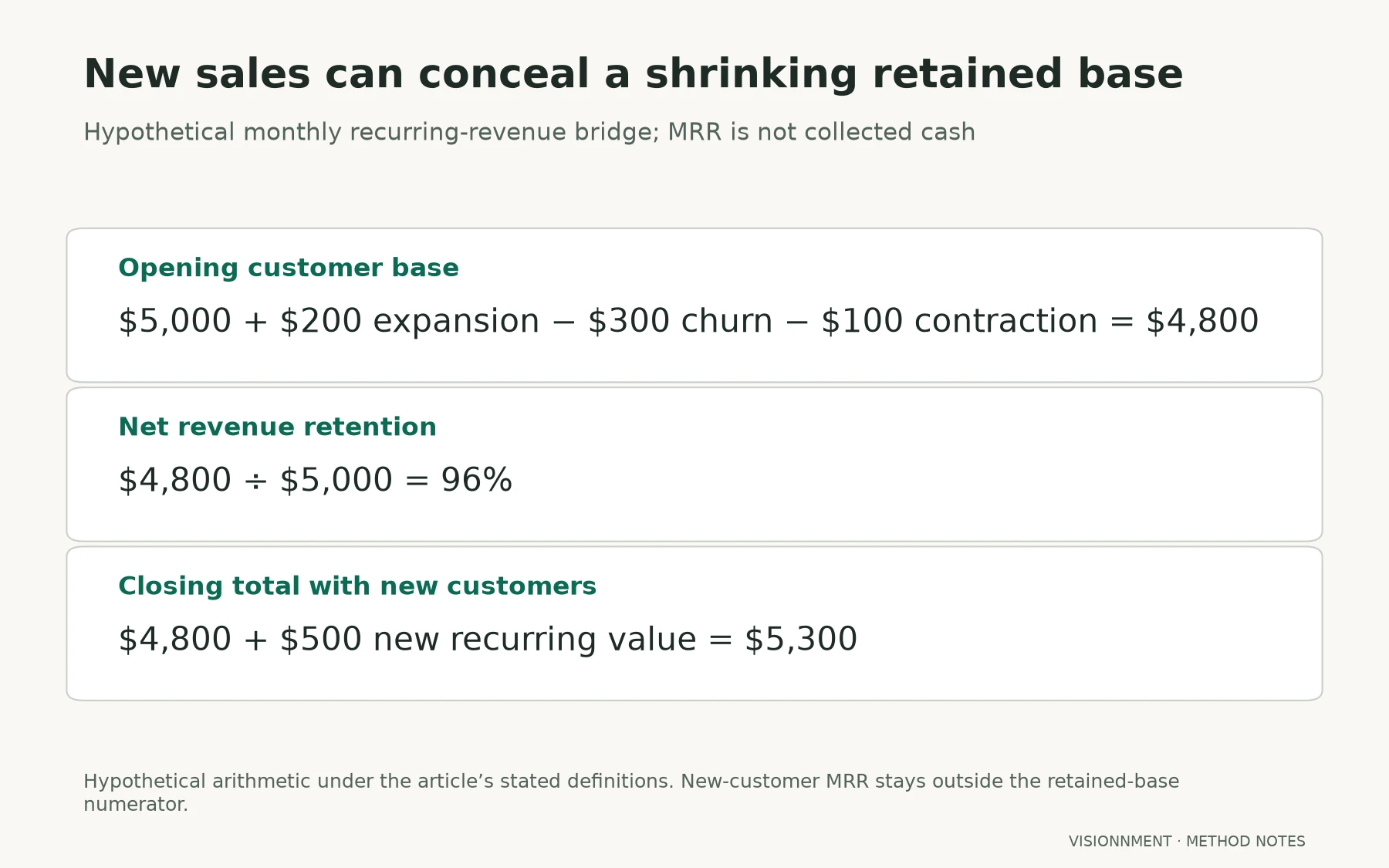
For the hypothetical product, start MRR at $5,000. New business adds $500, expansion adds $200, cancellations remove $300 and contraction removes $100.
| Bridge item | Hypothetical monthly value |
|---|---|
| Opening recurring value | $5,000 |
| New customers | +$500 |
| Existing-customer expansion | +$200 |
| Cancellations | −$300 |
| Contraction | −$100 |
| Closing recurring value | $5,300 |
The overall total grows by $300. But the opening customer base ends at $4,800: $5,000 + $200 − $300 − $100. Under this stated definition, net revenue retention is $4,800 divided by $5,000, or 96%.
ChartMogul's NRR explanation distinguishes retained-base changes from new-customer acquisition. That distinction prevents new sales from concealing erosion in existing accounts.
Trace every movement to account records. If a customer appears as both cancelled and reactivated, preserve the event sequence and your reporting policy rather than double-counting the movement. If the bridge does not reconcile, fix the definitions before interpreting it.
2. Identify an outcome worth expanding
Look for customers who need more of a result the product already supports. Expansion could involve more seats, more usage, an additional capability or a broader workflow. It should correspond to a real need rather than an arbitrary paywall added to repair the revenue chart.
For a fictional reporting tool, one customer might need two authorized reviewers instead of one. Another may need more data processed each month. Those are different value and cost mechanisms even if both produce a larger invoice.
Inspect accepted outcomes, not only activity. More logins may reflect confusion. More processing may reflect waste. Ask the customer what additional work they need completed, who benefits and what the current limit prevents.
Use cohort analysis to keep the opening customers and observation periods visible. A recently acquired cohort may behave differently from a mature one, so do not use its expansion opportunity as proof about the whole customer base.
If no clear additional outcome appears, prioritize the original product promise or retention problem. An upsell cannot repair a customer relationship that never achieved its initial purpose.
3. Compare seats, usage and packaging against delivery cost
For each candidate offer, model the unit that creates both value and cost. Seats may require onboarding and permissions. Usage can consume hosting, third-party services or specialist review. A premium feature can add support, security and maintenance obligations.
Build a contribution worksheet with current recurring price, proposed additional price, incremental service cost, payment charges, support work and implementation. Distinguish one-time setup from continuing monthly work.
Suppose an illustrative upgrade adds $20 monthly but needs an assumed half-hour of continuing support valued at $30 per hour and $8 of service cost. Its incremental contribution after those two items is negative $3 before payment charges and other costs. These invented inputs demonstrate the method, not a market benchmark.
Do not spread that burden invisibly across the existing subscription and call the upgrade high margin. Determine whether the offer can be redesigned, supported more efficiently or priced appropriately. If not, declining the expansion can be rational.
Use current applicable payment pricing and the actual transaction mix. Stripe's pricing page is a starting source for its offers, not one universal fee for every country, method or negotiated account. Record the quote and scope used.
4. Check contracts, billing and customer choice
Read the customer's existing entitlement before changing it. Specify what remains included, what is optional, when a change takes effect and how the customer accepts it. A new package name does not remove an existing contractual obligation.
Map the billing event separately from the product entitlement. An upgrade request, invoice creation, payment and provisioned access are different states. Define the supported sequence and how to reverse a mistaken change.
For an annual customer, do not treat a monthly equivalent as permission to collect a new monthly fee. Inspect proration, renewal, notice, tax and refund questions under the actual agreement and provider configuration. Obtain qualified advice for legal uncertainties rather than inferring rules from another SaaS business.
Use secure supported payment and account controls. Do not ask customers to email card details or share another person's login to obtain a seat. A product that sells access needs an authorized way to deliver that access.
Before launch, test the changed billing and entitlement workflow in a suitable non-production environment. Check that declining the upgrade preserves the legitimate original service and that support can explain both options accurately.
5. Test the offer within a fixed retained cohort
Select a bounded group with an evidenced need and appropriate contact permission. Define the offer, customer outcome, cost ceiling and review period. Record the denominator: eligible customers, contacted customers, accepted upgrades and successfully delivered upgrades are different counts.
Keep retention guardrails. Watch contraction, cancellation, refunds, failed payments and support backlog among both accepting and declining customers. An expansion campaign that pressures existing users away can raise one line while damaging the base.
For the reporting tool, acceptance might require the additional reviewer to complete the intended approval workflow without unauthorized access. A paid upgrade with a broken reviewer experience has not fulfilled the customer promise.
Record other changes during the period, including price changes and new onboarding. Without a suitable comparison design, report observed outcomes and plausible explanations rather than a causal uplift.
If the test exceeds support capacity, pause invitations and repair the bottleneck. Selling more of an obligation than you can deliver creates risk that an MRR chart does not display.
6. Report expansion, contribution and support separately
Return to the original bridge. Keep new MRR outside the retained-base numerator and apply the same definitions at the review date. Explain changes to currency or classification if they affect comparability.
Add an operating table: incremental recognized or recurring value under your definition, collected cash, refunds, direct delivery cost, support hours and unresolved customer obligations. Do not call an unpaid invoice recovered cash or an upgrade acceptance durable retention.
Inspect distribution as well as totals. One customer's large upgrade can dominate the result and increase concentration. Ask what happens if that customer contracts again and whether the new obligations can be scaled down.
Choose keep, change or stop based on useful delivered value and economic contribution. If MRR grew while NRR remained below 100%, state both. Expansion can help without proving that the retained base is healthy.
Keep the bridge, offer terms and operating records with the product's documentation. They help another operator understand the model described in building a SaaS digital asset and eventually support sale preparation. No valuation improvement is assumed.
Reconcile credits and timing after the test
An accepted upgrade can create a credit for unused service, a prorated invoice or a later effective entitlement under the actual arrangement. Preserve those events instead of treating the package's full advertised price as this month's collected expansion. If the bridge and invoice report differ, trace the account-level timing and reporting definitions before changing either total. Give support the same effective date used by billing so a customer does not pay for a capability they cannot yet use. Close the exception with records, then return to the retained-cohort review.
Common questions
Is higher MRR evidence of better retention?
Not by itself. New customers can replace lost value. Reconcile the opening cohort and retained-base changes separately.
Should I charge by seats or usage?
Choose a unit the customer understands that reflects value and a supportable cost structure. Test the entitlement, bill and outcome together rather than copying a competitor's metric.
When is expansion successful?
When the promised extra outcome is delivered, the customer relationship remains sound and the continuing contribution fits the operation. A larger invoice alone does not establish any of those conditions.