
A SaaS retention playbook should diagnose why a customer may leave before selecting an intervention. An unpaid invoice, a stalled workflow and a successfully completed occasional task are different situations. Treating them all as “low engagement” can produce irrelevant messages and misleading results.
Start with the product's intended outcome, inspect equally mature customer groups and choose one bounded response to an observed obstacle. You need account and billing states, appropriate product-event records, support history and a clear permission boundary for customer contact.
This guide uses three fictional accounts in a weekly reporting product. No customer investigation or retention experiment was performed, and no universal login-frequency threshold is proposed.
1. Separate voluntary, payment and product-fit problems
Write a diagnostic record before an outreach campaign. Distinguish an explicit cancellation, payment failure, failure to achieve value and absence of a current need. Also allow “unknown”; an unexplained silence does not establish dissatisfaction.
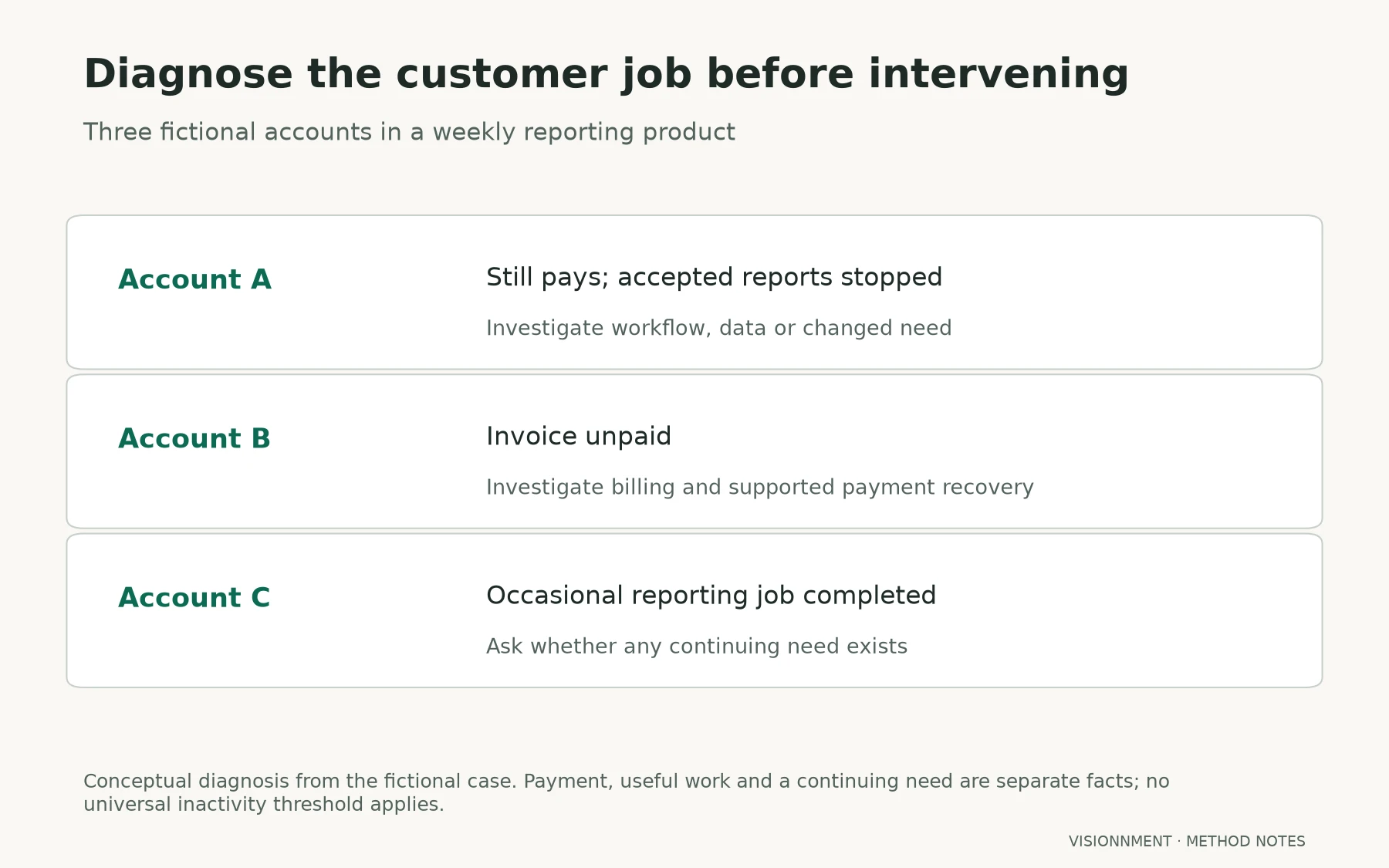
In the fictional product, Account A still pays but has stopped producing accepted reports. Account B has an unpaid invoice. Account C completed a one-off reporting task and does not currently need another.
| Account | Observed evidence | Next investigation |
|---|---|---|
| A | Paid, but accepted reports stopped | Workflow, data or changed need |
| B | Invoice unpaid | Billing state and supported recovery |
| C | Intended occasional job completed | Whether any continuing need exists |
Account A may need help, but payment alone does not prove value. Account B may still use and value the product, but usage does not settle the debt. Account C may have completed the promise successfully, making aggressive retention messaging inappropriate.
Stripe's Smart Retries documentation describes payment recovery controls rather than a general product-retention strategy. Use the failed-payment recovery guide for that specific workflow; keep the product investigation separate.
If the underlying records disagree, reconcile them first. A cancelled subscription still visible in a product dashboard should not enter an automated “welcome back” sequence until the actual state is understood.
2. Compare equally mature cohorts by useful work
Choose a cohort start event and elapsed observation period. An account in its first setup week cannot be compared fairly with one that has operated for six months. Record plan, acquisition context and intended workflow where those affect the task.
ChartMogul's cohort analysis guidance provides a way to examine groups over time. The tool's cohort definitions still need to match your operating question. A chart cannot fix mismatched maturity or missing outcomes.
For the weekly reporting product, a meaningful sequence might be connecting authorized data, generating a report, reviewing it and accepting or sharing the result. Login count alone may miss that whole sequence.
Define each event precisely. A generated report is not necessarily an accepted report. An automated background event may not show intentional use. Document what the event means and where the evidence comes from.
If the product serves occasional needs, choose a different rhythm. Do not import a weekly warning threshold from a provider's example into a quarterly workflow. An otherwise healthy customer can appear inactive under an unsuitable definition.
3. Combine usage evidence with bounded investigation
Start with the observed change and ask for context. For Account A, inspect whether the input source failed, a report became inaccurate, the reviewer left or the reporting need changed. Use authorized records and avoid inspecting customer content beyond what your role permits.
Then ask a focused question: what prevented the last intended report from being accepted? Allow the customer to explain a new workflow or a completed need. Avoid leading with an upgrade or discount before understanding the obstacle.
ChartMogul's early-adoption segmentation example can help frame a relationship between adoption and later churn. Its example segments are not universal danger thresholds, and an observed relationship does not identify a cause in your product.
Keep customer explanations, product records and your interpretation in separate fields. A customer saying the report took too long is evidence of their account, not proof that speed causes all cancellations.
If several explanations remain plausible, choose the next safe observation that could distinguish them. For example, inspect a synthetic report path before requesting customer-specific data. Escalate a suspected security or data-integrity issue through the appropriate support process instead of treating it as a marketing opportunity.
4. Choose one intervention that fits the obstacle
Match the response to the diagnosis. Broken setup needs a setup repair. A confusing review step may need clearer guidance. An unwanted product needs an honest cancellation path. An unpaid invoice needs supported payment recovery.
For fictional Account A, suppose the evidence points to a confusing approval handoff. A bounded intervention could be a short guided walkthrough and clearer instructions for the existing reviewer role. The hypothesis is that this helps the customer complete an accepted report; retention remains an outcome to observe later.
Specify what the customer should be able to do, who delivers the help and what falls outside the offer. Do not promise bespoke work indefinitely because one customer is at risk of leaving.
Record the maximum support time and any technical change. If the intervention requires access to customer data, obtain the necessary authorization and use the least access needed. A retention concern does not create blanket permission.
If the obstacle cannot be solved within the product's promise, explain the limitation. A refund, an alternative workflow or an orderly departure may serve the customer better than another sequence of persuasion messages.
5. Set cost, consent and cancellation guardrails
Include staff time, infrastructure, credits and refunds in the intervention cost. Report one-off learning work separately from continuing support the business would have to repeat. An intervention can improve a count while creating an unsustainable service obligation.
Use appropriate contact permissions and honour customer choices. Keep cancellation accessible and truthful. Do not delay it or add hidden friction to make the retained-customer metric look better.
Check whether the response is fair to existing users on the same terms. A special promise made in a support conversation can create an obligation that the standard plan does not describe. Record and price any accepted exception.
Set a stopping condition: repeated failed delivery, excessive support burden, a customer declining further contact or discovery that the proposed feature does not fit. Give a person responsibility for stopping the test when that condition appears.
For Account C, the guardrail might simply prevent unnecessary contact after the occasional job is complete. Respecting that outcome preserves the accuracy of the product's promise even if it does not maximize a short-term subscription count.
6. Compare outcomes without overstating causation
Record eligible accounts, contacted accounts, accepted help, completed outcomes, payments, cancellations and later renewal separately. Each step has a different denominator. A support call completed is not a customer retained.
Use equally mature observation periods and document other changes, such as a new onboarding flow or pricing campaign. If there is no suitable comparison design, report that the outcome followed the intervention and state the remaining explanations.
For Account A, first verify whether accepted reports resume. Later inspect payment and continued useful operation at the chosen review. For Account B, confirm collected cash separately from the scheduled retry. For Account C, record task completion without inventing a recurring need.
Inspect whether the intervention transferred work to staff. A renewed customer receiving hours of undocumented manual reporting may represent a service model change. Include that burden in contribution and capacity planning.
Decide keep, revise or stop based on the customer outcome and operating cost. If the sample is too small or incomplete, preserve the uncertainty and choose a narrower next review. Do not announce “churn solved” from a handful of favourable replies.
Keep the playbook usable by another operator
Store the diagnosis, evidence, intervention, permitted access, cost and next review in one record. Use a customer-safe summary where detailed data is restricted. Update the playbook when the procedure changes.
This operating record connects the retention work to building a SaaS digital asset. It also helps when you prepare the business for sale, because a successor needs to understand the continuing work behind recurring revenue.
The accepted result is a defensible intervention decision: what was observed, what was attempted, what the customer achieved and what remains unknown. A polished risk score without those facts is insufficient.
Common questions
Should every inactive account receive a discount?
No. Investigate the task and billing state first. A discount does not repair missing permissions, a broken integration or an already completed occasional need.
Can I use another product's warning thresholds?
Treat them as hypotheses at most. Define meaningful use for your own product and compare cohorts with the appropriate maturity.
What if the intervention does not improve renewal?
Check whether the intended customer outcome was achieved and whether renewal was actually the right question. Keep the evidence, adjust the supported hypothesis or stop rather than rewriting the result as success.