
A conversion audit for small websites should find whether a reader can complete one useful action and whether the site records that outcome accurately. Low traffic makes it especially important to distinguish an observed usability problem from a statistical claim. You can justify repairing a broken task without pretending a handful of completions proves a revenue uplift.
Choose one path and produce an evidence-linked repair decision. Gather the relevant page, available device access, event definitions and actual completion records. Set aside time for manual inspection and reconciliation before proposing an experiment. This guide’s funnel is hypothetical; no user test or live-site experiment was performed for the example.
Define one useful reader action and measurement scope
Name an outcome meaningful to both the reader and the business. It might be a qualified inquiry, completed purchase or confirmed newsletter subscription. An action click is usually an intermediate event. Do not substitute it for the final outcome simply because it is easier to track.
Write the path from eligible arrival to completion. Define eligibility, the reporting period and whether counts describe users, sessions or events. Exclude internal checks only through a documented rule. Otherwise your own troubleshooting can inflate the small sample you are trying to interpret.
Google Analytics funnel explorations distinguish steps and funnel configurations. Decide whether entry requires the first step and whether the path needs a particular sequence. A changed configuration can alter reported counts without any change in visitor behavior.
Set quality criteria for the final action. A form submission might be duplicate, spam, incomplete or unrelated to the service offered. Keep raw submissions and qualified completions separate, using a written qualification rule. A higher completion count is not automatically a better commercial result.
Record the privacy and consent conditions governing measurement. Use the evidence available within those conditions and state any gaps. Do not treat missing analytics events as proof that every unmeasured person abandoned the task.
Verify the real path on available devices
Walk the exact page and action under authorized conditions. Record device, browser, viewport, input method, account state and consent state. Use devices you actually have, and state where coverage is incomplete. An emulator or resized browser is useful evidence within its limits, not a test of every phone.
Inspect the path with a keyboard as well as a pointer where practical. Can a reader reach the action, understand labels, enter information, identify errors and confirm completion? Record the specific step and expected behavior. “The page feels confusing” is less actionable than “the required field cannot be reached in the tested keyboard sequence.”
Check the commercial promise against the destination. A button offering a quote should not silently lead to an unrelated signup. For a purchase or application, use a safe test route and avoid unintended customer messages, charges or commitments. Stop where you lack authorization to complete the action.
In the hypothetical case, the audit finds an inaccessible required field. The evidence is the observed task failure under the stated input method. It does not require a traffic forecast to be relevant. Preserve the reproduction steps so another reviewer can confirm the problem and later verify the repair.
Inspect the completion state too. A success message that appears before the back-end action finishes can mislead both readers and measurement. Confirm what the system actually accepted, using an authorized synthetic record where supported. Keep customer data out of the audit note.
Reconcile funnel events with actual outcomes
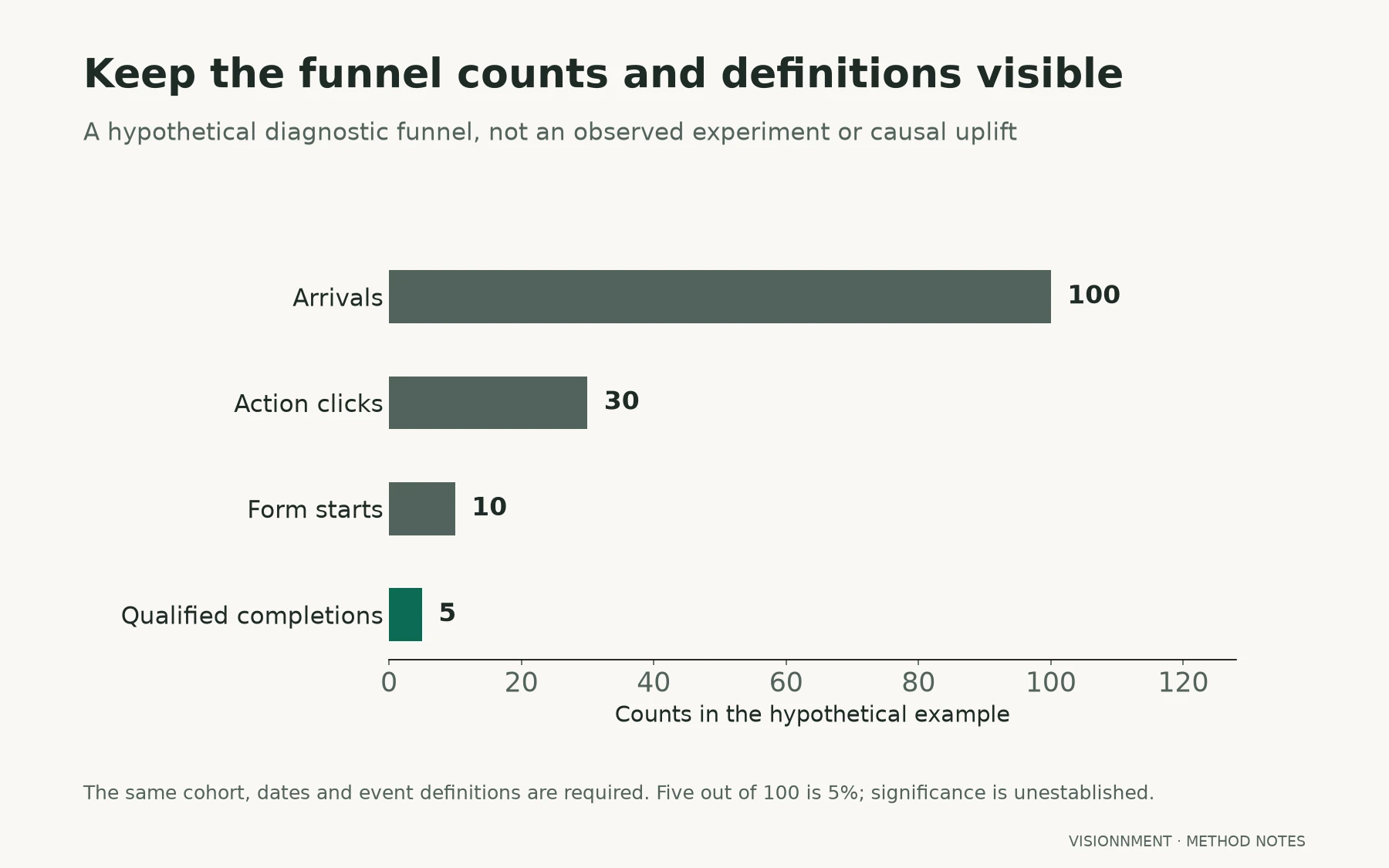
The hypothetical funnel contains 100 eligible arrivals, 30 action clicks, ten form starts and five qualified completions. Those numbers describe the designed example, not a benchmark for small websites. Start by checking that the events use the same period, population and counting basis.
| Step | Hypothetical count | Question to resolve |
|---|---|---|
| Eligible arrival | 100 | Was the correct page and audience counted? |
| Action click | 30 | Did one action create duplicate events? |
| Form start | 10 | Does the event mean meaningful interaction? |
| Qualified completion | 5 | Does the operational record confirm quality? |
Join completion records to events through an appropriate privacy-preserving method where available. Compare totals when individual matching is not appropriate or possible. Identify duplicate events, missing events and ambiguous names. Do not force perfect agreement by discarding unexplained records.
In this example, inconsistent event names make the apparent step drop unreliable. Fix the measurement definition separately from the inaccessible field. Otherwise a later increase could reflect corrected tracking rather than improved task completion.
Calculate descriptive rates only after the scope is consistent. Five qualified completions among 100 eligible arrivals is 5% in the hypothetical window. It is not a predicted future conversion rate, and the count alone does not identify why the other visitors did not complete.
Preserve the event-definition version and the date it changed. If old and new definitions cannot be reconciled, mark the break in the series. A clean-looking continuous chart is less useful than an honest explanation of what can actually be compared.
Separate usability observations from statistical claims
A repeatable task failure is direct evidence about that task. A before-and-after completion difference is an observation involving traffic, timing and other conditions. Treat the two kinds of evidence differently. Repairing the field can be warranted without claiming a proven causal increase in sales.
Small samples fluctuate. One extra qualified completion in this hypothetical funnel changes the observed rate noticeably, but it does not establish a stable effect. Avoid significance language, confidence claims or a forecast of monthly revenue unless the design and data actually support them.
List plausible alternative explanations for a later change: different traffic sources, a promotion, seasonality, revised qualification or tracking repairs. Record concurrent changes instead of pretending the site operated under controlled laboratory conditions. If several variables moved together, say attribution is unresolved.
Google’s people-first content guidance supports useful, trustworthy pages that serve their intended audience. Apply that standard to the action itself. A higher click count achieved through a misleading promise would not establish a better reader experience.
If the business later has enough suitable traffic for a controlled test, plan it properly. Do not choose an arbitrary stopping point because the current result looks favorable. Obtain appropriate analytical help when the decision’s financial importance exceeds the team’s ability to interpret the evidence.
Save the reproduction conditions with the issue: starting URL, input method, expected field behavior and actual result. Another authorized reviewer should be able to repeat the same task without guessing what the original observer meant.
Prioritize one reversible repair
Write a repair note containing the problem, reproduction steps, proposed change, responsible person, expected mechanism and rollback. For the hypothetical field issue, the change should restore a usable input and error path. It should not simultaneously rewrite the offer, change pricing and redesign every page.
Prioritize the direct task blocker before speculative persuasion changes. Define acceptance as the complete authorized path working under the tested conditions, with correct completion evidence. Recheck the original failure and the surrounding steps so the repair does not merely move the problem.
For search-visible testing, Google’s website-testing guidance describes relevant implementation considerations. Use the applicable instructions for the actual test design. Do not infer that following search guidance guarantees ranking stability or validates the commercial experiment.
Record deployment and rollback responsibility. A reversible code change can still produce real submissions, messages or orders that cannot simply be erased. Plan how those records will be handled and verified. Keep the test population and customer effects proportionate to the authorized scope.
Compare the result with quality and revenue guardrails
After the repair, repeat the task inspection and measurement reconciliation. Report what was verified: the field can be completed, the system accepts the synthetic submission and the intended event occurs once. Keep that result separate from any observed change in real qualified completions.
Review quality and operating consequences. Did spam rise, support work increase or the action become less relevant to readers? Where revenue matters, trace it beyond the initial click to approved transactions or actual customer outcomes. A new event firing does not establish cash earned.
Use a dated decision table: retain the repair, correct it further, revert it or collect more evidence. Name the next review point and unresolved question. The practical outcome can be “task restored; commercial effect unknown.” That is useful evidence rather than an incomplete success story.
For an acquired asset, place the repair within the first 90 days ownership plan. Establish control and reliable records before stacking experiments. The Empire Flippers buying-process guide is an optional next answer for readers still evaluating an assisted purchase route; the immediate operating action is the single verified repair.