
Source-reviewed platform guide
Flippa Review: Fees, Risks and Who It’s For
A broad marketplace suits prepared buyers and smaller sellers who can handle screening, diligence and the work their package leaves to them.
This is a source-reviewed guide, not a claim of hands-on product testing. Confirm current prices, eligibility, and terms with the provider.

Decision snapshot
Fit before features.
Use these fields as a shortlist filter. The full review below explains evidence, tradeoffs, transfer implications, and alternatives.
Best for
Self-directed buyers and sellers seeking a broad range of eligible digital assets and service levels.
Not for
Buyers expecting listing badges to replace independent diligence, or sellers needing an unquoted fully managed process.
Cost lens
Checked November 8, 2026: selected sub-$10,000 self-service band shows $29 Entry, $49 Boosted or $199 Premium plus a 10% success fee. Buyer access includes free and $49/month Premium options. Other bands, renewals, services and payment charges differ.
Public terms last fact-checked: 2026-11-08. Pricing may change between checks.
Affiliate disclosure: Visionnment may earn a commission from eligible activity after you use a Flippa referral link on this page. That relationship does not determine our assessment. Check the price and terms shown for your own route before paying. Our source links remain separate from the referral recommendation.
Our verdict: Flippa rewards a prepared, self-directed operator
Flippa is worth shortlisting when you want a broad choice of digital assets and can do the screening yourself. Its low entry package makes it accessible to smaller sellers; buyers can compare different business models in one place. The cost is more work separating a promising listing from a persuasive sales pitch.
Use it for: self-directed buying, smaller eligible assets and sellers who want to choose their service level. Compare a broker first if: you need curation and negotiation support more than a large inventory.
This is a source-reviewed assessment. We captured the public marketplace and both sides of the pricing page on November 8, 2026. We did not open an account, list an asset or complete a transaction.
Explore Flippa — browse or sell
Opens Flippa. Choose Browse for listings or Sell for the applicable package; no purchase is made by following the link. Referral link; Visionnment may earn a commission from qualifying activity.
What you gain, and what it costs in effort
| Useful advantage | Trade-off to decide now |
|---|---|
| A wide range of business models and asking prices | Write your budget, skills and evidence requirements before browsing. |
| A low upfront option for an eligible small sale | Budget the success fee, renewal terms and optional services as well. |
| Connected-data badges and transaction tools | Check exactly which source, period and claim each signal covers. |
| Self-service and broker options | Confirm which work is included in the route quoted to you. |
A look at the public marketplace
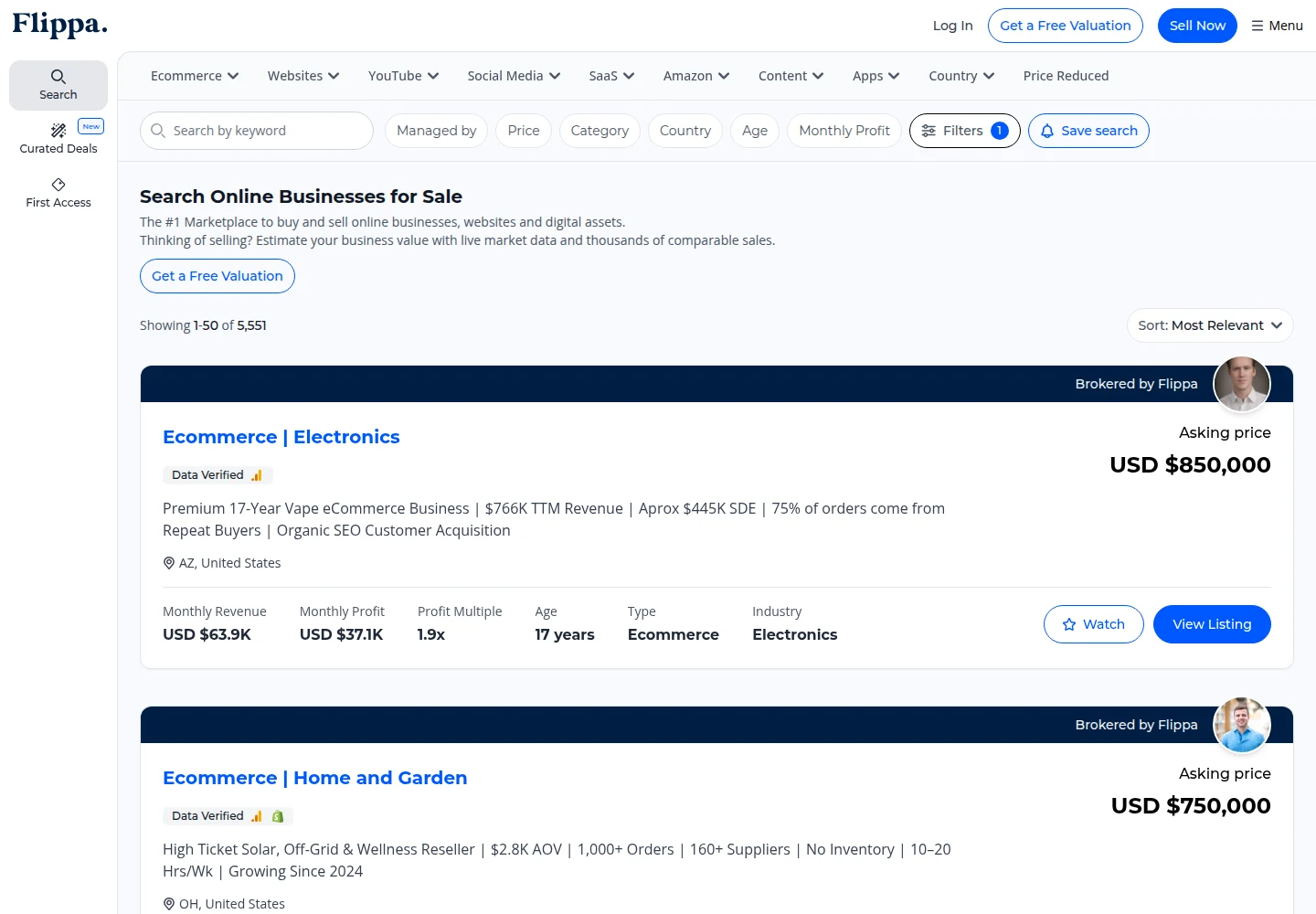
Start with category, price and monthly-profit filters, then read the evidence behind each candidate. The card separates asking price from revenue and profit: none of those figures is a forecast of your result. The screenshot is an interface example, not a recommendation of either displayed business.
Who Flippa is for
Flippa is a marketplace and broker platform for buying and selling online businesses and digital assets. Its current seller materials cover blogs, ecommerce, SaaS, apps, communities, plugins, YouTube channels, newsletters, and related assets. The platform combines self-service listings with broker-led service for businesses that meet its criteria.
The defining advantage is access. Sellers can reach a broad buyer pool without qualifying for a narrow brokerage, and buyers can browse many business types and price points. The trade-off is variance: asset quality, evidence, seller preparedness, and buyer seriousness can differ substantially.
Flippa is a better fit when you can define your acquisition criteria, verify source data, screen counterparties, negotiate terms, and coordinate specialists. It is a weaker fit if you want the venue to make the investment decision for you.
Features and workflow
Broad self-service marketplace
Flippa markets a broad range of digital-asset categories and different sale structures. That breadth can help buyers compare models and sellers evaluate a route outside a broker's minimum profit requirement. It does not establish that a particular partial sale, young project or shared operation is eligible.
Breadth is not curation. A large inventory increases the need for filters, a written buy box, and consistent diligence. For a supplier-fulfilled store, the dropshipping acquisition guide adds order economics, supplier continuity and operating-cash checks.
Check the actual category and sale perimeter
Flippa's published exclusions restrict partial-site arrangements, shared-supplier storefront splits and certain white-label operations. A pricing page's broad sale label does not override those rules. Record the included domain, storefronts, suppliers and continuing dependencies before choosing a listing.
Where a young, loss-making or pre-revenue asset's category is uncertain, obtain the detailed applicable rules before paying. Public category descriptions and price ceilings are not a valuation or an approval of the individual project. Confirm the detailed Projects & Concepts requirements for the actual category before relying on that route. Use the Flippa seller preparation guide to connect that eligibility question to the evidence and proposed transfer.
Deal Room and LOI workflow
Flippa's Deal Room documentation describes messaging, buyer management, LOIs, verification services, legal tools, and payment access in one workflow. Its current LOI tool can record price, a diligence period, a target closing date, included assets, support, and additional terms.
These tools can organize a transaction. They do not decide whether the economics, legal terms, or evidence are adequate.
Identity and funds signals
Flippa documents profile checks including email, phone, government ID, credit card, LinkedIn, and proof of funds. These signals can help prioritize counterparties. Flippa also tells buyers that seller claims still need verification. Read the current buyer and seller verification guidance.
Treat a badge as evidence of the check it names—nothing more. Identity verification does not validate revenue, traffic, IP ownership, or future performance.
What the listing badges establish
Flippa's listing-verification guide distinguishes the evidence behind two badges:
| Signal | What Flippa describes | What you still need to check |
|---|---|---|
| Data Verified | Read-only data connected from one or more supported sources | Which source and period are covered; omitted costs, rights and other unconnected claims |
| Vetted by Flippa | A manual review of key revenue, primary-expense and traffic evidence for listings priced at $50,000 or more | The actual review scope, remaining gaps and whether the asset fits your own constraints |
| Editor's Choice | Editorial selection, rather than verification | The same source evidence you would request without the designation |
The final row follows Flippa's separate Editor's Choice explanation. A connected revenue source, for example, does not establish that every contractor expense has been included. Record the claim, period, source and missing question before shortlisting an asset.
Optional assessment and broker support
Flippa offers paid verification/assessment and broker-led routes. The scope and cost vary, so request the current deliverables in writing. An additional report can improve the evidence set, but the buyer remains responsible for the final decision and specialist advice.
Compare the actual self-service and brokered routes
Flippa brokerage snapshot, November 17, 2026: The public broker-led criteria describe 12 months of consistent monthly net profit and at least 12 months of trading history, with six-month monetization-history wording for YouTube. Flippa also says it may consider an unprofitable business with a compelling growth profile or customer base for strategic buyers. It requests 12 months of financials, ready or buildable, supported by accounting, bank or revenue records. Do not assume the YouTube history exception waives the financial-document request; obtain the actual branch and acceptance in writing.
The displayed brokerage offer is $1,499 upfront for a six-month term, plus a success fee when the business sells. Confirm the selected asset, asking-price band, success-fee base, renewal and exact engagement scope in a current quote. This describes Flippa's own brokerage, not the eligibility or cost of every self-service listing.
Flippa's current pricing and service selector distinguishes its own broker-led service from self-service packages. Compare the specific work, support, eligibility and quote for the same asset. An open-market listing category is not evidence that the asset satisfies brokerage's historical and financial requirements. Neither a lower starting success-fee percentage nor a more expensive package establishes higher net proceeds or a sale.
The small-asset calculation below is a dated example for one selected asking-price band. Obtain a route-specific quote including term, renewal, success-fee base, optional services, payment costs and seller work before comparing it with a different broker. The unsold-listing diagnosis is the next useful step if the current process is failing; paying for more exposure is not the only available response.
Integrated closing options
The current pricing page lists FlippaPay and Escrow.com options, with fees varying by service and plan. Before agreeing to a closing flow, verify who holds funds, release conditions, dispute rules, identity requirements, currencies, transfer acceptance, and the provider's current fee schedule.
Flippa fees: what buyers and sellers actually pay
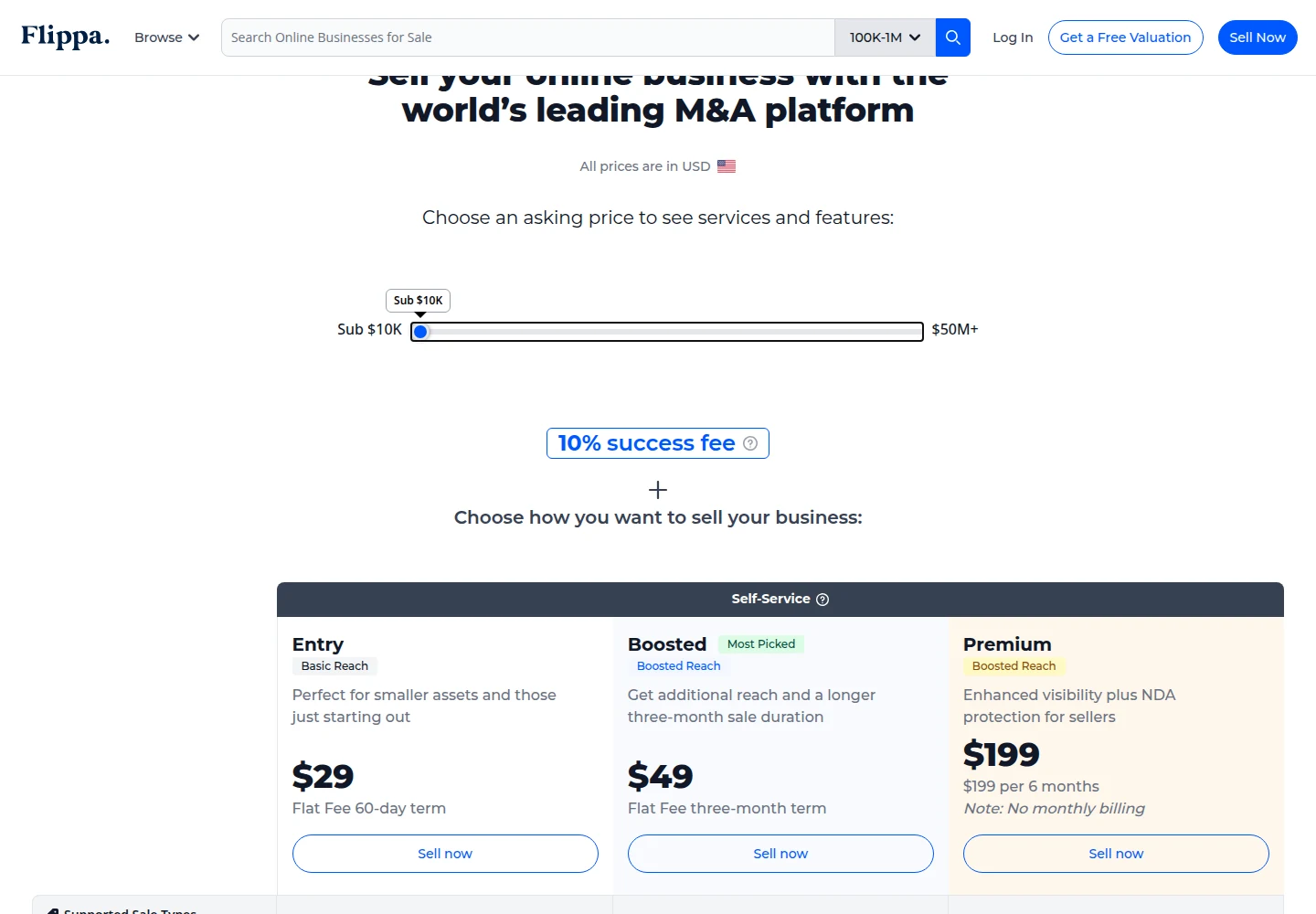
Flippa's pricing page changes with asking-price band and sale route. At the November 8, 2026 check, the selected sub-$10,000 self-service band showed the following USD prices:
| Item | Displayed November 8, 2026 | Important condition |
|---|---|---|
| Entry self-service listing | $29 | 60-day term; basic reach |
| Boosted self-service listing | $49 | Three-month term; boosted reach |
| Premium self-service listing | $199 | Six-month term; NDA included |
| Success fee in that selected band | 10% | Charged on a completed sale |
| Premium buyer access | $49 monthly; check the current annual option separately | Early access and additional buyer tools |
| FlippaPay / Escrow.com | From 1% / 1.2% as displayed | Exact cost and discounts depend on route and plan |
This is a dated snapshot, not a quote. The live Flippa pricing selector displays different packages, upfront fees, and success fees for other asking-price bands and broker-led routes. Verify the selected band and all add-ons before listing or making an offer.
Calculate seller net proceeds after listing, success, payment, escrow, legal, tax, and transfer costs. Buyers should also price subscriptions, assessment services, advisers, remediation, and their own time.
An older Flippa fee-help page still describes FlippaPay from 0.5%, while the pricing page above displays from 1%. Obtain the current provider quote and agreed fee allocation for your transaction; the lower historical figure is not a universal entitlement.
Worked seller example: a $7,500 sale
Assume an eligible asset sells for $7,500 using the $29 Entry package and the displayed 10% success fee. The listing and success fees total $779, leaving $6,721 before every other cost: $7,500 − $750 − $29. A second listing term, optional services, payment fees, advisers and taxes would reduce that amount further. This is a fee calculation, not a valuation or a predicted sale.
That makes the package decision concrete: pay for additional reach or support only when you understand what it changes in your sale process. The current pricing table also includes renewal/relist terms; read those before choosing a term.
Explore Flippa selling options
Choose your actual asking-price band on Flippa before paying. The $29 example applies only to the selected small-asset route. Referral link; Visionnment may earn a commission from qualifying activity.
Free access or Premium: what would justify paying?

Flippa's Premium help page limits its 21-day First Access window to applicable classified listings priced at $10,000 or more. Auctions and sub-$10,000 listings are outside that window. Buyers can still message sellers without Premium; making offers or LOIs during the applicable early-access period is restricted.
Promotional access needs its own check. Flippa's public six-month Premium promotion advertises a free period, but its header says the usual price is $49 a month while its FAQ says $99.
That conflict prevents a reliable renewal-cost assumption. Confirm eligibility, included benefits, when billing starts, renewal price and cancellation terms on the exact offer before accepting. We did not activate the promotion. The 21-day First Access window describes listing access, not a trial's duration.
Consider two fictional buyers. One is evaluating an $8,000 auction: paying does not add the First Access window to that listing, so free access may cover their initial screening. The other has a clear acquisition brief and is evaluating a newly listed $30,000 classified business: the applicable early offer/LOI window may justify Premium if it helps a decision they are ready to make. Paying still does not establish ownership, accurate earnings or suitability.
For a beginner still learning to read financials, extra data cannot replace that skill. Start with free access and a written acquisition brief. Automatic NDA approval applies to future requests after subscribing, rather than retroactively clearing earlier requests.
Fit, alternatives, and decision
| Platform | Strongest fit | Access and curation | Seller support | Main trade-off |
|---|---|---|---|---|
| Flippa | Broad asset types and self-directed deals | Large marketplace; listing-level quality varies | Self-service through broker-led routes | More screening and diligence workload |
| Empire Flippers | Established, profitable online businesses | Curated; current seller minimums apply | Broker and managed migration process | Higher qualification barrier and seller commission |
| Motion Invest | Smaller content sites and selected YouTube assets | Pre-listing review; route chosen after review | Marketplace or occasional direct buy | Narrower fit and material small-deal commission |
| Acquire.com | Startups, SaaS, and online businesses | Marketplace with subscription and closing workflow | Guided tools and M&A support | Startup-centric fit and current listing/closing fees |
Empire Flippers: better for a curated brokered process
See our Empire Flippers review with fee examples and eligibility screenshots if your business has an established profit history and a managed process may be worth the commission.
Empire Flippers' published listing criteria require at least $2,000 average monthly net profit over the previous 12 months and at least 12 months of revenue history, alongside other conditions. Its team handles vetting, buyer access, negotiation support, and migration. That can reduce seller workload, but it excludes smaller or less mature assets and uses a published tiered commission schedule.
Motion Invest: better for a narrower content-site route
At the October 27, 2026 review, Motion Invest's seller page described a website and YouTube focus, pre-listing diligence, marketplace sales, and transfer support. Recheck the applicable route before relying on that historical summary. Some qualifying sites may receive a direct-buy offer, but the company decides the route after review. The Flippa vs Motion Invest comparison separates those proposals and their fee conditions.
Acquire.com: better for startup and SaaS deal tooling
Acquire.com's current marketplace information and seller pricing emphasize startups, integrated financials, NDAs, LOI/APA tools, funds verification, and escrow. Its pricing currently combines a monthly seller listing fee with a closing fee, so compare total route cost rather than one percentage. Use Flippa vs Acquire.com to compare SaaS fit, buyer access and the same seller scenario.
See the broader Flippa alternatives guide or the direct Flippa vs Empire Flippers comparison before selecting a venue.
Is Flippa legitimate?
Flippa is an operating marketplace with published terms, pricing, support documentation, identity checks, transaction tools, and a long public history. “Legitimate” does not mean every listing is accurate or every deal is suitable.
Flippa's own help center distinguishes editorial selection, connected data and manual vetting. Buyers still need to independently reconcile financials, inspect analytics and search data, verify IP and contracts, review the technical stack, and test transferability.
The Trustpilot profile showed 4.3/5 from 3,308 reviews on October 27, 2026. Trustpilot also showed that Flippa has a claimed, paid profile and invites customer reviews. The distribution included substantial positive feedback and 18% one-star reviews. This is a broad but self-selected reputation signal—not an audit of listings or outcomes.
Use the website due diligence checklist even when a listing shows verification, a platform badge, or integrated data.
How to start with Flippa
Listing-level red flags to investigate
A broad marketplace makes a consistent screen valuable. Pause before an offer when:
- the seller supplies screenshots but avoids read-only source access;
- revenue and traffic periods do not match;
- one page, keyword, customer, or program drives most results without a credible mitigation;
- essential content, code, trademarks, email consent, or contractor rights lack a clear chain of title;
- the seller describes account transfer without confirming the provider's rules;
- add-backs remove work or cost the buyer will still need;
- urgency increases while reasonable evidence requests remain unanswered.
None of these automatically proves misconduct. Each changes the evidence required, price, terms, or decision to stop.
Seller preparation that improves the process
Sellers can reduce buyer friction by publishing a consistent monthly profit schedule, preparing source access, naming all included and excluded assets, documenting weekly owner work, and testing transfer paths before listing. A clean package does not guarantee a higher price, but it reduces avoidable uncertainty and contradictory answers.
Keep marketplace messages, data-room changes, offers, and closing instructions inside an auditable workflow. Confirm any payment or credential request through a trusted channel rather than acting on a forwarded message alone.
As a buyer
- Define asset type, budget, operator time, required history, and stop conditions.
- Browse without treating the asking price as value.
- Request source access and reconcile revenue, expenses, traffic, rights, and operations.
- Screen the seller and document every material claim.
- Put price, included assets, diligence, closing, and support into written terms.
- Use a controlled payment and transfer process with qualified advisers where needed.
For a first-pass decision, use the Flippa listing-screening worksheet. A shortlisted candidate can then move through the Flippa buying-process guide alongside full independent diligence.
As a seller
- Reconcile financials and prepare source evidence.
- Confirm IP, contracts, accounts, and transfer paths.
- Choose the correct asking-price band and package on the live pricing page.
- Model net proceeds after all current fees and tax advice.
- Screen buyers before exposing sensitive information.
- Maintain the business during diligence and use a written transfer runbook.
If the asset is only a domain name, the Flippa, Sedo and Afternic domain guide compares that distinct fee, distribution and commitment decision.
For a channel business, use the YouTube acquisition and transfer checklist before relying on subscriber or revenue screenshots. For a website exit, the Flippa-specific seller guide covers package selection, buyer proof, net proceeds, and handover; neither guide replaces the current terms for an actual deal.
If broad access fits your skills and you have a diligence plan, you can explore Flippa through our referral link. Compare suitable assets and the current route terms before making any commitment.
Your first useful session on Flippa
- Set one asset category, a price ceiling and the owner workload you can handle.
- Shortlist three candidates and record what each revenue or verification badge actually covers.
- Ask for the missing evidence before paying for deeper diligence or making an offer.
If you cannot describe the next evidence request, keep learning before bidding. If you can, browsing with that brief is a productive next step.
Frequently asked questions
Does Flippa verify every listing?
No single badge verifies every aspect of every listing. Data Verified covers connected sources, while Vetted by Flippa describes a manual review for the eligible listings noted above. Identity checks and editorial selection serve different purposes. Confirm the actual evidence covered and complete independent diligence.
Is Flippa free for buyers?
Basic browsing and marketplace access may be free, while Premium buyer access and some services cost extra. Payment, escrow, adviser, and diligence costs can also apply. Check the live pricing page for the route you intend to use.
What can be sold on Flippa?
The current seller page lists digital businesses and assets including SaaS, apps, ecommerce, blogs, communities, plugins, YouTube channels, and newsletters. Eligibility, package, and broker fit depend on the specific asset and price band.
Does a Flippa valuation equal a buyer offer?
No. An automated or platform valuation is an estimate based on inputs and comparisons. A buyer sets an offer after evaluating evidence, risk, terms, and alternatives.
Before relying on the public estimate, prepare the actual asset model, earnings periods, cost and owner-work evidence, concentration and transferable assets. Retain what you supplied and distinguish the estimate from an asking price, an offer and net cash after a completed sale. We have not submitted a valuation or measured the tool's accuracy. Use the normalized valuation method and earnings-quality review to test the input evidence rather than treating a calculator label as verification.
Does Flippa have a referral program?
Yes. Flippa's public referral terms cover qualifying attributed activity within a 12-month window and require a minimum $5,000 listing price for referral rewards. Marketplace eligibility for a smaller starter asset is a separate question. Qualifying-user, country, attribution, exclusions and approval conditions also apply.
The incentives use actual qualifying fees paid to Flippa, not the business purchase price. A buyer event does not establish that the buyer paid a qualifying success fee; listing-fee and success-fee events have different payment clocks. Visionnment uses a referral link on this page, but an outbound click does not establish a qualifying event, attribution or payment. Confirm the current terms before treating a potential referral as commissionable.
Verdict
Flippa is a practical choice when broad access and route flexibility matter more than curation, and when you have the skill or advisers to verify a deal independently. Its transaction tools can organize the process, but they do not convert an uncertain listing into a safe acquisition.
Choose Empire Flippers when a qualifying business benefits from a more curated brokered process. Consider Motion Invest for a smaller content-site focus or Acquire.com for startup/SaaS deal tooling. Whichever route you use, make evidence—not marketplace branding—the basis of the decision.
This review is based on public sources; we have not tested the platform or completed a transaction.
Ready to compare? Explore Flippa
Use the shortlist and evidence checks above when you browse. Marketplace access is the beginning of the decision. Referral link; Visionnment may earn a commission from qualifying activity.
Keep comparing
A tool should fit the asset and the decision.
Compare alternatives on actual workflow, total cost, control, and the steps needed to transfer an asset later.