
Digital business asset purchase agreement schedules should describe what changes hands, what stays behind and what evidence confirms completion. A document saying “the website” can leave software rights, customer obligations, stock or a personal mailbox dangerously ambiguous.
Build an asset-and-obligation register for qualified counsel, then reconcile it with price, consents, disclosures and release instructions. This is a preparation method, not a universal agreement or legal opinion. A company-share transaction needs its own structure and governance review.
The schedule below is hypothetical. No contract was drafted, signed or tested. You need current asset records, rights and provider terms, financial obligations, the proposed consideration and the actual transaction documents.
1. Define included assets, exclusions and liabilities
List assets individually or in clearly bounded groups. Identify domains, code, content, designs, inventory, contracts, customer data, provider arrangements and operating records. Separate ownership from access: a repository login does not establish every code right.
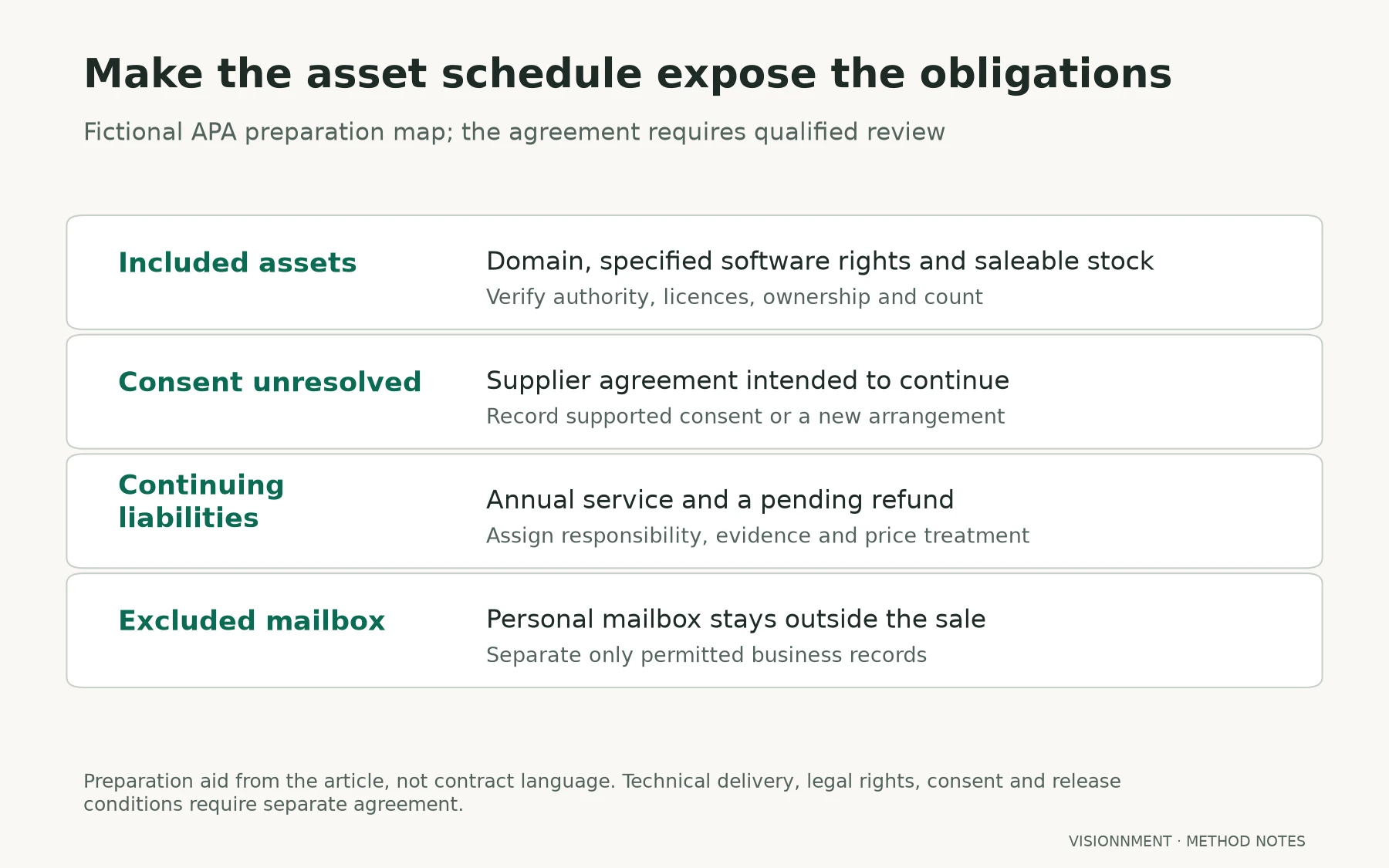
For the fictional sale, the starting schedule is:
| Item | Proposed treatment | Evidence or unresolved question |
|---|---|---|
| Domain | Included | Registrant authority and supported transfer |
| Software | Specified rights included | Creator and dependency licences |
| Stock | Identified saleable units | Ownership, count and valuation |
| Supplier agreement | Intended continuity | Consent or new arrangement unresolved |
| Annual customer service | Continuing obligation | Delivery responsibility and price treatment |
| Pending refund | Unresolved liability | Amount, decision and responsible party |
| Personal mailbox | Excluded | Separate permitted business records |
For every row, name the owner, recipient, evidence, approval, price treatment and acceptance check. Do not assume an exclusion removes an obligation to provide necessary business information lawfully.
Ask counsel to distinguish assets from assumed and retained liabilities. A seller receiving annual customer payments before closing may leave future service work for the buyer. The economics and legal allocation need to be explicit.
BDC's acquisition overview provides a broad transaction framework. The actual register makes that investigation specific to your business.
2. Reconcile consideration and cash at closing
Record total contractual consideration separately from cash due at closing. Identify deposits, deferred payments, seller financing, contingent amounts, stock treatment and any working-capital adjustment. Do not treat every component as immediately available money.
Match the economic schedule to the assets. If stock is priced separately, make that visible rather than counting its value in both the headline and an extra payment. If annual customer obligations remain, identify how the agreed treatment affects the economics.
Build a closing statement with expected, contracted and collected fields. Keep commission, professional costs, debt settlement, retained liabilities and adviser-determined tax provisions distinct. An arithmetic balance is not proof that the funds arrived.
For US asset transactions, the IRS Form 8594 overview describes reporting that applies to specified purchases of a trade or business. Ask the tax adviser about applicability and allocation before the parties lock in economic terms; do not assume the form covers every deal.
If the parties disagree about what the price buys, resolve the scope before improving the wording. A polished agreement cannot substitute for agreement on the underlying transaction.
3. Map consents and disclosures to specific conditions
Identify third parties whose contracts, accounts or rights may need action. Separate assignment, change-of-control, identity verification and new-account approval. The applicable route depends on the actual transaction and governing terms.
For the supplier row, record the requested consent and current status. For the software row, identify the licence or assignment supporting the buyer's use. For customer data, keep the purpose and legal basis question separate from the technical export.
Create a condition register with the required result, responsible person, target date, evidence and consequence if unresolved. Avoid writing “all approvals complete” when a provider has merely acknowledged a request.
Keep disclosures current. If an unresolved refund becomes a known obligation, update the schedule and advisers. A material change should not remain hidden because the first draft was already circulated.
Quiet Light's contract overview describes purchase agreements and related documents in its process. It is useful context, but counsel must determine the actual warranties, disclosures, remedies and conditions for this transaction.
4. Specify delivery, inspection and release evidence
Separate asset delivery from operational acceptance and payment release. A domain arriving in the intended account establishes one fact. A buyer reproducing a deployment establishes another. Neither automatically resolves every legal or financial condition.
Use a delivery matrix: asset, supported transfer route, delivery event, verification task, evidence location, person accepting and applicable deadline. Link it to the actual signed instructions rather than inventing a standard inspection period.
Escrow.com's process overview explains a general payment structure. Its presence does not establish that every promised obligation is secured or that funds can be held indefinitely. Read the transaction's instructions, inspection and notice terms.
Verify payment instructions independently through an established trusted channel. Do not rely solely on a changed bank-detail email or a seller's screenshot. Give the appropriate professionals the exact destination and authorizing process before funds move.
If delivery is incomplete, record the deficiency, evidence, contractual condition, notice channel and deadline. An internal issue list may not satisfy the actual required notice procedure. Counsel and the payment provider should resolve the proper response under the governing documents.
5. Separate holdbacks and later obligations
A holdback, funded escrow milestone and unfunded later promise are different protections. Record where money is held, who controls it, what conditions apply and whether later amounts have actually been funded.
List support obligations concretely: tasks, hours or other agreed boundaries, contact route, duration and escalation. Avoid an undefined promise to “help until everything works,” which can conceal a substantial continuing service commitment.
Track the pending refund independently from future support. Identify who decides it, who pays if required and how the buyer or seller obtains the relevant records. Do not assume the party holding the customer relationship automatically bears every historic claim.
Ask counsel about any proposed non-compete, non-solicitation or restrictive covenant in the relevant jurisdictions. Do not copy a duration or geographic limit from another deal and describe it as universally enforceable.
If the agreement uses seller financing, obtain review of the actual payment, default and security arrangements. A deferred amount is not collected proceeds, and the asset schedule alone does not establish the lender's rights.
6. Walk through the schedules as a rehearsal
Choose a representative row and ask each party to explain the sequence. For the fictional software: which version and rights are delivered, where it runs, which external services remain, who tests the output and what happens if the test fails?
Then rehearse the annual-customer row. Who services the customer after closing, how is access maintained and what records can lawfully follow? If the parties give different answers, the schedule is not ready for signature.
Use Empire Flippers' buying-process explanation or Acquire.com's transaction guide only for the chosen platform's workflow. Neither replaces the actual agreement or independent advice.
Compare the schedules with the LOI and exclusivity record. Explain any change in scope, price, conditions or deadlines. Do not assume an earlier commercial summary resolves a later inconsistency.
Keep a final version register and a clear authorized signatory list. The closing team should know which agreement, schedules and instructions govern rather than assembling them from scattered messages.
7. Close with a complete exception record
Before acceptance, list conditions completed, conditions waived through the proper authorized process and conditions still open. Retain evidence supporting each status. A checkbox without a source is weak closing documentation.
If a material asset cannot follow, pause that condition and obtain advice on repair, changed scope, price or a permitted termination. Do not silently replace it with a lesser capability while preserving the original representations.
After closing, retain the signed packet, transfer evidence, actual payment records and continuing-obligation calendar securely. Access should match legitimate operating and professional needs.
The Empire Flippers seller guide covers a separate provider route where relevant. The accepted result here is a schedule that exposes omissions and makes responsibilities reviewable—not a claim that a generic template has made the transaction safe.
Common questions
Does an asset purchase agreement cover shares too?
An asset schedule does not substitute for the appropriate equity transaction and governance documents. Confirm the transaction form with counsel.
Is receiving source code enough to release funds?
Only the actual agreed conditions can answer that. Rights, reproducibility, dependencies and other assets may remain unresolved.
What if the parties disagree during closing?
Preserve the evidence and use the agreement's notice, escalation and dispute process with advisers. Do not invent a deadline extension or payment remedy unilaterally.