
Digital business LOI exclusivity questions matter before an owner treats a headline offer as the best deal. A letter of intent can describe a proposed transaction while also containing provisions intended to bind the parties. Its title alone does not settle the legal effect.
Prepare a comparison of scope, evidence, funding, exclusivity, timing and exit conditions for qualified counsel. This guide helps organize that review; it does not draft clauses or decide whether a particular document is enforceable.
The $250,000 and $230,000 offers below are hypothetical. No offer was made, accepted or legally reviewed. You need the actual document versions, authority of the parties, current seller evidence and the applicable platform or broker agreement.
1. Separate initial interest from an LOI
Record what has actually occurred: an enquiry, an indicative price, a written offer, a signed LOI or a definitive purchase agreement. A buyer expressing interest is not evidence of funding or an obligation to close.
Ask what the document is intended to achieve. It may establish a diligence framework, outline consideration and propose a timetable. Some transactions use another structure, so do not assume every sale follows exactly the same sequence.
Quiet Light's contract overview describes several documents commonly encountered in online-business sales. Use that provider account as context for your adviser questions, not a universal statement about the legal effect of all LOIs.
Create a version record with date, sender, recipient and attachments. Identify any schedules incorporated by reference. An email describing the price can differ from the document later presented for signature.
If you cannot tell which version is current, resolve that before comparing terms. A well-organized summary of the wrong draft can create more confusion than no summary at all.
2. Identify intended binding provisions with counsel
Flag confidentiality, exclusivity, costs, governing law, dispute procedures, access obligations and termination questions. Ask counsel what is intended to bind, what may bind under the applicable law and how inconsistencies should be resolved.
Do not describe the entire LOI as harmless because the commercial price is labelled non-binding. Equally, do not assume signing automatically completes a binding purchase of every asset. The wording, structure, conduct and jurisdiction matter.
Use a question table rather than rewriting clauses yourself:
| Provision | Question for review | Practical dependency |
|---|---|---|
| Exclusivity | What activity is restricted, for whom and when? | Other buyer conversations |
| Confidentiality | What can be used, shared or retained? | Diligence access |
| Costs | Who pays if the deal stops? | Review budget |
| Expiry | What ends automatically and what survives? | Next negotiation step |
| Authority | Who can sign for each party? | Valid approval process |
Give counsel the platform or broker terms too. Flippa's terms of service can create a separate relationship from the proposed buyer-seller document. A private label in the LOI does not automatically erase introduced-buyer or platform obligations.
3. Define asset scope, funding and evidence conditions
Write what is proposed for sale and what is excluded. Separate a domain and content purchase from a company share purchase. Identify stock, software, customer obligations, contracts and data that the buyer expects to receive.
Record the consideration components: cash at closing, deferred payments, contingent amounts, assumed obligations and any financing. A larger total with uncertain later payments is not economically identical to a smaller all-cash proposal.
Ask for appropriate evidence of the buyer's funding route. Funds verification, a financing condition and final lender approval are different events. Keep any confidential financial material within the authorized review process.
Map the diligence conditions to records the seller can actually provide. If a buyer needs customer-contract consent, identify the party and supported process. Do not promise to deliver an approval controlled by someone else.
For background on transaction stages, Acquire.com's buying guide separates offer, diligence and closing work. It does not establish that the parties' actual conditions have been satisfied.
4. Compare the two hypothetical offers
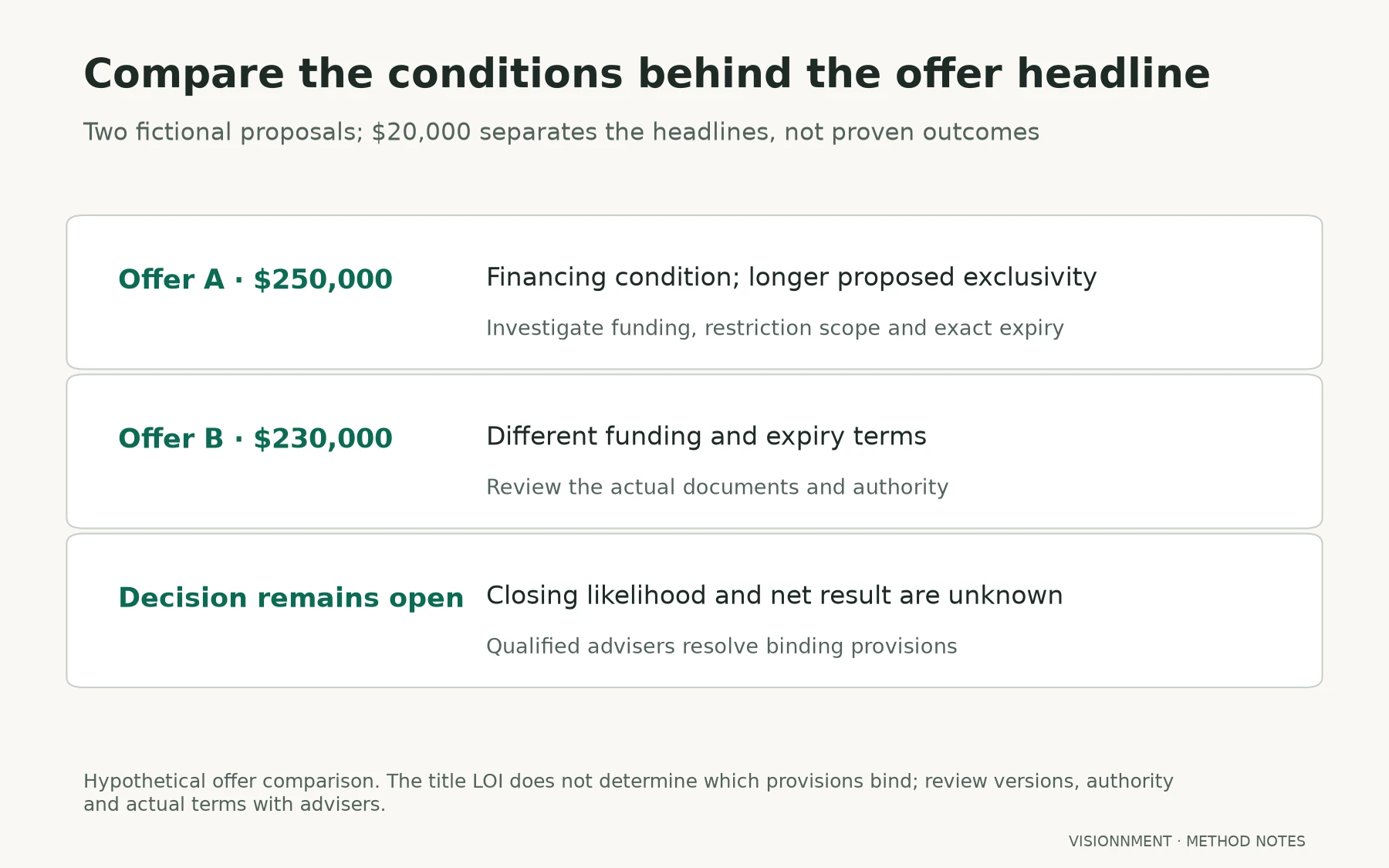
Offer A has a $250,000 headline, a financing condition and a longer proposed exclusive period. Offer B has a $230,000 headline with different funding and expiry terms. The $20,000 difference is real arithmetic, but the example does not supply enough information to choose a winner.
| Hypothetical factor | Offer A | Offer B |
|---|---|---|
| Headline consideration | $250,000 | $230,000 |
| Funding | Condition requiring investigation | Different terms requiring evidence |
| Exclusivity | Longer proposed period | Review the actual period and scope |
| Expiry | Confirm exact date and effect | Confirm exact date and effect |
| Closing likelihood | Unknown | Unknown |
Do not invent a probability of closing to make a spreadsheet decisive. Instead, identify what evidence could change the comparison: funding documentation, adviser review, a narrower exclusive period or a clearly defined diligence milestone.
Ask what the seller cannot do while exclusive. Can they respond to unsolicited enquiries, operate normal marketing or continue an existing discussion? Those questions need the actual wording and counsel's answer.
If the buyer requests an extension, treat it as a new decision. Record progress against the original evidence plan, the unresolved dependency and the consequences of extending. Silence or continued cooperation may have consequences under the actual arrangements; obtain advice before assuming the period simply vanished.
5. Preserve operating and confidentiality responsibilities
Continue ordinary operation under the applicable agreements. A sale discussion does not remove customer delivery, security, support or reporting obligations. Record material changes rather than allowing the earnings presentation to become stale.
Plan staged access. Early summaries may answer a question without disclosing identifiable customer records or broad production credentials. Give the buyer only the authorized access needed for the current diligence task.
Identify who may contact staff, customers, suppliers and providers, when contact is permitted and how it is documented. An LOI should not become an implied blanket mandate for unsupervised outreach.
Keep a disclosure log linking each material update to its source and recipient. If profit changes, explain the new information consistently. Do not give different buyers contradictory versions because one received a more favourable earlier packet.
If the deal stops, follow the actual confidentiality and data-return or destruction process. A failed sale does not create permission to keep using another party's confidential information.
6. Record expiry, extension and withdrawal questions
Prepare a timeline containing signature, access start, diligence milestones, exclusivity end, document deadlines and proposed closing. Specify time zones and the notice mechanism where the documents do. Do not invent default deadlines.
Ask counsel what must happen to terminate, extend or withdraw and which obligations survive. A buyer changing their mind is not necessarily enough to erase every commitment. A seller should also understand the cost and remedy questions before acting.
If a material condition fails, record the condition and evidence. Compare a supported repair, revised commercial terms or a permitted end to the process. No approach guarantees a better negotiating outcome.
Move the accepted scope into the asset-purchase-agreement preparation guide when that transaction form fits. A share sale needs the appropriate governance and transaction review instead of an asset schedule alone.
Bring structure and allocation questions to the sale-tax adviser checklist before economic terms become difficult to change. The LOI is not a tax opinion.
Finish with an adviser-ready comparison
Your packet should contain both complete offers, a consistent consideration table, evidence status, proposed deadlines, binding-provision questions and a record of the seller's priorities. Keep unknown funding and consents labelled unknown.
Use website sale preparation to organize the operating evidence and the Empire Flippers selling guide only if that provider is the actual route. There is no immediate commercial recommendation here.
The accepted result is a precise next decision: seek clarification, negotiate a stated issue, obtain advice on a current version or decline within the applicable process. The larger headline alone should not make that decision.
Before sharing the comparison, confirm that every attachment reached the adviser and that both offers use the same currency and asset scope. If one proposal excludes stock or includes an unfunded contingent amount, identify that difference prominently. Otherwise the comparison can preserve the headline while losing the economic question it was meant to answer.
Common questions
Is an LOI binding?
Some provisions can be binding even when a proposed purchase remains conditional. Qualified counsel must review the actual wording and law.
Does exclusivity guarantee a sale?
No. It can restrict activity while evidence, financing and other conditions remain unresolved. Compare its cost and purpose explicitly.
What should I do before signing an extension?
Check completed diligence, remaining work, funding, changed facts and surviving obligations with advisers. An extension should be a documented decision, not an automatic response to delay.