
Buying an ecommerce business with a third-party logistics provider requires three separate handovers: permission to use the service, an accurate stock and order position, and a working flow of fulfillment messages. A successful store ownership change does not, by itself, establish any of those conditions.
Use this ecommerce 3PL handover checklist to produce an authorized cutover record. Gather the 3PL agreement, warehouse stock reports, location and SKU maps, open orders, returns, unpaid charges and integration documentation. Involve the seller, buyer, warehouse contact, store operator and advisers responsible for contract questions. Do not start changing live routing until responsibility and a supported transition path are clear.
Identify the agreement and provider consent
Identify the contracting entity and the person authorized to instruct the warehouse. Record the agreement’s scope, service locations, billing terms, deposits, release conditions and any assignment or ownership-change provisions. Ask qualified counsel to interpret material restrictions; warehouse possession does not establish the buyer’s right to direct the stock.
Obtain provider confirmation for the actual transaction. An asset purchase, entity acquisition and simple administrator change may need different steps. Ask whether a new agreement, credit review, account setup or guarantee is required. Record unresolved items as conditions rather than assuming the old terms continue.
Quiet Light’s diligence discussion includes vendor and operating questions in the review process. Use that as a prompt to collect evidence, not as proof that any named provider has consented to the sale.
Separate warehouse continuity from store continuity. Shopify’s ownership guidance explains its supported store ownership routes. It does not assign an independent warehouse contract. Keep both approvals in the transaction schedule, with their own responsible parties and acceptance evidence.
Reconcile warehouse stock states and release rights
Take a dated inventory snapshot from the warehouse and store. Match SKU, variant, location, unit of measure and condition. Resolve duplicate identifiers or bundles before comparing totals. A carton count cannot be reconciled directly with individual saleable units without a conversion rule.
Separate physical possession from availability. Identify saleable stock, reserved units, damaged goods, quarantine, goods in transit and customer returns awaiting inspection. Ask who owns each quantity and whether any lien, unpaid charge or release restriction affects it. Escalate legal ownership questions to advisers.
Use a simple reconciliation: opening stock plus received movements, less shipped movements, adjusted for documented returns and other changes, equals closing physical stock. Then bridge physical stock to saleable stock by condition and reservation status. Preserve the report date and movement cutoff so the same shipment is not counted twice.
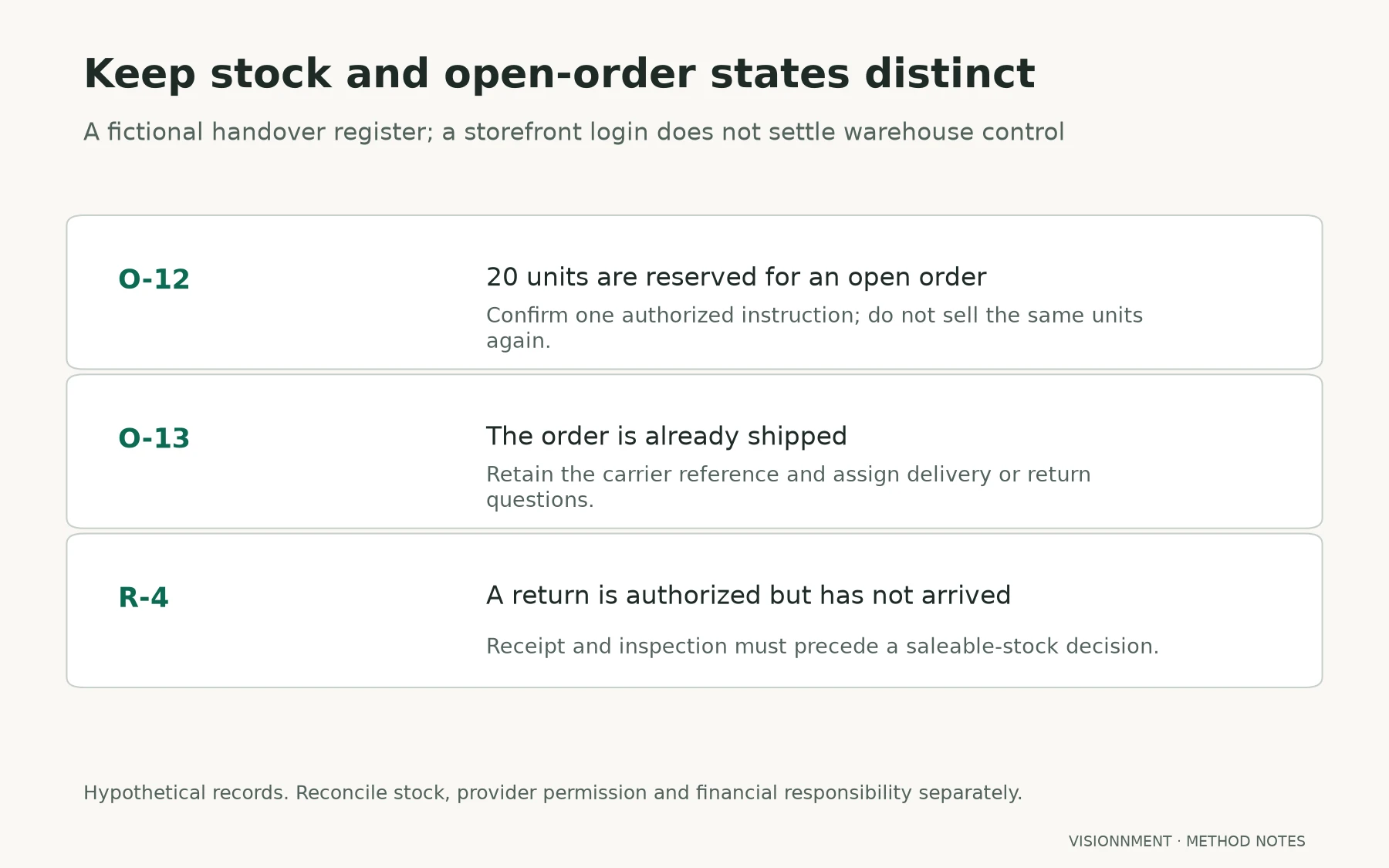
A hypothetical record includes the following states:
| Record | Physical or order state | Assigned next action | Required evidence |
|---|---|---|---|
| O-12 | 20 units reserved | Buyer order lead confirms routing | Warehouse reservation and order match |
| O-13 | Shipped | Support owner monitors delivery | Shipment and carrier reference |
| R-4 | Return authorized, not received | Returns owner tracks receipt | Receiving and inspection record |
| Location B stock | Saleable only after reconciliation | Inventory lead confirms quantity | Dated count and ownership evidence |
R-4 does not increase saleable inventory when a refund or return is authorized. Receipt, inspection and the applicable stock policy remain outstanding. Likewise, O-12’s reserved units should not be offered again simply because the buyer now controls the store.
Map apps, locations and fulfillment messages
Document how an order becomes a warehouse instruction. Identify the integration type, location assignment, trigger, acknowledgement, shipping update and failure notification. Include manual email steps, webhooks, apps and any middleware. Name the account that pays for and controls each component.
Shopify’s custom fulfillment guidance distinguishes its email-based custom services from app-integrated services. Custom services do not automatically update order status in the same way. The buyer must understand the actual route instead of assuming every warehouse sends a complete tracking update back to Shopify.
Create a message map for each location. Record the initiating event, receiving system, unique order identifier, expected response and retry owner. Where a message can be repeated, ask the technical operator how duplicate fulfillment is prevented. Do not replay live orders merely to see what happens.
Shopify’s fulfillment overview describes location, routing, shipping and return capabilities. Use the applicable features as an inventory of possible dependencies, then verify which are actually configured. A documented feature is not evidence that the seller implemented it correctly.
Confirm who can change credentials, fulfillment addresses and notification settings. Rotate access through an approved plan, preserving continuity and recovery. Removing the seller’s only integration identity before the buyer has a supported replacement can interrupt instructions even while the storefront remains available.
Assign open orders, returns and cancellation exceptions
Build an open-obligation register at the agreed cutoff. Include order number, customer promise, paid amount, reserved quantity, shipment state, refund status, responsible operator and financial allocation. Identify partial orders separately. A single “fulfilled” label can conceal split shipments or an unacknowledged cancellation.
For O-12 in the hypothetical example, one named buyer operator owns the next warehouse instruction for its 20 reserved units. The seller must not send a competing instruction after the cutoff. The warehouse contact confirms the request was received and records the resulting state.
For O-13, preserve shipment evidence and assign responsibility for delivery questions and any later return. For R-4, identify who receives the item, who approves the refund, which party bears its cost and who decides whether the returned stock can be sold. These can be different people.
Check cancellation-pending orders before running a cutover. Shopify’s custom-service instructions tell merchants to contact the fulfillment provider directly when canceling or changing fulfillment. A changed admin status therefore does not establish that the warehouse stopped the package. Obtain acknowledgement through the actual operating route.
Keep financial responsibility separate from customer communication. A buyer may handle a customer inquiry while the agreement allocates the associated refund to the seller. Ask advisers to document material allocations; the operating sheet should point to the controlling agreement rather than invent a legal settlement.
Rehearse an authorized cutover and rollback
Agree a limited rehearsal using synthetic or otherwise expressly authorized test records. Define expected results before sending anything. If the provider cannot support a safe test, use a documented walkthrough and identify the untested dependency. Do not report a rehearsal as completed unless it actually occurred.
The test plan should trace one order instruction, one acknowledgement and one status update across the intended buyer-controlled route. It should also cover a rejected message or unavailable service. Verify that notifications reach the correct operator without sending misleading customer messages or dispatching unwanted goods.
Set a cutover window with a change owner and a communication channel. Freeze unnecessary configuration changes and capture the open-order snapshot. Record what the seller stops doing and what the buyer begins doing. A short pause can be easier to reconcile than overlapping uncontrolled operation, but only use a pause that fits customer obligations and provider support.
Define rollback before making the change. Name the condition that triggers it, who has authority, which configuration can be restored and what stock or order states must be reconciled first. Rolling back software does not reverse a package already shipped or a refund already issued.
In the hypothetical register, an unacknowledged O-12 instruction holds acceptance for that workstream. The operator checks the warehouse state before retrying, preventing a duplicate shipment. The response is evidence-led rather than assuming silence means the instruction failed.
Accept stock, service and financial obligations separately
Close each workstream on its own evidence. Stock acceptance needs reconciled quantities, conditions, ownership and release rights. Service acceptance needs provider permission and a usable instruction route. Financial acceptance needs agreed charges, deposits, open-order allocations and responsibility for later corrections.
Review the first operating cycle under buyer control. Match shipped quantities to order records and warehouse charges. Investigate a mismatch at the relevant identifier and date rather than offsetting unrelated differences to make the totals agree. Preserve unresolved items with a named owner and due date.
The website handover checklist coordinates the wider digital assets around the warehouse transition. If a broker-assisted purchase is relevant, the Empire Flippers buying-process guide explains that optional route. Neither replaces the 3PL’s actual agreement or supported integration instructions.
The finished record should let a new operator answer one question for every open order: who can act next, what evidence establishes completion, and what happens if it fails? That clarity supports continuity. It does not guarantee future sales, uninterrupted fulfillment or the commercial success of the acquisition.
Keep the warehouse contact list with the register, including an approved backup. An exception discovered outside the main contact’s working hours still needs a responsible person and a supported response.