
Affiliate disclosure: Visionnment may earn a commission from qualifying referrals to Empire Flippers, including eligible seller or buyer referrals under its programme terms. That commercial relationship does not determine our analysis. Referral eligibility and payment depend on the provider's current conditions.
Use the Empire Flippers valuation tool after reconciling your records, not as a substitute for them. Its public questions vary by business model, and the estimate is a starting point for discussion. It is neither a guaranteed offer nor evidence that your business will be accepted for listing.
This guide reviews the public input categories available on November 16–17, 2026. No calculator submission or accuracy test was performed. The worked seller packet is hypothetical, so its figures illustrate preparation rather than a result returned by the tool.
You need twelve months of revenue and expense records, a clear business model, the creation or acquisition date, audience records and model-specific operating evidence. Preparing those inputs may expose more useful questions than the estimate itself.
1. Assemble a packet for the actual business model
Begin with the earning mechanism. A content site's visitor and monetization records do not replace a SaaS business's subscription records, and an ecommerce seller's sales do not explain stock funding. If the business has several mechanisms, identify the primary one and preserve a breakdown of the others.
The public valuation page asks owners to prepare the business's creation date, annual gross revenue and net profit, average monthly unique visitors, email subscribers or social followers, and model-specific details such as products, downloads or revenue models. Follow the actual form's definitions when you use it; do not assume every field appears for every model.
Prepare a source beside each input:
| Input | Supporting record | Question to resolve |
|---|---|---|
| Gross revenue | Sales or billing ledger | Are refunds and tax treated consistently? |
| Net profit | Reconciled monthly accounts | Are recurring costs complete? |
| Business age | Domain, company and operating history | Does creation differ from acquisition? |
| Audience | Named analytics report and dates | Are users, sessions and visitors confused? |
| Model details | Product or subscription records | Does the count describe active or historical items? |
Keep bank receipts alongside the ledger, but do not substitute deposits for the revenue calculation. Timing, processor fees, refunds and receivables can make them different.
If the packet contains seller adjustments, show reported profit, each proposed adjustment and the resulting earnings separately. A buyer may need to replace work you currently do without pay. Adding back your compensation does not eliminate that operating task.
2. Label annual and monthly earnings explicitly
The current public estimator describes a trailing twelve-month profit basis. Older marketplace discussions may use monthly-profit multiples. Both can express a valuation, but they are not interchangeable labels.
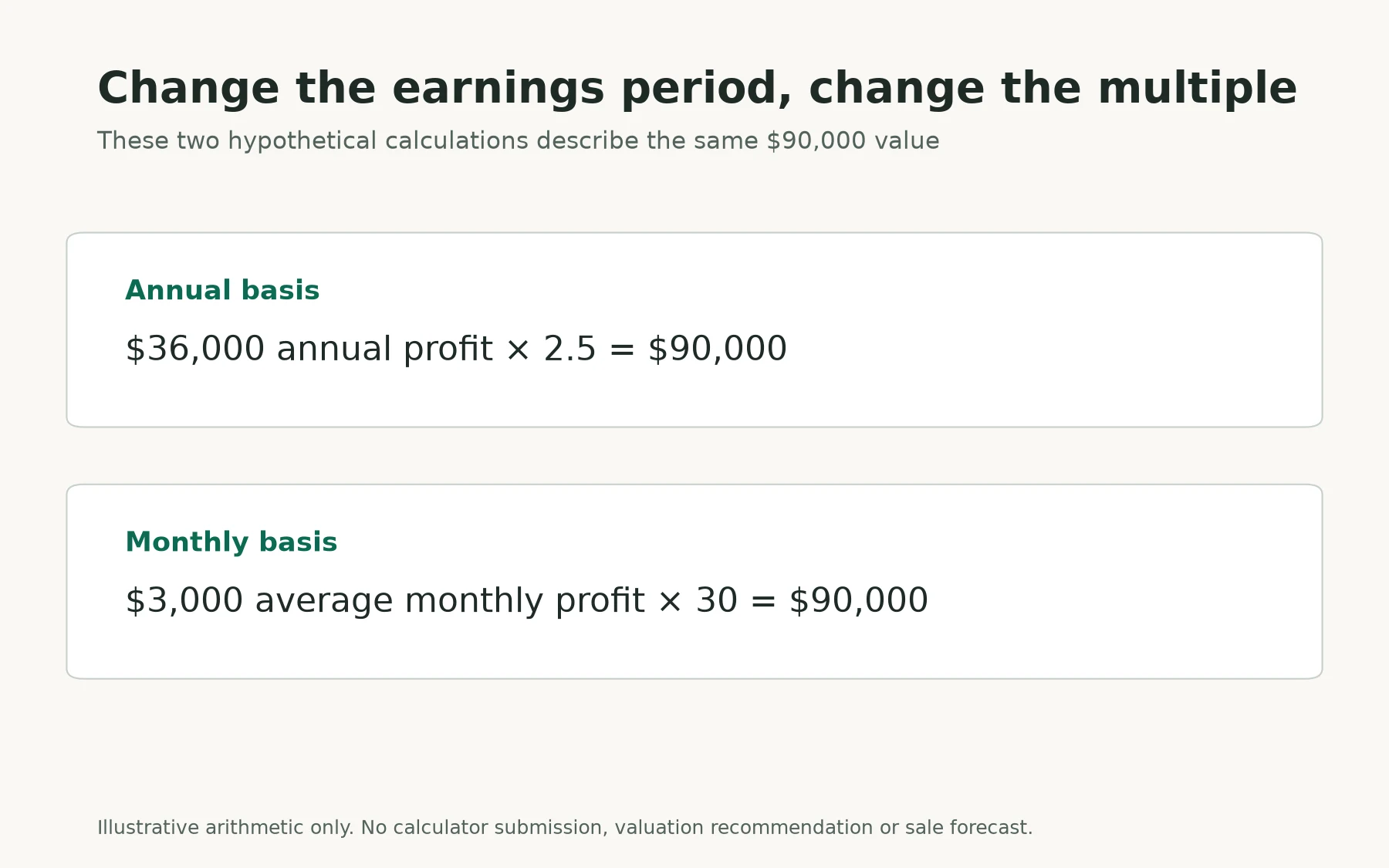
Suppose a fictional business has twelve monthly columns totalling $36,000 of profit. Dividing by 12 gives average monthly profit of $3,000. These are two descriptions of the same earnings period, not two independent performance observations.
For an illustrative calculation only, an assumed 2.5 times annual earnings would produce $90,000. The mathematically equivalent multiple of average monthly earnings would be 30 times, also producing $90,000. Neither number is a submitted calculator output or an Empire Flippers recommendation for this fictional business.
Write the period directly beside the amount: “$36,000 trailing twelve-month profit, ending October 31” is more useful than “$3,000 earnings.” Identify the currency too. If you only have six months, mark the missing history rather than silently annualizing it into a twelve-month record.
Inspect the monthly series for a decline, seasonal peak or one-time promotion. Two businesses can have the same annual total with different current operating conditions. Give a reviewer the series and the explanation rather than hiding both behind an average.
3. Walk through the categories without manufacturing precision
Choose the main monetization model and read each question before transferring a number. Record the measurement period, source and any interpretation needed. If a requested input has no trustworthy record, repair the record or ask what is acceptable; do not enter an aspirational value.
For a content site, distinguish unique visitors from sessions and pageviews. For an application, distinguish cumulative downloads from active or paying use. For a product business, explain whether product counts include inactive variants. A larger count is not automatically evidence of a better business.
The public page describes different earnings conventions for smaller owner-operated businesses and larger managed operations. Treat that description as the provider's methodology, not permission to make any owner expense disappear. Preserve the underlying accounts and ask how replacement management or technical work should be treated in your case.
Record what you entered and why. If you later change an expense or select a different model, keep a second dated version. Otherwise you cannot tell whether a changed estimate came from improved operations, a corrected definition or a different assumption.
Do not submit confidential customer records merely because a tool asks for a count. Use authorized summaries at the requested scope and inspect the relevant privacy and submission terms before providing identifiable material.
4. Treat an estimate as a conditional range
The valuation methodology says the estimate precedes the team's review of financials, traffic and listing price. That distinction is central: a public calculation does not establish what a qualified buyer will pay for your specific rights, risks and transfer obligations.
Create a short interpretation note containing the input date, earnings window, currency, adjustments, unresolved costs and major dependencies. For the fictional $36,000 packet, an unresolved ad-network ownership route or undocumented contractor right remains unresolved even after an estimate exists.
Ask which uncertainties could change the decision. A small software renewal may be easy to price. An account that cannot follow the intended transaction may change what is saleable. Do not pretend both uncertainties are captured adequately by one chosen multiple.
Avoid repeated input changes designed to produce a pleasing number. A useful sensitivity analysis shows a plausible cost or earnings change and explains its cause. It does not remove necessary work, invent diversified traffic or convert a hoped-for contract into current revenue.
5. Separate value, price, offer and proceeds
Keep five fields in the seller worksheet: estimator output, proposed asking price, buyer offer, contractual consideration and cash received. They answer different questions and can differ materially.
An offer may include contingent payments rather than all cash at closing. A contract may allocate stock or working capital separately. A headline price also precedes commission, legal and accounting costs, debt settlement, retained obligations and any applicable tax provision.
The public valuation page describes a commission minimum and progressive rates; the selling guide explains the broader sale process. Obtain a current written quote for the actual price and structure. Do not apply one percentage indiscriminately across higher price bands or assume a minimum never matters.
Make a proceeds worksheet with separate columns for expected, contracted and collected amounts. Leave adviser-dependent tax estimates unresolved until reviewed. An unpaid earnout belongs in the contingent-consideration record, not in available closing cash.
This distinction also prevents a common reading error: a seller reporting a substantial payout has not established the buyer's investment return. Different parties, cash flows and periods require different evidence.
6. Decide whether a seller application is the next step
The dedicated listing requirements reviewed for this guide state at least $2,000 average monthly net profit over the previous twelve months, twelve months of revenue history and at least three months of Google Analytics or Clicky tracking. They also set model-specific and qualitative conditions. Meeting an earnings number alone does not establish acceptance.
Check the dedicated requirements rather than relying on a stray threshold in older general copy. Where provider pages conflict, ask for clarification and retain the answer. Confirm domain-history conditions, customer concentration and restricted-category questions where relevant.
If you qualify and want the supported route, read the Empire Flippers review for the service and trade-offs before proceeding. If you do not qualify, the useful next action is a repair or evidence plan, not inflated inputs.
An established seller whose records and business fit the current conditions can check Empire Flippers seller requirements. Request the applicable eligibility decision, service scope and quote; an estimate does not commit you to a sale.
Common questions
Does averaging $3,000 a month prove acceptance?
No. It establishes arithmetic under your stated earnings definition. History, analytics, category, transferability and the provider's assessment still matter.
Can I use a result in negotiations?
You can explain the dated estimate and its inputs, but a buyer can challenge them. Keep source records and unresolved risks beside the number rather than presenting it as an independent appraisal.
What is a useful outcome if I am not selling?
A reconciled earnings series and a ranked repair list. Those let you address missing records, expensive obligations and owner dependence without assuming an exit price or timetable.