
SaaS failed payment churn recovery starts with invoice and payment evidence. A retry scheduled for tomorrow is not cash collected today, and a paid invoice does not establish that the customer will continue using the product.
Separate voluntary cancellation from billing failure, inspect the actual retry configuration and verify recovery through supported controls. You need authorized billing access, the invoice and subscription identifiers, payment-attempt records, applicable provider documentation and a non-production testing route.
The $100 invoice below is hypothetical. No customer charge, payment-method change or recovery action was performed for this guide. This is an operating procedure for an appropriately authorized person, not permission to act on live accounts.
1. Classify the problem before intervening
Record the observed event: an unpaid invoice, a failed payment attempt, an explicit cancellation or a product-support complaint. Several may coexist, but they are not the same evidence.
A customer can want the service while a payment fails. Another can have a valid card but choose to cancel. A retry policy addresses collection under its supported conditions; it does not resolve dissatisfaction or create permission to continue charging after a valid cancellation.
Use a diagnostic row with invoice amount, service period, customer intent if known, subscription state, attempt result and next authorized action. Do not record a guessed intent as fact.
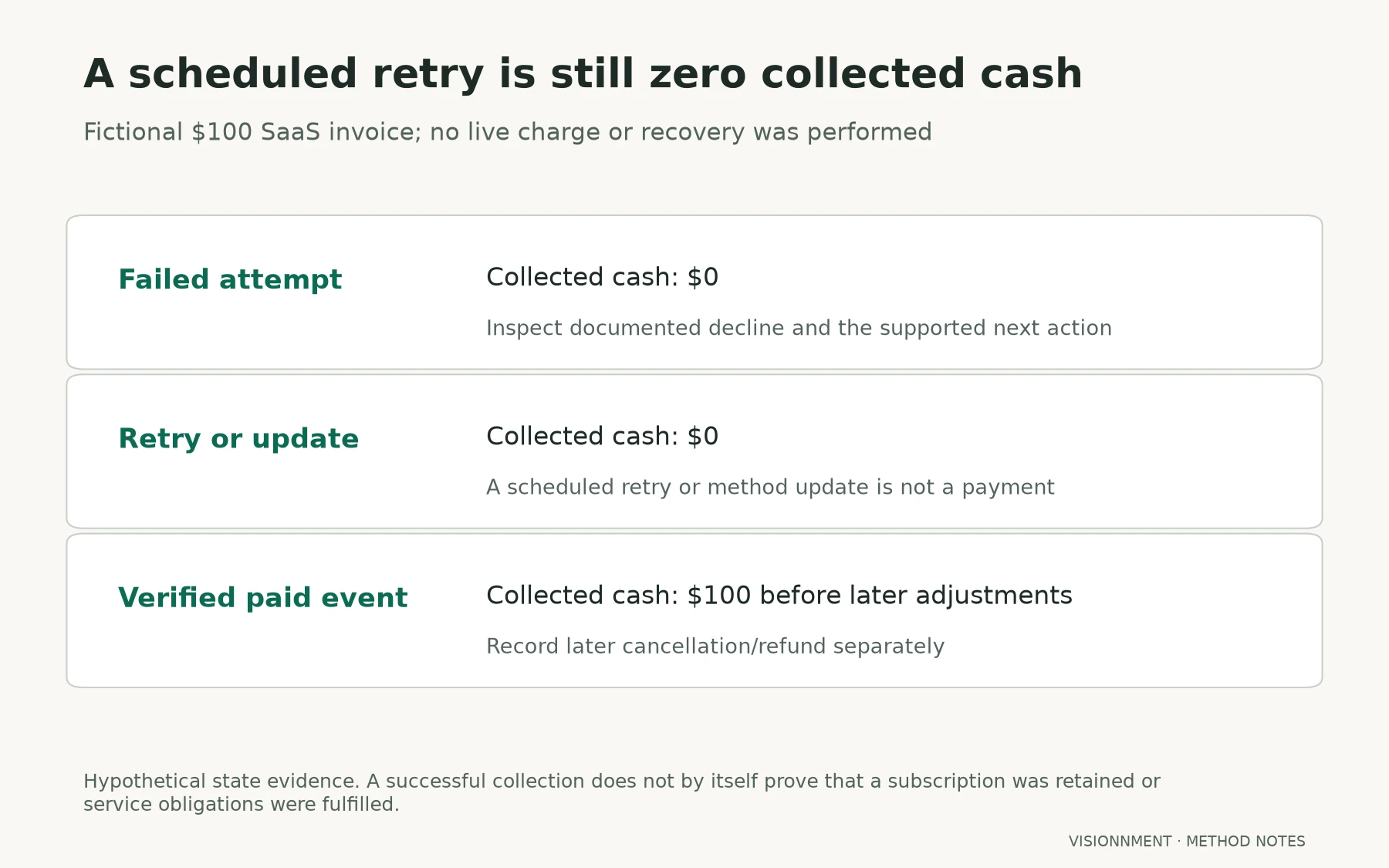
For the fictional $100 invoice, the first attempt fails. Collected cash remains $0. The next question is what the documented failure and account configuration permit—not whether a retention email can persuade the customer to log in.
If the customer disputes the charge or requests cancellation, route that through the applicable support and contractual process. Do not let a recovery metric override the actual customer instruction.
2. Reconcile invoice, subscription and customer states
Retrieve the specific invoice and inspect its amount, status, related subscription, attempt history and relevant events. Confirm that you are looking at the intended environment and customer, using access appropriate to your role.
Keep a state timeline:
| Hypothetical event | Evidence to inspect | Collected cash |
|---|---|---|
| $100 invoice created | Invoice and service period | $0 |
| First attempt fails | Attempt result and decline reason | $0 |
| Retry scheduled | Current retry configuration and event | $0 |
| Payment method updated | Supported update at the relevant scope | $0 |
| Invoice payment succeeds | Actual successful payment evidence | $100 before later adjustments |
The final row is conditional, not a performed result. A later refund or reversal would require another entry. Do not overwrite the history with the latest convenient label.
Inspect the subscription separately. Depending on settings and timing, its state may differ from the invoice's state. Product access can also have a separate application entitlement. Reconcile all three before telling a customer that their account is resolved.
If event handling is delayed or duplicated, use stable identifiers and current provider state to investigate. A dashboard counter alone is insufficient evidence of the final financial outcome.
3. Inspect the actual retry configuration and payment-method priority
Stripe's Smart Retries documentation describes supported retry configuration, payment-method priority and limitations. Inspect your account's actual settings rather than assuming that a documented default is the configuration you use.
The documented priority starts with a subscription-level default payment method before lower-priority customer defaults. Consequently, changing a customer-level default may leave a higher-priority subscription method in use. Follow the supported update process at the field responsible for the failed attempt.
Record the payment method type and the retry policy applicable to it. Direct-debit recovery uses method-specific settings; card retry assumptions should not be copied indiscriminately to other payment methods.
Ask a competent billing engineer to review the event path if configuration and observed behaviour do not agree. Keep a redacted record of the relevant identifiers and settings, without copying card details into a worksheet or chat.
Changing the policy is an operational change, not a recovery result. Verify future supported behaviour in the proper environment and continue to report the unpaid invoice as unpaid until payment evidence supports a different conclusion.
4. Handle non-retriable cases through supported recovery
Not every failure permits another automatic charge. The provider documentation lists limitations including missing payment methods, hard declines and other account or method conditions. Use the specific documented failure, not a general assumption that more retries will solve it.
For a hard decline, a scheduled retry can remain visible while execution requires a new payment method. Stripe also explains that an attempt counter can advance without a new executed charge in such circumstances. Do not interpret either signal as collection.
Use a secure, supported customer route for any necessary update or authentication. Never request raw card information by email, copy it into a support ticket or try to circumvent an issuer's decline.
If the customer cannot complete the supported route, escalate to the provider or the appropriate internal specialist. Record the unresolved condition and the service decision under the applicable agreement. Do not invent a manual workaround that weakens security or bypasses consent.
For the fictional invoice, an updated supported method is an intermediate event. Only a later successful payment can change the collected amount, and the customer may still choose to cancel afterward.
5. Test without making live customers the experiment
Define a non-production test plan using the provider's supported test mechanisms and synthetic customer data. Cover a recoverable failure, a non-retriable case, an authorized method update, successful payment evidence and the configured exhausted-retry outcome.
Specify the expected invoice, subscription and application states for each case. Check notifications, access handling and the records used by support. A configuration screen passing review does not prove the application handles the resulting events correctly.
Limit credentials and access to what the task requires. Keep secrets and sensitive customer data out of the evidence bundle. Use the environment's supported controls and ensure a test cannot reach live charging by accident.
If a test fails, repair the event or configuration path and repeat the affected scenario. Do not repeat unrelated checks indefinitely or begin live retries to compensate for an unexplained test result.
After an authorized production change, monitor real events within the agreed operational process. Testing supports confidence in the workflow; it does not prove any real invoice will be paid or customer retained.
6. Define exhausted-retry and service outcomes
Inspect what happens when recovery ends. The provider can support different subscription outcomes depending on configuration and eligibility. Your application and customer communication must agree with the actual selected route.
Document who decides about access, what the customer is told, how an unresolved balance is handled and how support finds the record. Obtain qualified advice where contract, collection or local legal requirements are uncertain.
Do not leave an unintended loop in which invoices or support demands accumulate while nobody understands the service state. Equally, do not remove legitimate access prematurely because one event arrived late.
For the fictional customer, successful recovery of the $100 invoice and later cancellation should be recorded as two events. Calling the account “retained” solely because payment succeeded would hide the second outcome.
7. Compare recovered cash with continuing retention
Build a recovery report with a defined starting population: eligible failed invoices, amounts, observation window and exclusions. Separate scheduled attempts, executed attempts, successful payments, refunds and reversals.
Avoid double-counting one invoice across several failed attempts. Report the invoice's recovered amount under the chosen definition, not the sum of repeated attempted amounts. Reconcile the total to actual payment records.
Then inspect customer continuation at an appropriate later point. ChartMogul's cohort analysis guidance can support consistent customer groups and elapsed periods, but the selected metric still needs to match your question.
Include provider charges, support work and concessions when evaluating the recovery operation. A collected payment can come with a support burden that affects contribution. Report owner-time imputation separately from cash expenses.
Connect the evidence to building a SaaS digital asset and, when relevant, sale preparation. A successor needs the configuration, state logic and exception handling behind the revenue—not only a recovery percentage.
Common questions
Does a future retry mean the customer will be charged?
No. Execution depends on the payment method, failure, configuration and provider conditions. It certainly does not mean cash has been collected.
Why did changing the default card not help?
Check which supported payment-method field has priority for the subscription. A lower-priority customer change may not replace the method the subscription still uses.
Is a recovered invoice a retained customer?
It is evidence of a payment under its recorded conditions. Continued useful service and later renewal need their own observation.