
A digital-business investment memo should explain why this buyer should own this asset under these conditions. Put the recommendation, material evidence gaps and downside near the front. A long diligence checklist is not enough if the reviewer cannot trace the proposed price, operating plan and decision authority to supporting records.
Prepare a concise decision document with linked schedules rather than copying the entire data room. Gather the mandate, transaction perimeter, reconciled financials, customer evidence, technical findings, provider permissions, staffing plan and financing assumptions. The worked memo below is fictional. It does not describe an acquisition reviewed, approved or completed by Visionnment.
State the mandate, thesis and operating owner
Open with the decision requested: continue diligence, authorize a bounded offer, approve subject to conditions, reject or defer. Specify the capital at risk and the authority being sought. Approval to investigate is different from approval to sign an agreement or release funds.
State the investment thesis as an operating proposition. For example, the buyer may believe its existing team can support a related product more efficiently. Identify the actual capability, what must change and what evidence would refute the thesis. Avoid a claim that a larger portfolio automatically commands a better exit price.
BDC’s acquisition framework connects objectives, budget, adviser responsibilities and integration. Use those connections in the memo: name the proposed operating owner and show that the person has relevant capacity. A transaction sponsor who will leave after closing is not the same role.
Define the mandate and the exception process. If the target lies outside approved geography, business model or capital limits, state that explicitly. The reviewer should not discover a mandate change in an appendix after reading an enthusiastic recommendation.
Reconcile the financial and customer evidence
Separate seller-reported figures, verified records, adjustments and buyer assumptions. Link each material number to a financial schedule with source period, currency and accounting basis. Revenue, bank receipts and profit should have separate labels. Explain unresolved differences rather than obscuring them in a normalized total.
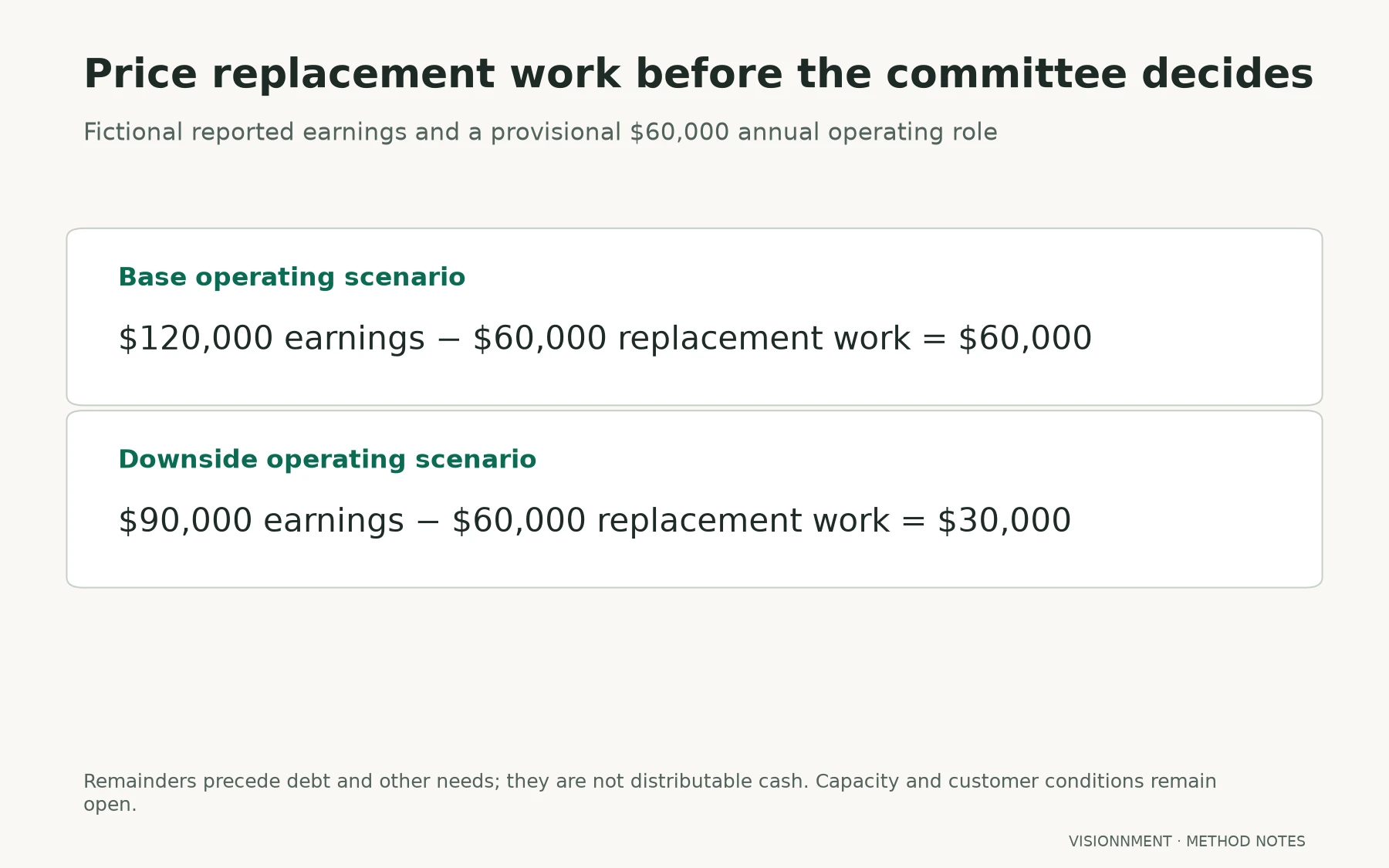
In the fictional memo, the seller reports $120,000 in annual earnings. The buyer estimates $60,000 annually to replace work currently performed by the seller. That leaves $60,000 before debt service and other needs. It is a buyer operating scenario, not proof that the target will earn that amount after acquisition.
| Earnings bridge | Hypothetical annual amount | Evidence needed |
|---|---|---|
| Reported earnings | $120,000 | Reconciled financial records |
| Replacement operating work | ($60,000) | Defined scope, qualified capacity and cost |
| Remainder before debt and other needs | $60,000 | Combined review of both inputs |
Keep the replacement-cost assumption provisional until the team has a credible operator and scope. A quote can help establish cost but may not establish availability or competence. The fictional committee cannot treat $60,000 as a complete solution if nobody has committed to performing the work.
Review customer concentration, retention, refunds, contracts and evidence of current demand at the target’s actual model. FE International’s buyer diligence framework covers these alongside other review areas. Its framework is a source for diligence questions, not independent confirmation of this target’s claims.
Where customer consent or contract continuity may be required, identify the controlling document and adviser assessment. Do not assume every contract requires consent or that no consent is needed. In the fictional case, a material customer-continuity question remains unsupported and becomes a decision condition.
Record technical, rights and people dependencies
Summarize findings by business consequence. A missing deployment procedure matters because the buyer may be unable to release a fix. An unclear content license matters because a material asset may not be usable as assumed. Connect the issue to the thesis, cost, timing and response.
Create a dependency table with current owner, proposed buyer destination, required approval, acceptance test and fallback. Include repositories, infrastructure, payment services, customer data, intellectual property, key people and suppliers as relevant. Ownership of one component does not imply control over all connected services.
FE International’s sell-side diligence framework describes preparing evidence across financial, legal, technical and operating areas. Use the seller’s prepared packet where it is relevant, then independently assess what supports the buyer’s decision. The existence of an organized data room does not establish the truth of every statement inside it.
Separate a repairable gap from a fundamental mismatch. A missing instruction might be addressed through documented training. A business requiring a specialist the buyer cannot obtain may fail the operating mandate. Do not use a larger contingency allowance to conceal a problem that money alone cannot resolve.
For people dependencies, identify continuing responsibilities, lawful engagement requirements and handover commitments. Ask the proposed operator to review the scope. A plan approved without the person responsible for delivery can omit the most material implementation constraint.
Model base and downside operating cases
Build the base case from supported historical performance and explicit buyer adjustments. Then stress the identified risks rather than applying an arbitrary decline to every row. Keep operating earnings, cash available, debt payments and equity proceeds separate.
For the fictional target, $120,000 reported earnings less $60,000 replacement work leaves $60,000 before debt and other needs. If the reported earnings base falls to $90,000 while replacement work remains $60,000, the limited remainder falls to $30,000. This is scenario arithmetic, not a forecast or probability estimate.
Add working-capital timing, immediate repairs, taxes and financing under their actual definitions. Do not imply the entire $60,000 is distributable cash. A business can show positive earnings while lacking cash to meet a supplier deposit, customer obligation or scheduled debt payment.
Show which assumptions drive the recommendation. If most proposed value depends on future customer growth or a higher exit multiple, label that dependency. Distinguish operating improvements the buyer can attempt from market repricing that requires a future willing buyer.
Use the acquisition debt guide for the separate funding and coverage analysis. A financing scenario in the memo does not establish lender approval. Include actual proposed terms and unresolved eligibility questions before asking the committee to rely on borrowed funds.
Set diligence, financing and integration conditions
Write each condition as an observable result with an owner, due date and decision consequence. “Finish technical diligence” is too broad. “Buyer-controlled operator can build the approved running version through the supported deployment route” identifies the required evidence.
Separate conditions needed before an offer, before signing, before closing and after control transfers. Ask advisers to align material conditions with the actual agreements. An internal memo cannot create cancellation rights or change a signed deadline merely by labeling a row mandatory.
In the fictional case, two conditions remain unresolved: qualified replacement operating capacity and the material customer-continuity question. The committee rejects proceeding at present despite positive reported earnings. It may permit a bounded re-review if those conditions are supported, but it does not approve first and hope the evidence arrives later.
Budget the integration work and name the owner. Include duplicate running, training, specialist assistance and exception handling. If the acquisition thesis assumes cost savings, define the baseline and acceptance evidence before counting those savings in the base case.
The sourcing pipeline guide helps preserve the candidate’s path through earlier gates. Carry forward rejection reasons, access restrictions and conflicts. A memo should summarize that decision history accurately without letting prior effort become a reason to approve.
Include a short conditions register beside the recommendation. Each condition should identify the evidence needed to close it and the person authorized to accept that evidence. This prevents a general approval from being mistaken for permission to waive a material dependency.
Preserve dissent, decision authority and review evidence
Record who made the decision, their authority, conflicts, conditions and reasons. Preserve material dissent with its supporting concern. A useful dissent note identifies the assumption or evidence gap; it does not need to become a personal judgment about the sponsor.
Catcha Digital’s August 2024 investor briefing describes one company’s investment memo and committee process. It illustrates disclosed governance in that setting. It is not a universal 2026 approval sequence, nor does adopting similar terminology create equivalent controls.
Store the final memo version with source references and the decision record. If a material assumption changes, obtain the required new decision rather than treating the previous approval as unlimited authority. Keep the original record so later reviewers can distinguish what was known from what was learned afterward.
The Empire Flippers buying-process guide explains one optional assisted transaction route. The investment decision remains the buyer’s responsibility within its governance and adviser arrangements. A strong memo makes the evidence, uncertainty and accountability inspectable; it does not guarantee that an approved business will succeed.