
Digital-business portfolio integration should preserve customer service while changing the systems and responsibilities that support it. Combining reports can be sensible before combining brands, billing or support. Decide what the acquisition thesis requires, then make each workstream prove that it can change safely and economically.
Start with the diligence findings, operating calendars, customer commitments, supplier agreements, staffing capacity and system inventory for both businesses. The output is an integration register with owners, dependencies, cost and acceptance evidence. The hypothetical case below describes a plan, not an integration performed or a promise of savings.
Define the acquisition thesis and integration perimeter
State why the two businesses belong together. The reason might be a shared operating capability, complementary customers or a specific distribution opportunity. Describe the proposed mechanism and the evidence supporting it. A larger combined revenue total is an arithmetic consequence of ownership, not proof of operating improvement.
BDC’s acquisition process connects the acquisition plan with diligence and post-close integration. Translate that connection into scope. If the thesis concerns better reporting, it does not automatically require immediate checkout, brand or product consolidation.
Define the perimeter by entity, product, team, customer segment and system. Include services that will remain separate. Identify which changes require consent, professional advice or provider approval. A buyer’s ownership of both businesses does not necessarily permit unrestricted data sharing or contract reassignment.
Give integration its own operating owner and budget. The person coordinating the programme needs decision authority, access to evidence and a route for unresolved conflicts. Avoid assigning the role to someone whose entire schedule is already needed for customer delivery.
Separate preserve, coordinate and combine decisions
Classify each workstream deliberately. Preserve it when separate operation protects a valuable customer experience or avoids unsupported change. Coordinate it when shared definitions or escalation improve control. Combine it only when the new operating design has a supported route and an acceptable cost.
In the hypothetical case, two businesses keep their existing customer-facing workflows while joining management reporting and escalation responsibility. Customers continue using the established support addresses and service processes. A common reporting layer gives the owner visibility without requiring an immediate customer migration.
| Workstream | Initial decision | Reason | Acceptance evidence |
|---|---|---|---|
| Customer-facing workflow | Preserve | Avoid unsupported disruption | Existing commitments remain served |
| Management reporting | Coordinate | Compare consistent operating measures | Reconciled definitions and totals |
| Escalation ownership | Coordinate | Remove unclear responsibility | Named primary and backup owners |
| Identity and billing | Assess later | Provider and customer dependencies | Approved plan before change |
This table is a decision design, not a universal sequence. A security problem may require immediate containment. An incompatible billing arrangement may prevent a proposed combination. Do not postpone critical controls merely because the wider programme favors a slower transition.
FE International’s buyer diligence framework covers technical, operational and other dependencies that can shape this choice. Use findings about the actual assets rather than assuming a standard software stack makes the businesses interchangeable.
Map customer, employee and supplier continuity
Create a commitment map for each business. List what customers were promised, who delivers it, which people hold necessary knowledge and which suppliers or providers support the work. Include open exceptions and service deadlines, not only the normal procedure.
Review people changes with qualified local advisers. Employment, contractor, consultation and privacy obligations depend on the arrangement and jurisdiction. Do not treat an integration chart as authority to change a person’s terms or grant access to another entity’s customer data.
Quiet Light’s diligence discussion includes vendor and operational review. Ask each material supplier about the actual proposed change and preserve its response. Shared ownership does not itself establish a right to combine accounts, discounts, stock or credit terms.
For customers, identify differences in service level, product behavior, billing date and support expectations. A shared help desk can conceal those differences unless the operator can identify the correct business and commitment. Preserve routing and knowledge before adopting a common interface.
Name a continuity owner for the period between systems. If one team remains responsible for old orders while another handles new activity, write the cutoff and escalation route. Customers should not need to understand the internal acquisition structure to receive the service already promised.
Sequence shared identity, reporting and operating systems
Begin with inventories and definitions. Match account owners, recovery paths, permissions, reporting periods, currencies and metric boundaries. Two dashboards both labeled revenue may measure different events. Reconcile definitions before presenting a consolidated total to decision-makers.
Build dependencies as a sequence. A reporting feed may need authorized access and a data-handling decision before technical configuration. A support migration may require a complete knowledge base and routing map first. Do not confuse the fastest technical task with the next safe operating task.
Keep individual identities and appropriate access controls during the transition. Avoid a shared master password as the integration mechanism. Record who can grant access, who approves exceptional permissions and when old access should be reviewed.
For each change, define the old state, intended state, migration method, acceptance test and fallback. Verify a complete business journey, not only the import job. A successful ticket import does not establish that new inquiries reach the right team or that historical attachments remain appropriately protected.
Use a change window with a named coordinator. Avoid unrelated product and pricing changes during a fragile migration unless business conditions require them. Preserve the event log so a later failure can be traced to the actual sequence rather than attributed vaguely to integration.
Budget duplicate running and exception work
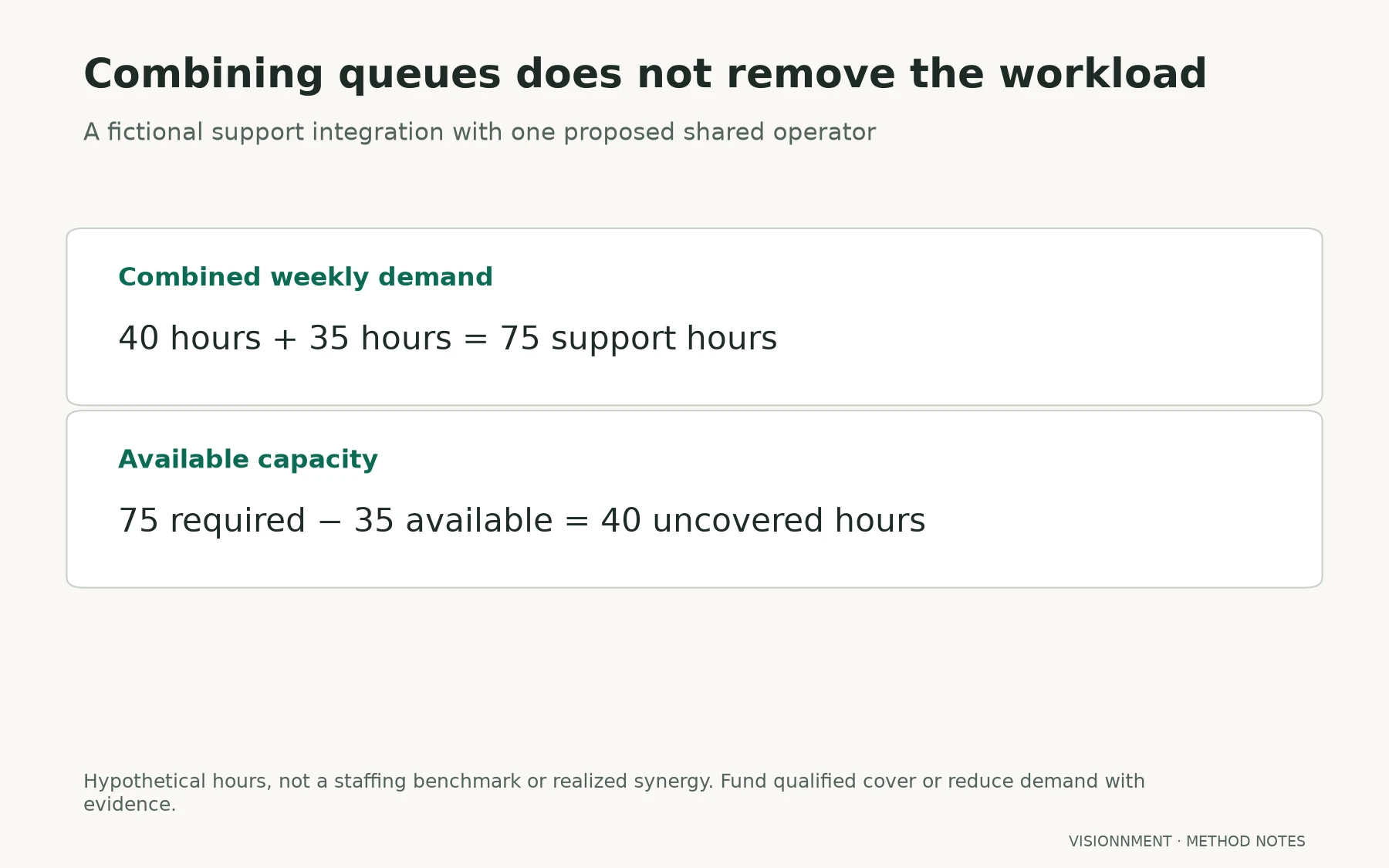
The hypothetical assets need 40 and 35 support hours each week. Together they require 75 hours. One shared operator has 35 available hours, leaving a 40-hour weekly deficit. Combining the support queues does not remove that work.
Before claiming staffing savings, specify which tasks disappear, which become faster and what evidence supports the estimate. Include training, supervision and unusual cases. If the operator must learn two products and reconcile old data, the transition may initially require more effort.
Create a separate integration cost schedule. Include duplicate software, migration specialists, additional cover, customer communication and internal owner time. Distinguish paid cash costs from the economic value assigned to owner work. Both matter, but they affect cash differently.
| Hypothetical constraint | Required response |
|---|---|
| 75 support hours, 35 available | Allocate the missing 40 hours or reduce demand with evidence |
| Two systems during cutover | Budget overlap until acceptance |
| Incomplete customer history | Preserve old access and resolve gaps lawfully |
| Unclear supplier permission | Hold the dependent combination |
Set a funding source and spending ceiling for the transition. Do not assume future savings will pay bills due before those savings are achieved. If the integration uses borrowed capital, reflect its actual repayment and covenant conditions in the cash schedule.
The portfolio capacity audit helps test whether the broader portfolio can absorb this workload. If capacity is insufficient, delay a combination, retain separate operation or add qualified cover. A delayed integration can be a rational operating decision rather than a failure to act.
Before retiring a system, identify the records needed for customer service, financial review and lawful retention. Confirm that the replacement can retrieve the required history with appropriate permissions. A migration total showing the correct number of rows does not establish that an operator can answer a specific customer question.
Review realized outcomes before claiming synergy
Define the baseline and review measures before changing the workstream. For support, track workload, response quality, unresolved cases and actual cost. For reporting, verify completeness and reconciliation time. A lower subscription bill alone does not establish that the combined operation is better.
Compare outcomes on the same boundaries. If one business adds customers or changes its service scope, explain the effect before calling a cost movement an integration saving. Separate recurring improvements from one-time credits and temporary transition effort.
Record the programme’s decisions as evidence develops: retain, revise, pause or reverse the change. Each workstream should have its own acceptance note. Completion of the reporting layer should not close an unresolved billing or customer-data dependency.
In the hypothetical case, a useful initial outcome is reliable joint reporting while separate customer workflows remain intact. The support-hour deficit still needs a funded answer. Until that happens, staffing savings remain an unsupported assumption, regardless of how attractive the consolidated chart looks.
If readers are still evaluating a broker-assisted acquisition, the Empire Flippers buying-process guide explains that optional route. The integration decision itself should remain grounded in actual commitments, capacity and provider permissions. Supported controls can reduce uncertainty about the change; they cannot guarantee future customer retention, sale value or business success.