
An affiliate link audit after a website acquisition should establish five different things: the destination works, the tracking identity is correct, the buyer has programme permission, transactions are attributed under the rules, and commissions are actually paid. A successful page load proves only the first of those conditions.
Build a dated link and exception register before replacing links in bulk. Gather commercial-page URLs, redirects, issued programme destinations, approval records, transaction reports, reversals and bank receipts. Use authorized access and safe checks. The examples below are hypothetical classifications; no merchant attribution test, purchase or paid commission was observed.
Inventory commercial pages and actual outgoing destinations
Start with the pages that explain or recommend products, compare services or direct readers toward a commercial action. Extract the actual outgoing links, including buttons, images and embedded modules. Record page URL, visible recommendation, link location, current destination and redirect behavior.
Include site-controlled redirects. A visible short path can hide the seller’s tracking identity or an outdated merchant destination. Preserve both the initial link and final resolved route where it can be checked safely. Do not assume every link to the same merchant uses the same account or programme.
Group links by programme and reader purpose. A review, comparison and troubleshooting article may legitimately offer different next actions. The audit should preserve the useful editorial context rather than replacing every destination with the same commercial homepage.
Keep copies of the original pages and redirect rules before making reversible changes. Record who may edit them and how changes will be reviewed. A bulk replacement without an inventory can alter ordinary citations, legal links or unrelated query parameters along with monetized destinations.
Prioritize material exposure using available evidence, such as prominent commercial pages and known broken routes. Do not invent traffic, earnings or conversion figures where reports are unavailable. An unknown page value is a data gap, not permission to assign an attractive estimate.
Separate broken links from expired or unauthorized programs
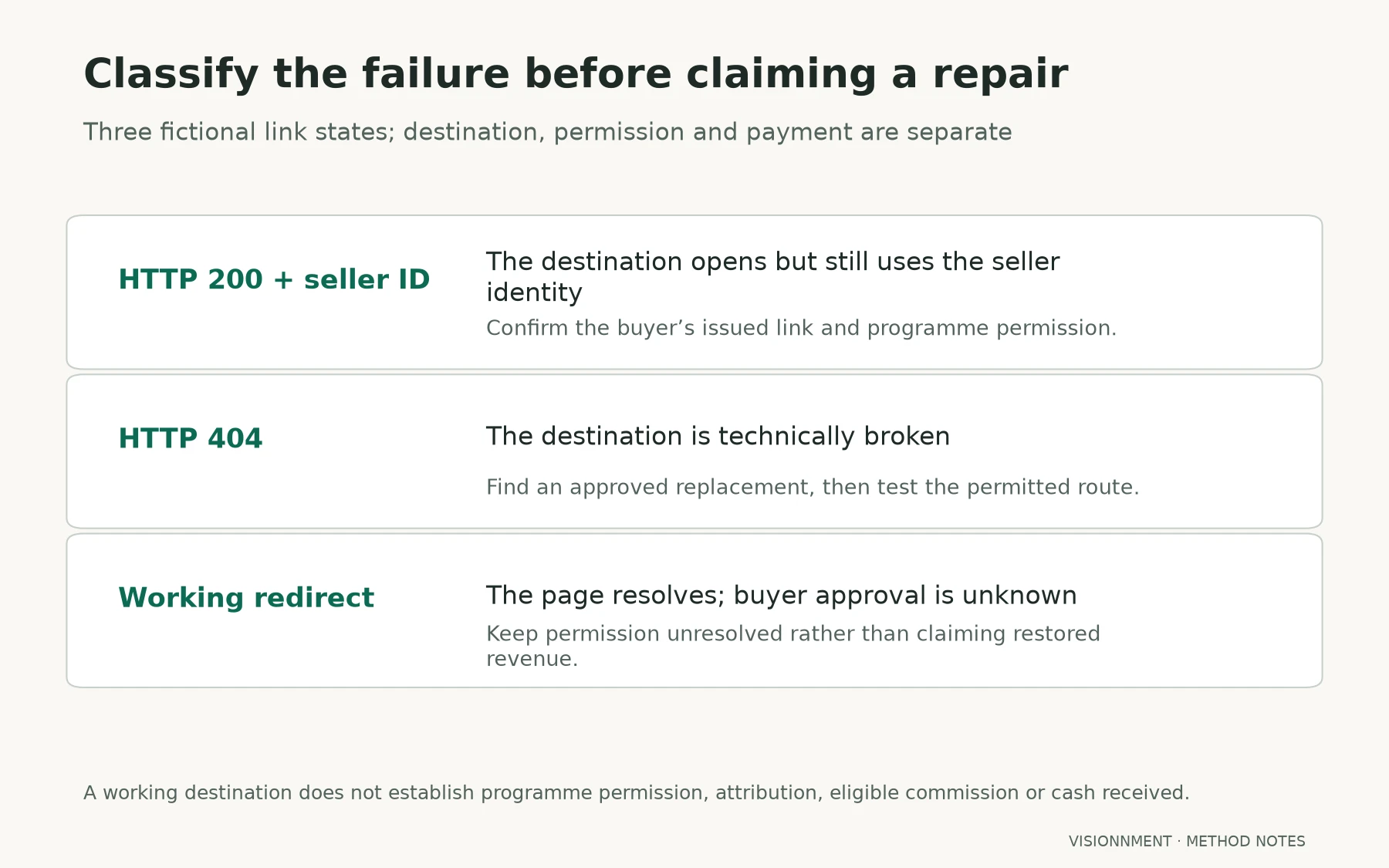
Classify technical behavior separately from commercial permission. A dead destination needs a supported replacement or removal. A working link with an obsolete tracking identity needs an ownership review. A technically correct link for an unapproved buyer programme needs permission before it becomes an authorized recommendation.
Use the hypothetical three-link case:
| Link | Observed design condition | Classification | Next action |
|---|---|---|---|
| A | HTTP 200 with seller tracking identity | Destination works; attribution identity unresolved | Confirm buyer route and replace only with issued link |
| B | HTTP 404 | Broken destination | Find a current supported destination or remove recommendation |
| C | Correct redirect; buyer approval unknown | Technical path passes; permission unresolved | Obtain programme confirmation before claiming readiness |
These are different repair tasks. Changing Link A’s tracking parameter by guessing a buyer identifier may produce a working URL without creating valid attribution. Removing a 404 also does not establish that a replacement product remains appropriate for the reader.
Check the article’s underlying recommendation at the same time. If the product, price, eligibility or promised feature has changed, a destination repair alone leaves misleading content. Record the required editorial correction as its own task rather than treating URL maintenance as a complete review.
Verify account ownership and issued tracking identities
List each programme’s contracting participant, approved website, account country, issued identifiers and relevant transfer restrictions. Obtain the buyer’s actual approval or provider-supported transition. Website ownership does not itself convey every affiliate agreement attached to the seller’s operation.
The Amazon Associates Operating Agreement requires its provided tagged link formats and restricts assignment without express prior written approval. Use the applicable programme and country documents for the actual business. Do not assume one Amazon programme’s rules are identical to another affiliate arrangement.
Record the source of each authorized buyer destination. Keep the issued URL exactly as supplied unless the programme explicitly supports a change. Avoid constructing a tracked deep link from an unverified identifier. Where approval is unavailable, hold the commercial route and choose an honest editorial response rather than implying enrollment.
Review disclosure obligations with the programme terms and applicable law. Place clear material-connection disclosure before monetized recommendations and use appropriate sponsored link attributes. A correct tracking identity does not cure a missing disclosure, and disclosure does not grant programme permission.
Empire Flippers’ buying-process guidance provides transaction context for migrating online businesses. Any broker assistance should be understood at its actual scope. The programme’s agreement and issued tracking route still control the affiliate relationship.
Test redirects and the full reader action safely
Perform a controlled technical inspection of the intended route. Record the starting page, link, redirects, final destination, test date and any device or regional limit. Avoid repeated automated requests or live actions that breach programme rules. A link check does not require manufacturing a purchase.
Check whether site-controlled redirects preserve the issued destination correctly. Inspect accidental encoding, removed parameters, insecure intermediate steps and unrelated redirects. Verify that the visible recommendation matches where the reader lands. Stop if the destination appears compromised or requests unexpected sensitive information.
Separate the safe technical check from commercial attribution. A click recorded by site analytics is not necessarily a merchant-recognized qualifying click. A merchant dashboard entry is not necessarily an approved transaction. Document what the available evidence actually shows.
For any permitted test method, follow the programme’s instructions. Do not make self-purchases, recruit artificial clicks or use customer accounts merely to generate commission evidence. If an attribution test cannot be performed lawfully and safely, leave it unobserved.
Test the page around the link as well. Readers should be able to identify the commercial relationship, understand the recommendation and return from an unsuitable destination. A technically functional link with misleading text remains an editorial failure.
Reconcile clicks, approved transactions, reversals and receipts
Build an attribution bridge by programme and reporting period. Keep site-recorded clicks, merchant-reported activity, pending transactions, approved transactions, reversals and paid commissions separate. Preserve the differing definitions and time zones. Do not expect every stage to have the same count.
Google Analytics funnel documentation explains how site-side steps can be organized for analysis. Such reporting observes the configured site events; it does not establish what the merchant approved or paid. Use merchant records and bank evidence for those later stages.
Match payment identifiers and periods where available. A commission received after acquisition can relate to seller-period activity. Allocate it using the actual agreement and programme records. Do not automatically classify the receipt as revenue newly generated by the buyer’s repaired links.
Investigate reversals at their stated scope. They may relate to programme conditions, canceled orders or other reasons shown in the report. Preserve unknown reasons instead of attributing every reversal to a technical link problem. The operating response depends on the evidence.
In the hypothetical audit, Link A can be corrected technically while paid commission remains unobserved. That is a valid partial result. Report the repair, the authorized destination and the remaining attribution checkpoint separately. Do not write that revenue was restored merely because the new link opened successfully.
Maintain one approved destination record for each issued link, including the programme and permitted use. When a page changes, compare its rendered destination with that record. This catches an editing error without implying that the merchant accepted a click or owes a commission.
Maintain a dated exception and repair register
Use one row per material issue with page, programme, original condition, evidence, permitted repair, responsible person and review date. Include whether the finding concerns technology, permission, content, disclosure or financial reconciliation. That makes the next action clear without reducing unrelated problems to one score.
After an authorized correction, recheck the original path and the rendered page. Confirm that the exact issued destination survived the editing and publishing process. Preserve the previous value so an accidental change can be investigated or reversed without guessing.
Set review triggers for expired approvals, merchant changes, site migrations, ownership changes and unexplained reporting gaps. The interval should reflect the business’s actual dependency and available capacity. A dated register is more useful than an unsupported promise that every commercial link is permanently valid.
Place the audit within the first 90 days ownership plan when the site was recently purchased. If readers need the surrounding assisted transaction route, the Empire Flippers buying-process guide supplies that next answer.
The completed audit should allow another operator to distinguish what was repaired, what is authorized and what remains unobserved. That protects the quality of the operating evidence. It does not guarantee a future qualifying transaction, paid commission, traffic level or profitable acquisition.