
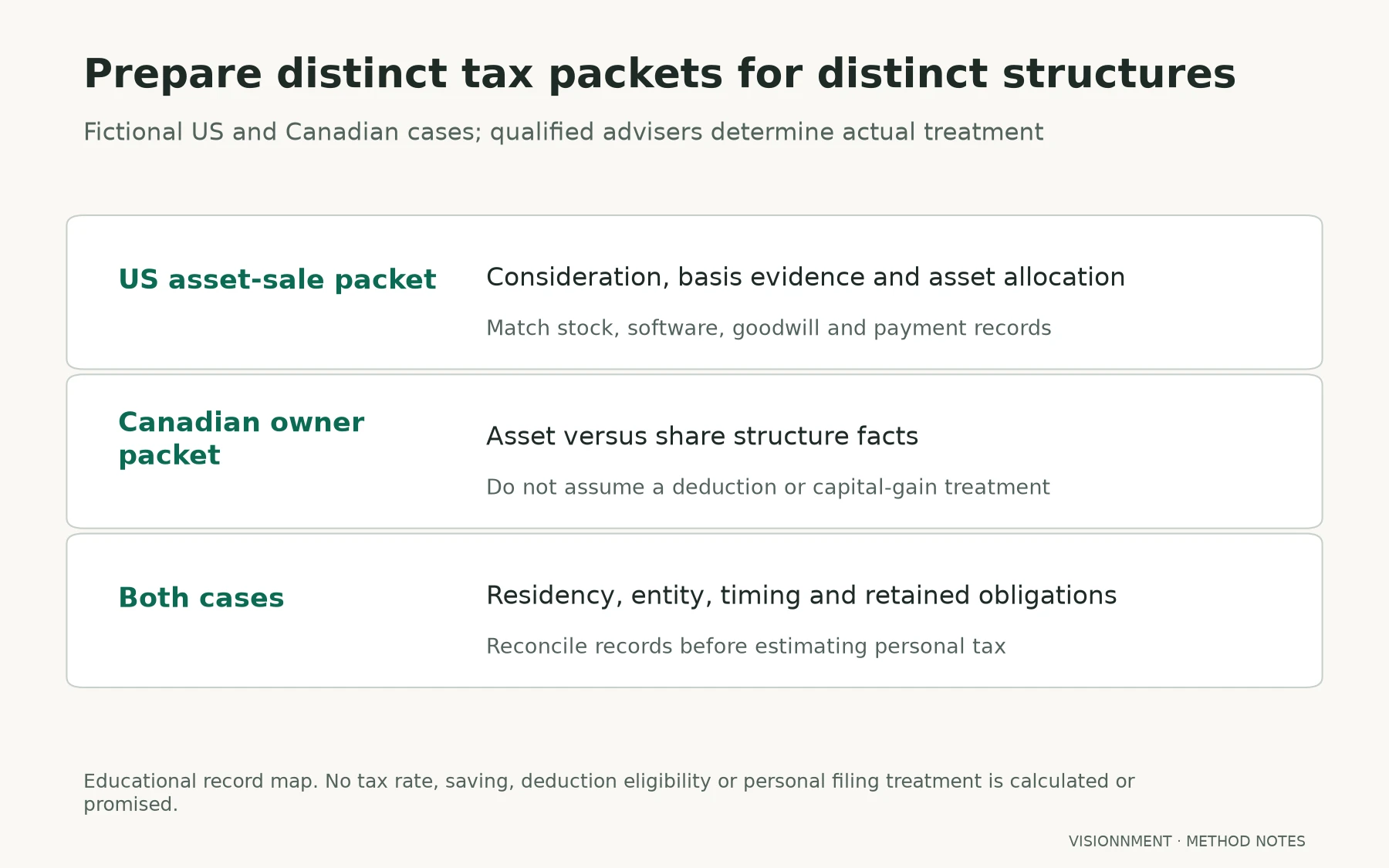
An online business sale tax adviser checklist should identify the taxpayer, jurisdiction, transaction form and actual consideration before anyone estimates available proceeds. A website sale does not automatically qualify for a preferred capital-gains treatment, deduction or indirect-tax election.
Build a factual packet and a decision timeline for qualified tax and legal advisers. This guide explains the preparation work; it does not calculate a personal tax liability or recommend a structure. The US and Canadian examples below are hypothetical and intentionally separate.
You need ownership records, proposed agreements, asset and cost-basis evidence, stock records, payment timing, retained obligations and relevant locations. Public primary materials were reviewed on November 16–17, 2026; advisers should confirm the current rules applicable to the actual transaction.
1. Identify the taxpayer and proposed transaction
Record who owns the business and each material asset. Separate an individual's ownership from a company-owned asset and a shareholder's interest in that company. The person negotiating may not be the taxpayer receiving every payment.
Describe the proposed form: sale of specified assets, sale of company shares, partial interest or another arrangement. State what has already been agreed and what remains negotiable. Do not use “selling the business” as a substitute for those facts.
Add residence and operating jurisdictions, customer and workforce locations where relevant, and any cross-border ownership. A US buyer does not by itself determine the Canadian seller's tax treatment.
For the fictional US packet, identify a proposed business asset sale and the buyer and seller entities. For the fictional Canadian packet, identify the current owner and the asset-versus-share structures being considered. No preferred outcome is assumed.
Ask which advisers cover which jurisdictions and who coordinates the analysis. An opinion about one country's reporting should not be extended to another country's classification without support.
2. Inventory assets, shares and intellectual-property interests
Create a register with the asset, legal owner, acquisition date, original cost evidence, later expenditure and proposed treatment. Include domains, software, content, trademarks, equipment, stock and goodwill questions as relevant.
Keep historical book values, claimed tax basis and proposed sale allocation distinct. They can answer different questions. Do not reconstruct a favourable basis from the asking price or assume undocumented creator work has a particular tax value.
For stock, collect quantities, condition, cost records and valuation method. For software and other intellectual property, collect purchase and development agreements and the rights actually held. Legal ownership and tax treatment are related but separate review tasks.
Use a packet table:
| Item | Evidence to provide | Adviser question |
|---|---|---|
| Purchased software | Agreement and payment record | Basis and proposed allocation |
| Developed content or code | Creation and cost records | Ownership and applicable treatment |
| Stock | Count, condition and costing | Sale and reporting treatment |
| Company shares | Ownership and company records | Structure and eligibility questions |
| Goodwill or going concern | Deal facts and valuation support | Allocation and reporting |
Mark missing records early. Some may be recoverable from accountants, vendors or historic files. An unknown should remain an unknown until an appropriate evidential reconstruction is agreed.
3. Reconcile consideration and payment timing
Prepare a consideration schedule showing cash at closing, deposits, seller financing, holdbacks, earnouts, assumed obligations and separately priced items. Record currency, payment dates and any contingent conditions.
Keep contracted, due and collected amounts separate. An uncollected earnout is not available cash, and its tax treatment cannot be inferred solely from when the owner hopes to receive it. Ask the adviser about the actual structure and timing.
List transaction costs and who pays them. Do not subtract an estimated tax percentage from the headline and call the remainder safe to reinvest. The tax reserve should follow qualified advice on the actual facts.
Include ongoing customer delivery, refunds, staff or contractor obligations and post-sale support. Some can affect cash or the consideration negotiation even when they are not simply deductible closing expenses.
If the price or structure changes during diligence, update the tax packet and closing statement together. Advice based on an all-cash asset sale should not silently carry over to a deferred share transaction.
4. Prepare the US allocation questions
The IRS Form 8594 overview says both seller and purchaser use the form for specified sales of a group of assets constituting a trade or business when its stated conditions apply. It identifies goodwill or going-concern value and a purchaser's basis determined by the amount paid as relevant conditions.
For the fictional US asset-sale packet, ask whether those conditions and reporting requirements apply. Provide the complete asset list, proposed consideration, allocation and later adjustment terms. Do not assume every domain sale or every transaction uses the same form.
Ask how the parties should agree and document allocation, which records support it and what happens if contingent consideration changes. Obtain advice before accepting an economic split that may be difficult to revisit.
Do not present the buyer's preferred allocation as automatically neutral to the seller. The parties can have different interests, and each needs appropriate independent advice.
Keep current forms and instructions in the professional workflow. This checklist does not replace them or assign a tax character to a specific payment.
5. Prepare the Canadian sale questions separately
The CRA's selling-a-business guidance identifies business-number, payroll, GST/HST, ownership-change, inventory and other asset questions. It also discusses conditional capital-gains and GST/HST provisions. Those are questions to evaluate, not automatic entitlements.
For the fictional Canadian owner, provide the current legal and ownership structure, business activities, asset records and proposed asset or share terms. Ask the adviser to compare applicable consequences and administrative steps using the same fact pattern.
If a capital-gains deduction is discussed, ask whether the specific property and taxpayer meet every relevant condition. Do not equate a profitable online business with qualified shares or assume eligibility from the company name.
If a GST/HST election is proposed, ask about the transaction perimeter, buyer and seller status, necessary property, excluded supplies, filing and timing. A general reference to selling substantially the business does not establish that the actual deal qualifies.
Ask about account changes and continuing filing or remittance obligations. Do not close registrations simply because a sale is planned; the professional should identify the actual required steps and dates.
6. Include retained obligations and post-close work
Create a calendar for refunds, support, payroll, tax filings, account changes, debt and contingent receipts. Name the responsible person and the evidence needed to mark each complete.
Separate personal spending capacity from company cash. If the seller is an entity, ask how funds can reach the owner and what further consequences apply. Receiving a sale payment into a company account does not necessarily make it unrestricted personal money.
Record post-sale consulting or employment terms separately from the asset or share consideration. Ask advisers to review the actual relationship and payment character rather than assuming all money has the same treatment.
Quiet Light's contract overview emphasizes the connection between allocation and professional review in its transaction process. It is professional commentary, not tax authority or a decision on your eligibility.
If an obligation cannot yet be quantified, identify a reserve question and review trigger. Do not set it to zero so the proceeds worksheet balances neatly.
7. Obtain advice before the economic decision hardens
Give advisers the current documents and a concise question list before accepting material allocation or structure terms. Flag real deadlines and existing commitments from the LOI and exclusivity process.
Request an answer identifying scope, assumptions, required records, recommended actions and unresolved issues. Keep the actual advice securely with the final transaction version. When facts change, ask whether the conclusion needs review.
Prepare the closing checklist from the agreed professional instructions rather than a generic internet sequence. Confirm who files, who pays, who retains evidence and who monitors later consideration.
Use the Empire Flippers seller guide only for the separate chosen-provider workflow. A broker's commercial process does not establish a personal tax result.
Common questions
Can I estimate tax as a fixed percentage of the price?
A rough reserve chosen without advice is not a tax calculation. Provide the ownership, assets, structure and timing so the professional can determine an appropriate approach.
Does selling shares always produce a better outcome?
No universal conclusion follows. Eligibility, liabilities, price, buyer acceptance and jurisdiction-specific treatment require comparison under the actual facts.
What should the completed packet achieve?
It should let qualified advisers identify the applicable questions and actions without reconstructing the business from scattered messages. The result is a documented decision process, not an unsupported tax-saving promise.