
To choose a display ad network, first identify the specific programme and the metric it actually uses. Then compare the likely net operating result and the effect of advertising on your readers. A traffic threshold establishes neither acceptance nor expected earnings.
The public sources reviewed on November 16–17, 2026 distinguish current entry programmes from legacy publisher arrangements. Treat this as a dated preparation method and confirm the actual requirements and offer before applying. No ad account, onboarding or revenue test was performed.
You need analytics with a defined period and geography, existing ad statements if available, a content and rights review, a list of technical dependencies and representative pages to inspect. The worked site is hypothetical.
1. Define the site and the audience you can evidence
Prepare a traffic sheet with separate columns for sessions, pageviews, audience geography and the exact analytics property. Include the reporting dates, time zone and any material tracking changes. Do not combine a peak week with a different month's geography share.
The fictional site records 40,000 sessions and 60,000 pageviews in one month. It also needs a separately measured count of sessions from the markets relevant to the chosen programme. The first two numbers cannot establish that third number by themselves.
Check that the property belongs to the proposed site and that the period covers ordinary operation. Explain known bot filtering, missing consent-related measurement or other limitations without treating every analytics discrepancy as fraudulent traffic.
Inventory the main content types and representative landing pages. A numerical traffic gate is only one part of a provider's assessment. If the site relies on unlicensed images, unsupported claims or interchangeable generated pages, fix those issues rather than assuming more traffic will resolve them.
Use content-site first revenue if you still need to define the earning mechanism. This article addresses a narrower decision: whether a named advertising offer fits an already understandable publishing operation.
2. Read the current programme rather than repeating an old threshold
Mediavine's public pages conflict as of November 17, 2026. Its current application requirements say Journey applicants need at least 5,000 monthly sessions from the United States, United Kingdom, Canada, Australia, Germany, France or the Netherlands, a domain at least four months old, original audience-first content and its quality and traffic standards. Use that application page as the current application-screen reference while confirming the exact route with Mediavine.
The retained 2026 Journey blog update instead says 1,000 premium sessions monthly and gives a different illustrative market list. Do not treat those numbers as interchangeable or silently assume the lower one governs your application. Record both URLs and ask which requirement applies to the actual site; meeting either numerical description alone does not guarantee admission.
For main Mediavine, the same application page states a site minimum of $5,000 annual ad revenue, original audience-first content, clean human brand-safe traffic, good standing with Google AdSense and AdExchange, and a reader experience supporting premium advertising. This site-level application screen is separate from later company-level programme placement.
Mediavine also has a current main-network path. Its publisher-programme guide places Official at $5,000–$99,999 annual net revenue, Select at $100,000–$249,999, Signature at $250,000–$499,999, Premiere at $500,000–$999,999 and Premiere Plus at $1 million or more. Initial annual programme placement uses the company's combined Mediavine portfolio net revenue from the previous calendar year; Journey revenue is excluded. Publishers can also qualify for promotion when current-year net revenue reaches the next tier. Net here means the earnings after revenue share shown in its dashboard, not the publisher's profit after all operating costs.
New applicants can document former-partner ad income to qualify for Select or higher at launch. Ask which entry and programme-placement conditions apply to your company. Annual revenue tiers do not convert a monthly traffic count into acceptance. The legacy Pro page concerns specified long-standing publishers; it is not the complete current main-network offer.
Raptive's current eligibility page separates two traffic bands. At 25,000–99,999 monthly pageviews, at least 50% of traffic must come from the United States, United Kingdom, Canada, New Zealand and/or Australia. At 100,000 or more, the stated share is 40%. It also requires a domain at least six months old, correctly configured Google Analytics and original, high-quality content with meaningful human involvement. The lower band additionally specifies a build suitable for ads and predominantly long-form pages. Review every applicable condition, not just the headline number.
| Route | Measure to preserve | Remaining decision |
|---|---|---|
| Journey | Current application page: qualifying sessions from seven named countries; conflicting blog threshold retained | Confirm the actual route, domain age and other conditions |
| Main Mediavine application | Site annual ad revenue and qualitative requirements | Confirm site eligibility and Google standing |
| Main Mediavine programme placement | Company-level annual net ad revenue, excluding Journey | Documentation, programme placement and promotion |
| Legacy Pro | Applicable historical publisher status | Whether this arrangement actually applies |
| Raptive | Pageviews, traffic geography and other criteria | Complete site eligibility and approval |
For the fictional 40,000-session, 60,000-pageview site, each row needs different evidence. Journey needs sessions from the application page's named markets, domain age and clarification of the conflicting public threshold. Raptive's lower-band geography condition needs the relevant traffic share and the other site checks. Mediavine programme placement needs the proper annual revenue and company scope; none can be inferred from total monthly sessions.
Save the source date and ask the provider about conflicts or changed terms. Do not rely on an expired referral promotion or a historical programme name to infer today's offer.
3. Compare net earnings on a consistent basis
Request a written explanation of revenue reporting, deductions, payout timing, exclusivity, termination and technical requirements. Ask whether a quoted metric uses sessions, pageviews or ad impressions. The same “RPM” label can be misleading if the denominator is different.
Define your own comparison measure explicitly. For example, net statement ad revenue divided by measured sessions, multiplied by 1,000, is a session-based measure under that definition. Do not compare it directly with a provider's pageview-based figure without reconciling both numerators and denominators.
Estimate the continuing workload: implementation, consent configuration, troubleshooting, layout reviews and payment reconciliation. Separate implementation cost from monthly work. Also distinguish earned statement revenue from cash received; a payment delay can create a reserve need even if the accounting margin is positive.
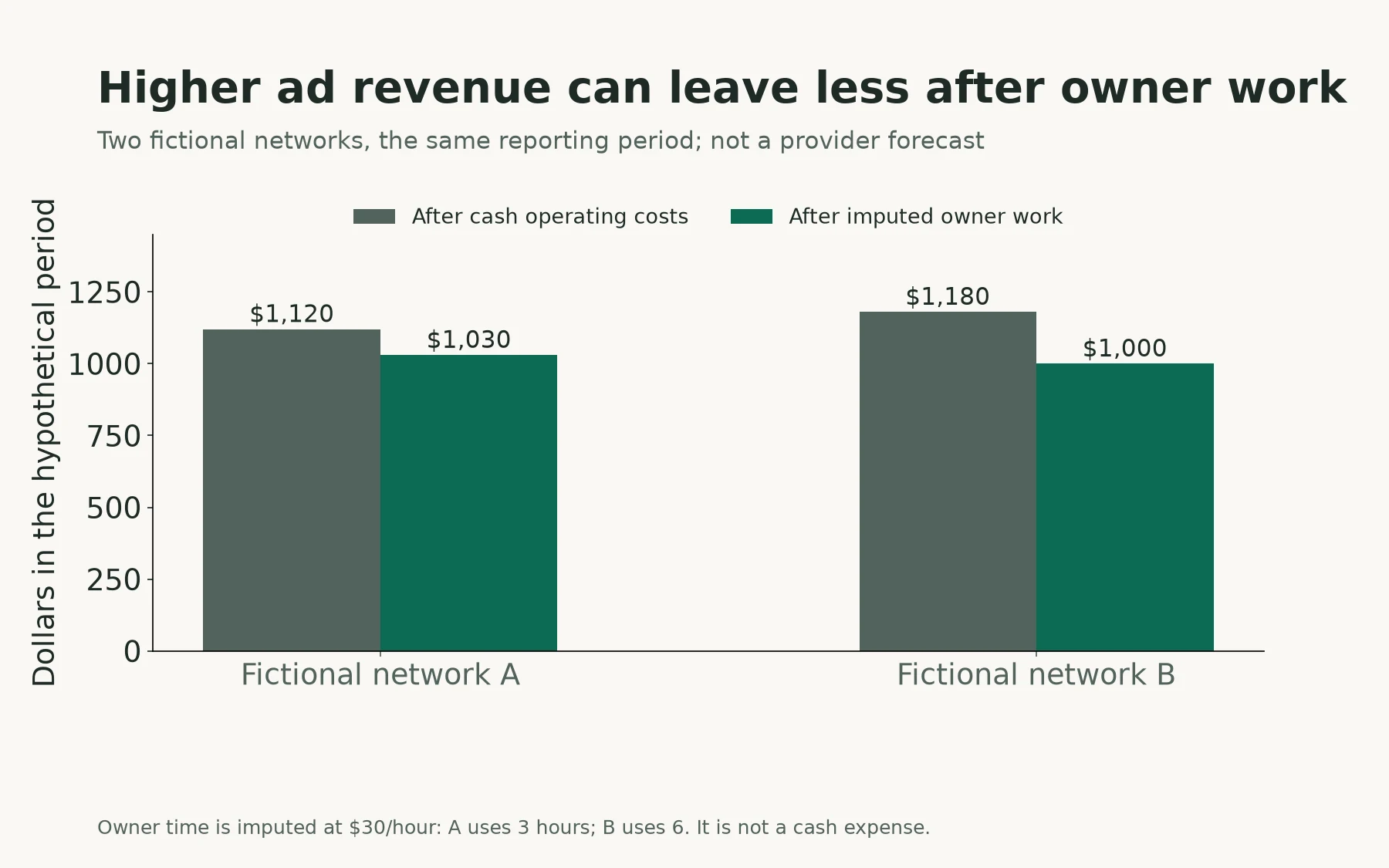
Consider two hypothetical offers observed over the same period and matched traffic. A produces $1,200 earned net ad statement revenue, with $80 of cash operating costs and three hours of owner work valued at an assumed $30 per hour. B produces $1,300, with $120 of cash costs and six hours at the same rate.
| Hypothetical offer | Earned net ad revenue | Cash operating costs | Imputed owner work | Economic contribution |
|---|---|---|---|---|
| A | $1,200 | $80 | $90 | $1,030 |
| B | $1,300 | $120 | $180 | $1,000 |
B earns more ad revenue but contributes $30 less after the stated work valuation. Before imputed owner time, the figures are $1,120 and $1,180. Imputed time is not cash paid; neither earned statement revenue nor these figures establish the period's cash receipts. Reconcile actual payouts separately.
The denominator also changes the metric. A's $1,200 divided by 40,000 sessions, multiplied by 1,000, is $30 per thousand sessions. Divided by 60,000 pageviews, it is $20 per thousand pageviews. Both describe the same hypothetical revenue. They are not evidence that one network paid 50% more.
A higher headline revenue estimate can lose its appeal if it requires costly changes or displaces another useful earning mechanism. Track affiliate activity, product sales and support complaints alongside ads where those belong to the same pages.
If no comparable offer or historical statement exists, leave earnings unknown. A traffic count multiplied by an invented industry RPM is not a provider quote and should not drive a purchase or spending commitment.
4. Set reader-experience guardrails before implementation
Choose representative mobile and desktop tasks. A reader should be able to find the answer, use navigation, complete a relevant interaction and understand what is advertising. Include a long article, a short answer and any calculator or purchase flow the site actually offers.
Record the starting conditions: device, viewport, page, connection assumptions and observed problems. After an authorized implementation, repeat the same tasks. Inspect obstruction, layout movement, accidental interactions and whether consent controls remain usable.
Google's helpful-content guidance supports evaluating the usefulness of the page for people. It does not certify a particular ad layout or promise search performance. The operator still has to inspect the actual experience.
If a placement blocks the principal answer or breaks a tool, reduce or change it and repeat the task. Do not excuse an unusable page because early ad receipts look encouraging. A review should have a named owner and a route for reporting defects after rollout.
5. Keep onboarding separate from a later sale
An existing approval is not a generic promise that a future buyer will receive identical monetization. Ownership-change procedures belong in a separate transaction plan.
Raptive's ownership-transfer eligibility guidance concerns a particular ownership route with its own conditions. Do not apply that route to Mediavine or assume that ordinary account access settles the issue.
For a transaction-specific procedure, use the Mediavine and Raptive ownership-transfer guide. If you are buying or selling, ask which entity will hold the agreement, whether the buyer and site require review, who receives pre-cutover earnings and when new payments begin. Record any expected transition work and reserve without describing a hypothetical delay as a provider service-level promise.
For a site you intend to keep operating, retain the same evidence anyway. The programme, agreement, reporting definitions and implementation record help you troubleshoot and eventually prepare the website for sale if that becomes relevant.
6. Run a dated review and make the decision
Set the observation window in advance and explain why it is representative. Match reporting definitions before and after. Record changes in traffic geography, seasonality, page mix, consent and other monetization so the review does not attribute every movement to the network.
Use a decision sheet with four outputs: verified eligibility, observed net economics, reader-task results and unresolved contract or technical questions. Qualification can be “pending,” and earnings can remain “not yet comparable.” Those are useful findings.
Keep the network if the economics and experience fit within the current obligations. Change the implementation if a specific defect can be repaired. Consider another route when the service or contract does not fit, while respecting the actual termination and exclusivity terms.
Do not announce a causal uplift from one uncontrolled before-and-after month. If revenue rose while high-value-market traffic also increased, state both facts and the remaining uncertainty. A reliable operating record is more useful than a confident but unsupported explanation.
Common questions
Are sessions and pageviews interchangeable?
No. One visit can include several pageviews. Use the exact measure and period requested by the named programme; do not estimate a missing qualifying metric from an unrelated total.
Does meeting the minimum mean I will earn enough?
No. Provider acceptance, monetizable audience, page mix, deductions, workload and reader effects all remain separate. Request the actual offer and model the costs you can support.
Should I switch immediately after one poor month?
Investigate measurement and traffic mix first, then inspect the contract and implementation. A rushed switch can introduce more disruption without resolving the reason for the disappointing result.