
An Empire Flippers rejected business needs a clear reason record before another application or marketplace switch. A published eligibility shortfall, missing evidence and a discretionary fit decision require different responses. None is repaired simply by changing the business label.
Start with the current dedicated requirements, preserve any actual feedback and separate operating improvements from presentation fixes. You need trailing accounts, analytics history, business and domain dates, customer concentration, rights and provider dependencies.
The business averaging $1,500 monthly profit below is hypothetical. No submission or rejection was performed for this guide. The method helps an owner choose a supported next action without promising later acceptance.
1. Distinguish a published miss from a discretionary decision
The dedicated Empire Flippers requirements page reviewed on November 16–17, 2026 states at least $2,000 monthly net profit averaged over the last twelve months and twelve months of revenue history. It also asks for at least three months of Google Analytics or Clicky tracking and includes further model-specific and qualitative conditions.
For specified content monetization models, domain history matters. Service and client businesses face concentration criteria. Restricted niches, manipulation concerns and whether the provider believes its buyer pool fits the business can also affect the decision.
Record the actual basis of a rejection if one exists. Do not describe a business as rejected merely because you predict that it fails a public screen. An owner can assess readiness without claiming that the provider has reviewed the business.
If general selling copy conflicts with the dedicated requirements, preserve the conflict and ask for current clarification. Avoid selecting the lower threshold silently. Published minimums remain necessary screens rather than guaranteed admission.
The first output is a classification: measurable eligibility miss, insufficient evidence, unresolved category or transfer issue, discretionary fit, or reason unknown. Several can apply at once.
2. Work the trailing-profit example honestly
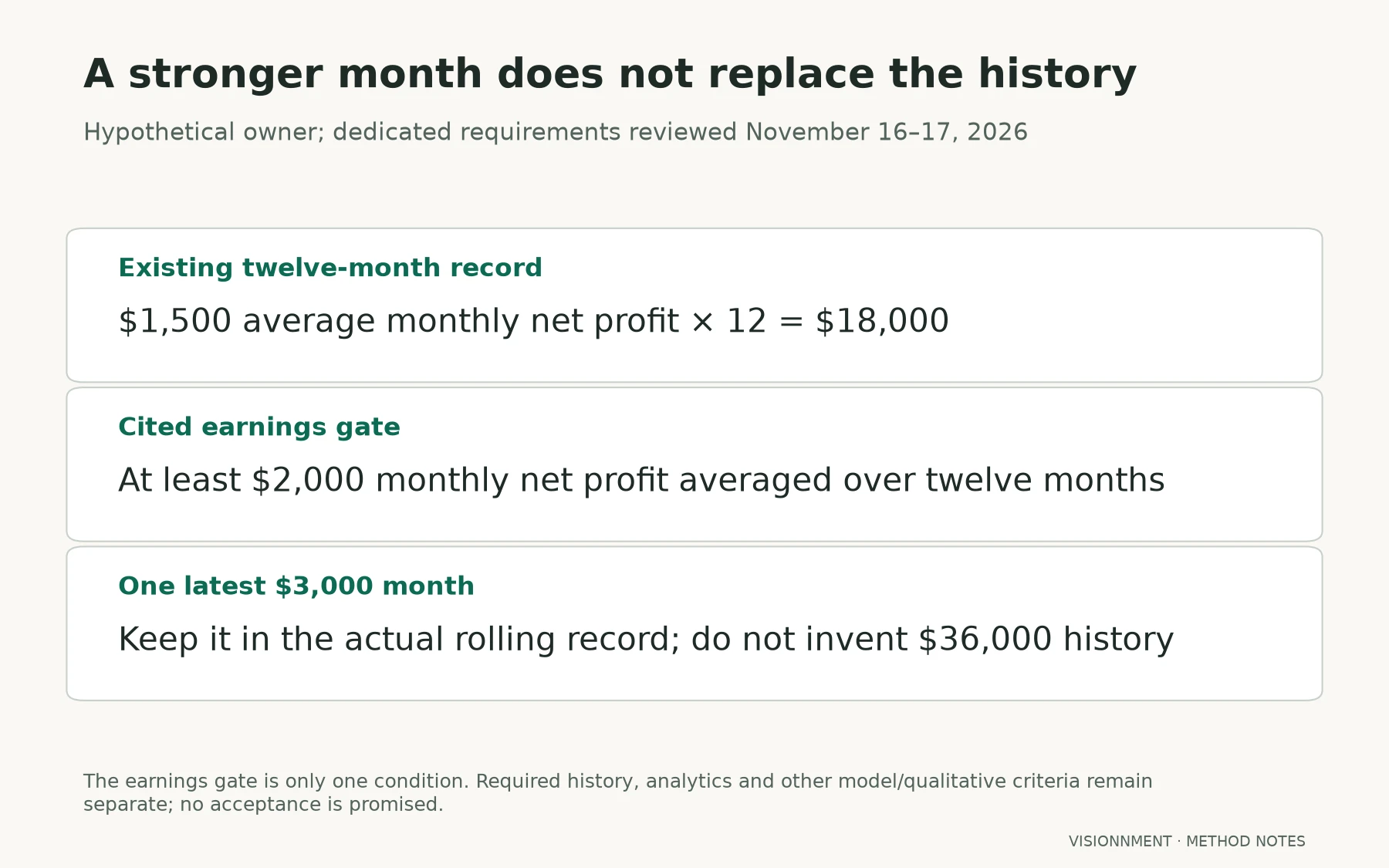
Suppose the fictional owner has twelve months of complete accounts averaging $1,500 monthly net profit. That is $18,000 for the year. One stronger month does not convert the existing twelve-month average into $2,000.
If the latest month reaches $3,000, preserve that observation and the rest of the series. Do not annualize $3,000 into a fictional $36,000 trailing record. Recalculate the actual rolling window only as months genuinely enter and leave it.
Check whether recurring costs are complete. Removing a required hosting, contractor or service cost from the worksheet does not improve the business. It misstates the earning capacity unless a real, supported operating change removes the obligation.
| Fictional issue | Valid next action | Invalid shortcut |
|---|---|---|
| $1,500 trailing monthly average | Improve contribution and build actual history | Substitute the best recent month |
| Missing analytics history | Install correctly and preserve future evidence | Invent earlier tracking |
| Necessary contractor cost | Test a genuine supported alternative | Delete the expense while work continues |
| Critical transfer uncertainty | Obtain the provider's supported route | Promise credentials as the solution |
Even a genuine improvement must survive delivery, costs and sufficient observation. Crossing a number on paper does not resolve the other eligibility conditions.
3. Build an evidence and operating repair register
For every issue, record the evidence, proposed action, responsible person, cost, review date and acceptance condition. Separate actions that repair records from actions that change the operation.
A record repair might reconcile processor statements to monthly accounts. An operating repair might remove a redundant subscription after verifying the workflow and actual cancellation. A customer-concentration repair requires real sustainable revenue from other customers, not splitting one client's invoice into several labels.
Prioritize by decision impact. A missing receipt may be easy to recover. An account that cannot transfer on the proposed terms may determine whether the asset is saleable. Resolve fundamental rights and continuity before spending heavily on presentation.
Retain before-and-after evidence. If profit improves because a service was replaced, show the replacement's cost and work. If the owner takes over the task without pay, reflect that owner dependence rather than calling the saving free.
Use the Empire Flippers seller guide for the provider-specific preparation sequence. A completed repair register supports a conversation; it does not compel the provider to list the business.
4. Identify problems that waiting cannot fix
Waiting can create real history if the business operates and records it. It cannot by itself establish missing intellectual-property rights, make prohibited activity acceptable or authorize a provider agreement to follow a sale.
If a critical account belongs personally to someone outside the proposed transaction, investigate the supported change route. If customer data has unclear permissions, obtain qualified advice about the actual jurisdictions and uses. Do not treat marketplace acceptance as legal clearance.
A declining business may need active repair or an honest reduction in scope. More months of deterioration do not automatically make the earnings record more attractive. Price the intervention against available cash and owner capacity.
For client concentration, understand the contract, relationship and replacement work. Adding a temporary low-value customer simply to alter a percentage does not establish durable diversification.
If the underlying activity does not fit the owner's skills, keeping it while chasing a future marketplace threshold may be the wrong objective. A smaller sale, orderly wind-down or no-sale plan can be valid after the actual obligations are understood.
5. Compare alternatives without bypassing restrictions
Consider four routes: continue operating, repair before sale, seek a suitable specialist or investigate a smaller-asset marketplace. Compare their eligibility, transaction costs, retained work and actual buyer fit rather than assuming every rejected asset belongs elsewhere.
Empire Flippers' requirements page points below-threshold owners toward its sister marketplace, Money Nomad. That pointer is not acceptance of a specific business or evidence that its terms fit your sale. Check them independently.
Flippa's listing-pricing rules distinguish listing categories and pricing treatment. Public category information does not establish that a particular asset is permitted, transferable or correctly priced.
The detailed Projects/Concepts policy linked in the reviewed research was unavailable behind an access restriction. General public Site Rules and category summaries are different documents. They do not supply the missing acceptance terms, so do not claim that a rejected business will qualify through that branch.
A useful small-asset route also need not produce an affiliate reward. Public Flippa referral terms include a listing-price gate of at least $5,000 and other qualifying-user and actual fee-event requirements. This is a publisher-reward condition, not the minimum price or acceptance rule for every listing. Those publisher incentives should never determine how an asset is described or priced.
Use the marketplace comparison to investigate suitable alternatives. Resolve the business and category decision before choosing a transaction route.
6. Reassess with a complete, dated packet
At the review date, recompute the actual trailing figures, confirm evidence history and close each repair with supporting records. Mark items that remain unknown or need an external decision. Do not replace uncertainty with a check mark because a deadline arrived.
If requesting reconsideration, explain what changed factually: new months of accounts, reconciled expenses, supported transfer confirmation or a completed operating repair. Avoid implying that an unrelated increase in traffic resolves every concern.
Ask whether the current provider route fits the updated business. Preserve the answer and applicable terms. A previous conversation does not guarantee that later conditions or buyer demand are identical.
If the fit remains poor, choose the alternative for its own merits. A no-sale decision can preserve cash and focus while you improve the operation or meet existing obligations.
The Empire Flippers review covers the separate platform trade-offs. The purpose here is to leave with a defensible next action and a repair record that another person can understand.
Check that the repair serves the business
Before spending on a repair, ask what useful operating problem it solves if no sale occurs. Correct accounts, supported rights and a reliable workflow usually have a clear operating purpose. A cosmetic relabel or a temporary expense omission does not. For the fictional owner, better contribution from a genuinely improved delivery process may justify a small test; expensive presentation work while the trailing history remains incomplete may not. Record the expected benefit and cost without promising that either will change the broker's decision.
Common questions
Does one strong month justify reapplying?
It can be relevant new evidence, but it does not erase a stated trailing-history requirement or other conditions. Show the actual series and ask about the current route.
Should I remove owner work from the profit calculation?
Preserve the reported accounts and explain any proposed adjustment. Work still required by a buyer belongs in the operating analysis, whether historically paid or unpaid.
What if the provider gives no detailed reason?
Record the reason as unknown, compare public requirements and ask a focused clarification. Continue useful independent repairs, but do not invent a cause or promise that those repairs will reverse the decision.