
LaurenAI off market deal sourcing costs need clarification before a buyer treats discovery as a free acquisition channel. The reviewed public product page contains both 5% and 1% completed-deal fee language. A matched business is also not necessarily for sale, affordable or evidence-qualified.
Write a mandate, confirm authority and terms, then inspect a small authorized sample through explicit qualification stages. You need capital and operating constraints, the current offer and agreement, contact-purpose controls and a way to record evidence without launching unsolicited activity by accident.
Affiliate disclosure: Visionnment may earn a commission from qualifying Flippa referrals, including eligible buyer or seller activity under its programme terms. That relationship does not determine this analysis. Eligibility and payment require the provider's current conditions and an actual qualifying event.
The $300,000 fee comparison and sourcing funnel below are hypothetical. No account, message, outreach or acquisition was performed. Vendor statements about speed or matches are not independently observed results.
1. Separate a match from a willing seller
Flippa's LaurenAI product page describes discovering off-market businesses and contacting owners. Its own explanation distinguishes those owners from people who have already indicated an intention to sell.
Use separate stages: discovered business, apparent mandate fit, correct authorized contact, reply, willingness to discuss, evidence access, qualified deal and transaction. A row should advance only when its specific evidence exists.
For example, a software company's description may match your keywords but reveal nothing about owner willingness, maintainable profit or transferability. A reply saying “send more information” does not establish an agreed sale.
Do not call all matches dealflow of equal quality. Record why each candidate fits or fails the actual constraints and what remains unknown. Avoid treating a larger list as an inherently better investment opportunity.
If the service's marketing describes faster closes or precise matching, attribute that to the provider. No public promise establishes the result for your mandate or capacity.
2. Write a mandate with operational limits
Specify the customer problem, business model, geography, earnings definition, total capital ceiling, reserve needs, available hours, skills and excluded dependencies. Include what you can operate without relying on an unknown specialist.
Separate purchase price from all-in capital. A $300,000 price target does not include diligence, service fees, working capital, remediation and reserves unless explicitly budgeted. A match inside the headline range may still be unaffordable.
Use clear inclusion and exclusion tests:
| Mandate field | Evidence needed later |
|---|---|
| Model and customer job | Actual product and delivery workflow |
| Earnings and period | Reconciled source records |
| Capital fit | Purchase plus all other requirements |
| Operator fit | Work, skills and replacement cost |
| Geography and rights | Supported transaction and provider routes |
Do not make the mandate so broad that every online business qualifies. Equally, do not invent precision, such as a universal minimum margin or maximum workload, without relating it to your actual limits.
The acquisition-sourcing pipeline provides the broader qualification process. The service should fit that process rather than determine the buyer's objectives.
3. Check contact purpose, permissions and controls
Before activation, inspect what the service will do, which identity it uses, who sends messages and what approval controls exist. Read LaurenAI's help guidance and the actual account terms at their current scope.
Do not assume that trying discovery also authorizes messages. Keep searches, sample inspection and outreach as separately controlled actions. A user should know which action creates an external communication before taking it.
Prepare truthful sender identity, purpose, scope and stop controls. Obtain qualified advice about relevant privacy, marketing and communication rules. A tool offering a messaging allowance does not establish that every recipient or message is permitted.
Canada's PIPEDA transaction provisions are not a general authorization for prospecting or reuse of personal information. Do not borrow a business-sale provision to justify unrelated sourcing outreach.
If the service cannot show adequate approval or suppression controls for your intended use, hold activation and choose another investigation route. No messages were sent in preparing this guide.
4. Resolve the public fee conflict
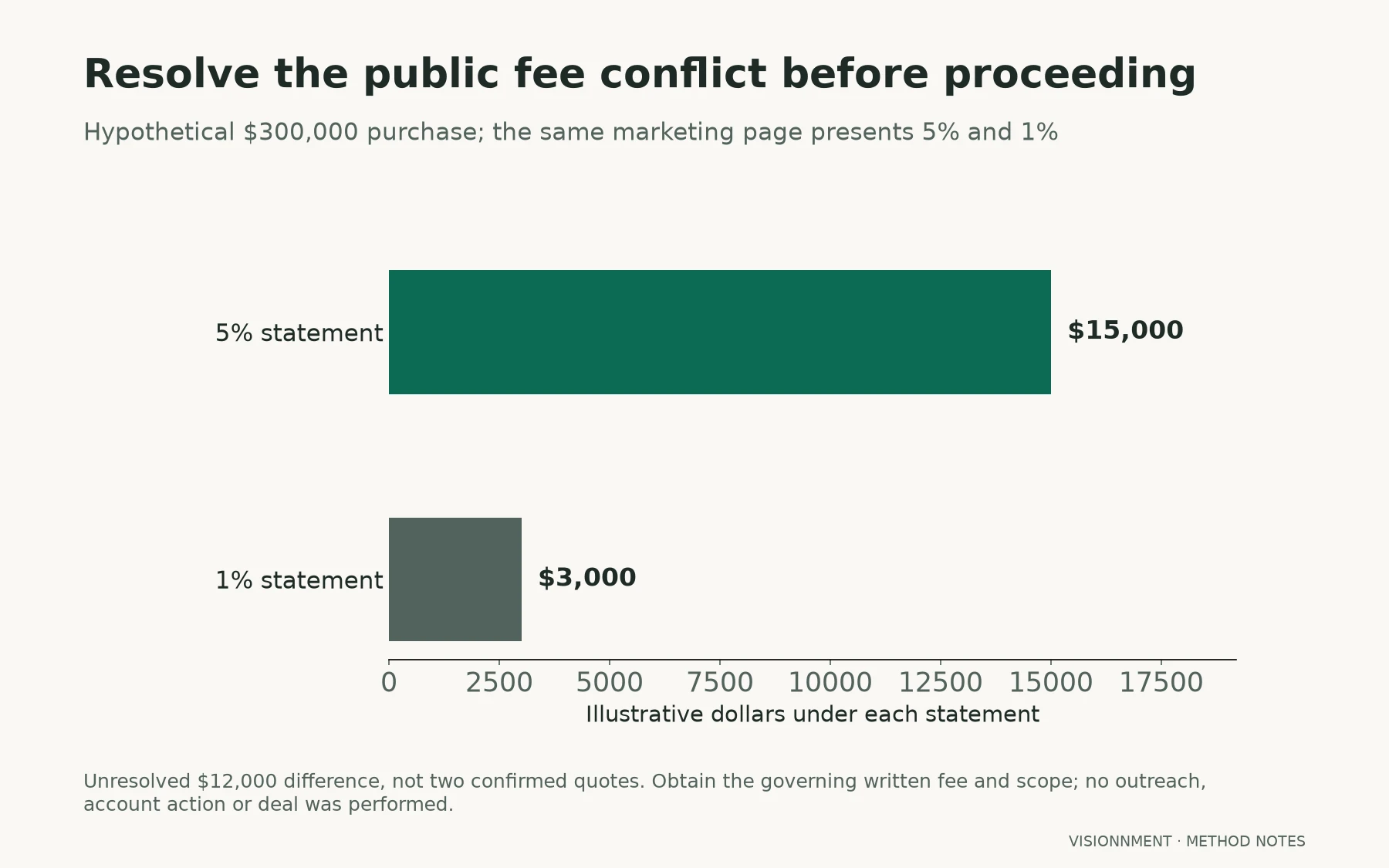
The reviewed product page presents both 5% and 1% completed-deal fee statements. Do not choose the lower statement silently or assume the larger one is obsolete. Request the current written quote and governing terms for the actual route.
On a hypothetical $300,000 purchase, 5% equals $15,000 and 1% equals $3,000. The difference is $12,000.
| Hypothetical interpretation | Calculation | Amount |
|---|---|---|
| 5% statement | $300,000 × 5% | $15,000 |
| 1% statement | $300,000 × 1% | $3,000 |
| Unresolved difference | $15,000 − $3,000 | $12,000 |
These are not proposals, invoices or observed charges. Both omit other transaction and operating costs. Keep the governing price unresolved until confirmed rather than presenting an invented all-in budget.
Ask how transaction value is defined, who pays, when the fee arises, what counts as an introduced deal and what obligations survive stopping the tool. Read the Flippa terms and applicable service agreement with appropriate advice.
A “free discovery” statement does not answer those later obligations. Preserve the quote version and route alongside the mandate.
5. Audit a small authorized sample
Choose a bounded sample and record the qualification stages consistently. Inspect only the information available through authorized access. Do not infer private financials or willingness from a public site.
The fictional funnel contains 20 matches, five replies, two willing sellers and zero evidence-qualified deals. It demonstrates stage distinctions, not a conversion benchmark or performed result.
| Hypothetical stage | Count | What remains unproved |
|---|---|---|
| Matches | 20 | Actual owner and operating fit |
| Replies | 5 | Willingness and price compatibility |
| Willing sellers | 2 | Evidence, rights and capital fit |
| Evidence-qualified deals | 0 | No candidate passed the stated gate |
Investigate where candidates fail. A poor keyword match needs a mandate change. A willing seller refusing essential evidence needs a different decision. More messages cannot by themselves repair a diligence gap.
Include buyer time and specialist review in the sample cost. A service producing many weak conversations can consume capacity even without a subscription charge.
6. Compare manual sourcing, browsing and specialist help
Use the same mandate for alternatives. Public listings may have clearer sale intent but still need independent diligence. Manual sourcing gives direct control while consuming research and communication work. A specialist may supply judgement and coordination under a quoted scope.
Compare stage-qualified candidates and retained work, not raw search results. Include fees, adviser costs, authority, introduction obligations and your ability to evaluate the asset.
Do not assume off-market means discounted or less competitive. Owner willingness, valuation and transaction conditions require actual evidence. A business absent from a marketplace can still be unsuitable or unavailable.
If the fee remains unresolved or controls do not fit, wait. A discovery tool is optional; it should not force a buyer into a poorly specified mandate or unwanted communications.
Convert a failed stage into a narrower investigation
Suppose the two fictional willing sellers both lack financial evidence sufficient for your mandate. Preserve that specific result: willingness was observed in the designed example, but earnings qualification was not. Do not rewrite the mandate to accept unverified profit merely to create a successful pipeline count.
The next bounded task might be to define the minimum authorized records needed and ask the service how evidence access is supported. That investigation does not authorize new messages or prove the sellers will cooperate. If the required evidence cannot be obtained within your review budget, leave both candidates unqualified and compare another source.
Keep the unresolved fee conflict in the same decision record. Even a candidate that later qualifies must fit capital after the actual fee, review costs and reserves. Match quality cannot settle an unknown price, and an attractive quote cannot settle unknown asset quality. Reconcile both before moving toward a commitment.
7. Decide the next bounded action
Record the mandate, unresolved quote, permitted actions, sample findings, work budget and review date. Choose further discovery, a clarified service proposal, another route or no action. Do not report replies as acquisition success.
Use the Flippa review and buying guide for the separate platform and transaction questions. If the service fits after terms and authority are resolved, explore Flippa and confirm the current sourcing offer.
Public Flippa referral terms require a listing price of at least $5,000 and other current user and qualifying-event conditions. A match, reply or signup does not establish a commission, completed deal or investment return.