
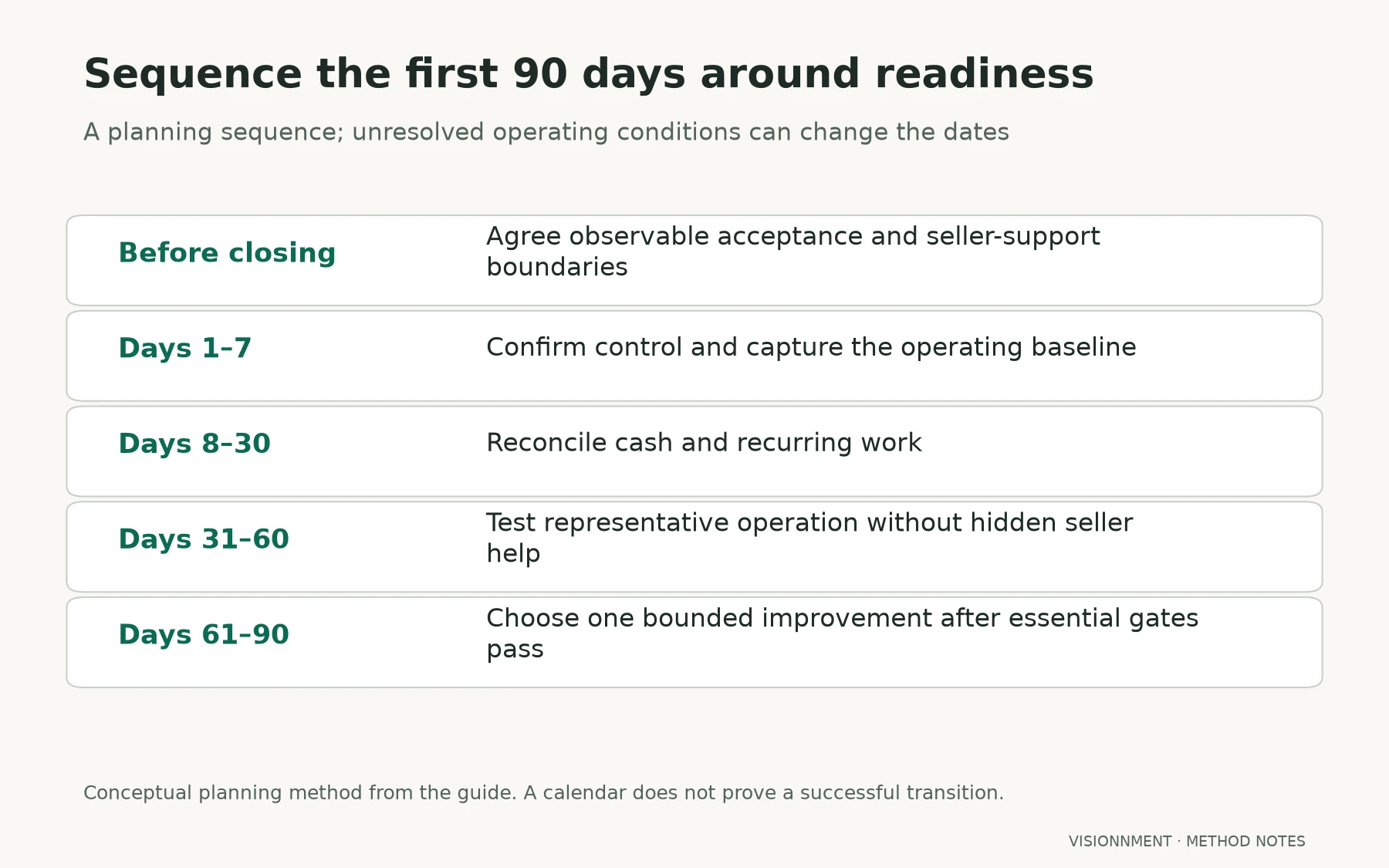
The first 90 days after buying an online business should establish three things: control of essential assets, an accurate cash picture and the ability to perform recurring work without relying on the seller. Growth comes after those operating conditions are understood. A calendar alone does not establish a successful transition.
Build a weekly responsibility and cash register before closing. You will need the acquisition agreement, asset schedule, approved provider transitions, current orders or customer obligations, seller training commitments and historical reports. Allow time for hands-on operation and specialist help. The plan below is an operating method, not a promise that every business can complete its handover within three months.
Agree operating acceptance before closing
Write observable acceptance criteria for the activities that keep the business running. “Receive hosting access” is weaker than “buyer-controlled administrator can restore an authorized backup into a safe environment.” “Receive supplier contact” is weaker than “supplier acknowledges the approved buyer contact and open purchase orders.”
BDC’s acquisition framework treats preparation, diligence, agreements and integration as connected phases. Use diligence findings to build the transition plan. An unresolved dependency should have an owner, condition and response before it becomes an operating surprise.
For each essential workflow, record the normal action, frequency, required authority, evidence of completion and escalation route. Include billing, fulfillment, support, publishing, security updates and reporting where relevant. Define which seller assistance is included and how additional help would be agreed.
Have advisers align material acceptance conditions with the actual transaction documents. An internal checklist does not create contractual inspection rights, extend deadlines or hold funds. The acquisition due diligence guide helps distinguish evidence still needed before purchase from work that can responsibly follow closing.
Days 1–7 preserve control and the evidence baseline
Begin with identities and recoverability. Confirm the correct buyer administrators, recovery contacts, domain control, billing authority and support permissions. Use each provider’s supported transfer process. Avoid copying personal credentials into a shared handover document or removing seller access before an essential approved transition is complete.
Capture a baseline before changing customer-facing systems. Export the agreed historical reports and record their periods, time zones, currencies and definitions. Save an inventory of current integrations, scheduled tasks, subscriptions, important pages and outstanding defects. This gives later comparisons a reference point.
Walk the main customer journey using an authorized safe method. For a store, trace product availability through order routing and support. For software, follow registration, authentication and the entitled service. For a content site, check that the important reader actions and monetization routes behave as documented.
A hypothetical week-one register might look like this:
| Workstream | Responsible person | Checkpoint | Escalation |
|---|---|---|---|
| Access | Buyer operations lead | Recovery contacts confirmed | Seller still sole recovery owner |
| Hosting | Technical specialist | Safe restore evidence recorded | Backup cannot be restored |
| Cash | Buyer bookkeeper | Opening obligations listed | Unknown payment recipient |
| Supplier | Buyer purchasing lead | Introduction acknowledged | Open orders lack accepted contact |
Do not call the business accepted merely because the buyer can sign in. If the supplier row remains unresolved, preserve its effect on current orders and the buyer’s capacity to replenish stock. A visible exception is easier to manage than a reassuring overall label.
Days 8–30 reconcile cash and recurring work
Create a rolling cash schedule with opening accessible cash, expected receipts, committed payments and reserve requirements. Separate the seller’s outstanding earnings from newly earned buyer revenue. Match payout identifiers to bank receipts; a dashboard balance is not yet unrestricted money in the buyer’s account.
List bills by due date and operational consequence. A modest hosting invoice can have a more immediate continuity effect than a larger discretionary project. Include supplier deposits, refund exposure, payroll or contractor commitments, software renewals and adviser fees. Record uncertain amounts as estimates with a review date.
Now compare documented work with actual required work. Ask the seller to demonstrate each recurring task, then have the buyer repeat it under the agreed authority. Note interruptions, hidden manual steps and knowledge that was absent from the documentation. This observation should update the operating budget as well as the task list.
Acquire.com’s buying guide identifies operational documents, financial records and technical evidence as separate diligence areas. Continue that distinction after closing. A completed training session does not reconcile a payout, and balanced cash records do not establish that the buyer can run a technical workflow.
In the hypothetical case, week two reveals that a supplier has not acknowledged the buyer’s contact. The purchasing lead checks current order deadlines and asks the authorized seller contact to complete the introduction. The growth experiment stays delayed until continuity is resolved. This protects the operating sequence without assuming that every supplier delay requires the same legal remedy.
Days 31–60 test operation without the seller
Choose a representative normal cycle and agree a bounded seller-observation period. The buyer performs the work; the seller records interventions instead of quietly completing missing steps. Use non-public or synthetic tasks where a real customer action would create unnecessary risk.
In week three of the hypothetical register, the buyer follows the seller’s documented stock-reorder task. The instructions identify the supplier but omit the person authorized to approve a changed delivery address. The buyer stops at that decision and records the dependency. Guessing would conceal the handover gap.
For each intervention, ask whether the problem is missing documentation, missing permission, missing skill or missing capacity. Each needs a different fix. A rewritten instruction will not replace a necessary specialist, and a new employee cannot grant provider approval.
Set an acceptance test for the repair. If the problem was an undocumented report export, the operator should produce the correct report and reconcile its period. If it was technical recovery, a qualified person should demonstrate the supported recovery path. Repeat only the affected test after the correction.
When supervision remains substantial, revisit replacement operating costs. The first operator hiring guide can help define a role from the observed work. Hiring should follow a clear authority and training plan rather than a vague instruction to take over everything the seller used to do.
Days 61–90 select one controlled improvement
Choose an improvement only after the essential control, cash and recurring-work conditions are met. Define a specific problem, a reversible change, a responsible person, a spending ceiling and a review period. Record the expected mechanism without calling it an established outcome.
For example, a content site might have a clearly broken reader action. The small-site conversion audit provides a way to inspect that path before changing it. Repairing an inaccessible form can be justified by observed behavior even when traffic is too small to prove a revenue uplift.
Keep the baseline and a change log. Note any concurrent movement in traffic mix, pricing, stock, seasonality or measurement. If several conditions change together, explain that the observed difference cannot be cleanly attributed to one repair.
Set guardrails tied to the business model. These might include support backlog, refund complaints, site availability, gross contribution or operator hours. A rise in sales with a larger increase in servicing burden can be a poor operating result. Preserve the ability to undo the change if the agreed guardrail fails.
The 90-day value-improvement plan develops the separate experiment decision. Here, the ownership transition has priority: the hypothetical supplier gap pushes the experiment later because the buyer still lacks a complete operating path. Missing a proposed experiment date is preferable to disguising an unresolved dependency.
Adapt the plan to content, SaaS and ecommerce
For a content business, emphasize publishing authority, content rights, traffic measurement and permitted monetization. Audit inherited affiliate destinations rather than assuming every old tracking identity belongs to the buyer. The affiliate link audit separates a working destination from programme permission and paid commissions.
For SaaS, emphasize subscriptions, customer entitlements, deployment, incident response and support. A repository transfer does not establish payment continuity or the ability to deploy the running system. Include recurring-service obligations when estimating how much seller assistance the buyer still needs.
For ecommerce, emphasize inventory states, supplier authority, open orders, returns and fulfillment messages. A shipped order, a reserved unit and a return authorization need different owners. Preserve customer promises while resolving commercial and technical handover details.
Review the weekly register with the operating owner and relevant specialists. Every exception needs a next checkpoint, responsible person, available reserve and escalation condition. Remove completed tasks only when their evidence is saved; carry unresolved obligations into the continuing operating calendar.
A broker may coordinate parts of the transition, but its scope must be understood. The Empire Flippers buying-process guide explains one assisted acquisition route. Whatever route applies, the buyer’s day-90 output should be a defensible operating record and a realistic next decision, not a declaration that the acquisition is now certain to succeed.